If you don’t know me, I’m Andy Goodman from the Goodman Center in Los Angeles, and I’m going to start things off. This is going to come as shock to those of you who know me. We’re going to start things off with? Sorry. This is the tribe. And if we’re going to tell a story, I got to start. I got to light the fire here. Hold on one second. I’m going to light the fire. There you go. So the crackling, nice, very nice. So the story I want to tell you has a title. It’s called A Momentous Discovery. About 15 years ago, I got a call from a friend who would, we can turn the crackling down now. I got a call from a friend who was on the board of directors of a nonprofit in the Bay area called Lighthawk. And he said, we’re doing great work, but we have a problem. Our message is kind of a muddle. Can you help us? I said, sure, that’s what I do. So I flew to San Francisco and met with people, the staff of Lighthawk. There was a small staff, about 12, 15 people. And they did have a problem. They took the non in their nonprofit name seriously because their communications were non-clear, non-concise, and non-interesting. So I interviewed them and I asked them to try to find out what they did. Now here’s the thing. Here’s the funny thing. What they do, it’s really very simple. And I’m going to show it to you right now. If there are certain environmental problems that are best understood from up above, you get into a plane and you fly over it. Like for example, a clear cut or an oil spill or sprawl or a wildfire. These are problems which sometimes are just not seen as clearly from the ground. So what Lighthawk is basically is a confederation of pilots who have these little planes that seat like four or six people, you know, like Cessna Piper Cup planes. And they’ll take decision makers, senators, policy makers, governors, mayors, etc., up to fly over these problems so that these people can look out the window and have that moment of, oh my God, I had no idea. And then they could hopefully do the right thing. So that’s what they do. Pretty simple. Yes, you get it? It’s not a rhetorical question. You get it? All right, fine. So it would seem simple, but the problem is that when I talked to people at Lighthawk about what they did, I had this experience. Each of them was talking about the same thing, but seeing it from a different angle, even though what they did was very clear and simple. For example, I would ask people, they really kind of broke into four factions. I say, what do you do? And one faction said, oh, Lighthawk, we’re an educator. And they use the very sexy term, a mediation platform, gathering people together to find common ground. We are primarily an educator. We provide the information that people will learn and see. Another faction thought that was a little too lame. So they said, no, we’re a staunch advocate. We’re fighting for environmental protection. So we’d rather we lead with the term advocate, not educator. A third group said, even stronger than that, we are a campaign leader fighting on the forefront of environmental protection. And a fourth group said, well, you know something that’s actually not true, because other environmental groups like Environmental Defense Fund or Sierra Club or NRDC will call us up and ask us to fly these people over these sites. So we’re really a service provider more than anything else. Now all of these things are true. But if you say them all at the same time, you get a muddle. And that’s what they ended up with. So I sort of sat and thought with that for a while. And then I came back and I sat down with each person again. But this time I asked them a new question. And for me, this was a breakthrough in my work with nonprofits. I asked them this question. I said, what is the lighthawk moment? What is the moment when the hair goes up on the back of your neck and you think, this is it, this is what we do? This is why I work here? What is the lighthawk moment? And to that question, they all had the same answer. Every single person, the staff said, it’s that moment in the plane when the person were flying up there, looks out the window and says, oh my god, I had no idea. And they had perfect clarity on this. And the funny thing was, if you read the clippings of articles written about them over the years, journalists had seen this as well. One of the clippings came from Country Living Magazine, which I know we all read. And said that the experience of flying led to these, quote, conversion experiences. The oh my god moment. So once I had that, it was not a very long leap to their slogan, which I gave them a new slogan, which appeared on the cover of their Admin Report in 2002. And there you see it, change is in the air. That’s what was happening. And all of a sudden with that, they had a new direction and a new way of talking about who they were. And so ever since that time, when I’ve gone to clients and their message has been a muddle, I’ve asked them this question. What is your moment? What is the moment where you say, this is what we do? And in some cases, I’ll even say to them, if I gave you a camera and said, go out and take a picture of your moment with a still picture or a video, what would you be capturing? Because when you force them to do that, all of the acronyms and the abstract language and the bullshit falls away and they will show you something real that’s happening. And it’s a great clarifying experience. So as this Frank 2016 celebrates the moment, I wanted to share that story with you about discovering this question. And we wanted to bring four people forward who have had key moments in their own lives. So right now I’d like to ask our four storytellers to leave the front row there and amen wherever you are. Come on down and join us around the campfire. Pull your chairs around. I’ve got marshmallows for you. There you go. There you go. It may take a while. And Katie, why don’t you introduce yourself and start first? OK. I don’t know if I should bring my marshmallow. All right. So hi everyone. I think like everyone, there’s not just one moment. There are probably a lot of moments. And I always say that I know I’m doing the work that I’m meant to do when the moments keep happening, if that makes sense. You keep meeting people and bring you to the right thing. But for me, I should start by saying that I grew up with a family that I think disagrees on every issue from how I felt even as a little kid. And sort of recognizing that my whole life and thinking, well, there’s must be another way. So when I went to college, I was immediately really passionate about social justice. And I was in love with communication and media because I’m a big talker. So I was volunteering for social justice groups. And I was learning what that meant. And I didn’t quite understand what that meant because there’s a lot that you’re sheltered from when you have a family that doesn’t want you to see the world. And so in my sophomore year of college, I saw Roger and me, which was Michael Moore’s first documentary a couple of years after he had made it. And Roger and me, if you all don’t know the story, you can Google it later. But it was a pure activist story. He was trying to communicate about what had happened to his hometown of Flint, Michigan, and Ironic in the face of really devastating poverty and manufacturing job flight that had just left the country. And he talked about crime and what had happened to the community. But what got me immediately, and this was just an elective, by the way, but what got me immediately was that I was allowed into this world that I would never have access to. And I didn’t even know it was called documentary storytelling. I just knew that it was the story of real people that I was privileged enough to hear from. And so I knew then that no matter what I did in media and research and communication, all of that, there was no way I could do what I wanted to do without staying really close to the storytelling and to the privilege of being involved and invited in people’s lives and being able to tell their stories. And so years later, as I started to produce documentaries, and I ended up making many, actually, about poverty, global poverty, domestic poverty, et cetera, it was as magical being in those moments, making the stories as I imagined it would be, as magical as it was for me to actually watch them. And so social change is not an amorphous technological idea. It is always about the stories of people. Thank you. Greetings again. Good to see you guys. Good to see you guys. My defining moment happened well before I ever took a step on the earth. It was when my parents decided to move to this country from Sri Lanka, which is a small island off the coast of India. They didn’t have much when they’re in Sri Lanka. They had even less when they decided to come to America. There was no safety net waiting for them, no scholarship, no job. This is vision, this hope for a better future. And coming to America, they decided to go to Minnesota of all places. Now, great place, great place. They’re coming from Sri Lanka, this really tropical climate, going to the frigid temperature of Minnesota. You might think that was the most difficult part of it, but it actually wasn’t even close. They worked multiple jobs, endless hours, not just to survive, but so that they can create a better future for myself and for my sisters. So when I look at that experience and what they went through, I don’t believe they went through that struggle so that I could be a nine to fiver. I don’t believe that they left their homeland and left their communities so that I could just blend in. I don’t think they defied the odds with my dad becoming a U.S. diplomat and my mom becoming an internationally recognized teacher so that I can just go ahead and fit in with everybody else and just cash a paycheck. So I think they went through that struggle. They made that decision so that I can have the opportunity to provide opportunity for others, so that I could approach every single moment with urgency and clarity and determination so that the path that my parents are able to follow, the path that I’m able to follow, is the same type of path that everybody else is able to follow at the same time. So my parents, they defined me way before they ever thought it was going to happen, way before I ever knew it was going to happen, and now I’m obligated, I have this requirement to give back in every single moment. So they defined me way before I ever took a step on this earth. Thank you. Hi. I met my husband on a street corner in Salvador Bay, Brazil, 17 years ago, and I was not working in the street, so this is not that kind of moment. It was not a pretty woman moment for those of you young enough to know that, maybe. The night clubs had just let out and we met on the street, and it was insane though. I instantly fell in love with him. It was love at first sight, which I had never experienced before. So as we were walking around the Pelerino into the wee hours of the morning, we found ourselves talking about the fact that we were both knee-deep in corporate careers, but both of us felt like that’s not where we were supposed to be. There was something else calling us, but we didn’t know what that was. So a week later, in a total fog of love, I flew to London to be with him, where he had just been transferred in his job, and the next morning we decided to pack in our jobs and travel around, backpacking around Southeast Asia to get to know each other. Good way to get to know each other. I highly recommend it. So we had a couple of credit cards, a stack of books, and a video camera, and the first stop on our trek was we trekked around the Nepali Himalayas. And we started making these little video diaries of our adventures and just screwing around having fun. And one village that we came into, this gorgeous village called Tal that was in this valley with these sort of mountain edges and waterfalls all around us, we met this amazing woman named Lakshmi. She was a nurse for the villages up and along the trek. And she was charismatic and funny, and we started talking to her and filming her, and we asked her if she would show us the health post, which she did. And when she did, she opened up the medicine cabinets, and we saw that she had less medical supplies in that health post for a village than either one of us had in our medicine cabinets at home. So we spent the rest of the afternoon getting a real education from her about the health challenges in the village and that the people were facing. As we walked back to our hotel, we kind of looked at each other and were like, oh my god, this is it. This is what we want to do. We want to tell stories that actually mean something. We want to tell the stories of people from all walks of life and all parts of the world and try to bridge these gaps of perception of what it means to be a human on this planet and what people are facing. And when we got back to the hostel, we actually turned the video camera on ourselves and we actually have this recorded. We said, note to self, become documentary filmmakers. And I am happy to say that 17 years, two kids in a film production company later, I am still madly in love with him and we still make documentary films. I was there when the Berlin Wall came down. Growing up in West Berlin, I had closely watched the development of protest movements in Eastern Europe. However, I could not imagine that it would actually mean that the Berlin Wall would come down on November 9, 1989. Even the next morning, I hadn’t really realized it. I went to high school like all my other classmates frantically studying for an exam. However, our teacher, Mr. von Einzigl, told us he could not teach on such a momentous day. Immediately, we said, let’s go to the Brandenburg Gate. That’s where, that’s the symbol of the divided and it’s now open. We can be there. Our teacher was all for it. He said, go. However, our principal simply said, no. That however, didn’t deter us. So I and my classmates went from class to class mobilizing the entire school. So about a hundred people were waiting outside his office and the principal said, just go. However, we didn’t directly go to the Brandenburg Gate. Instead, we panned out and went from high school to high school, storming in and grabbing class after class. Not all of them were supportive. Some actually went as far as pet locking the doors to prevent us from entering. Nevertheless, soon afterwards, between six and eight thousand students were walking down the main boulevard of Berlin, the Kofesten Damm, carrying a banner, we Berliners students are happy of the fall of the Berlin Wall. That moment is in many ways what has defined me. I have still that memory, that feeling, and it’s in many ways why I’m here today at Frank. We are 300 Franksters here. If 15 high school kids can mobilize 8000 people in three hours, I can hardly imagine what 300 public interest Spartans can do together. Thank you. Thank you, storytellers. So now it’s your turn. We have an assignment for you for the rest of this conference. We’d like you to tell us what is your Frank moment. You’re all walking around with cameras. So if you see a moment which for you defines what it is to be at Frank, take a picture or take a short video and send it to us. And I’ll show you in a moment how to do that. I’ve already had my Frank moment. Before we started here, there was a conference this morning and I got to meet one of my heroes, Paul Slovic. Where’s Paul? I’m sitting over there. I have, if you don’t know who Paul Slovic is, Google him for God’s sake. And he’ll be speaking later. But I have been writing about his research for years. I’ve interviewed him a couple of times. Never had a chance to meet him. But thank you to Frank, I did. And that’s what Frank is all about. Old friends, new friends, heroes, we all come together. So for me, there’s my Frank moment right there. So your assignment is to find your Frank moment and send it to hashtag Frank moment on Twitter or Instagram. I think that’s the way for us to do it. And throughout this conference, we’ll be showing those pictures, I think, up on this screen and other screens and memorializing your work. Deal? Deal. Thank you very much. Thank you guys.




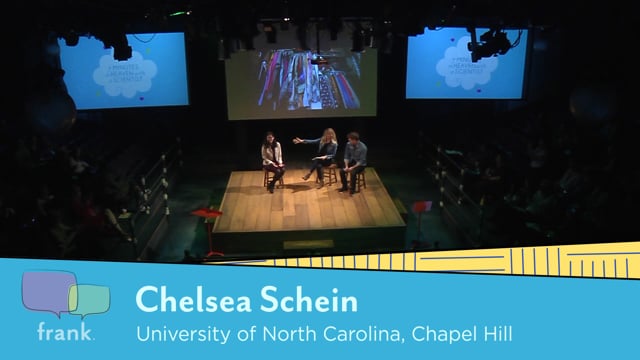 Seven Minutes In Heaven… With A Scientist
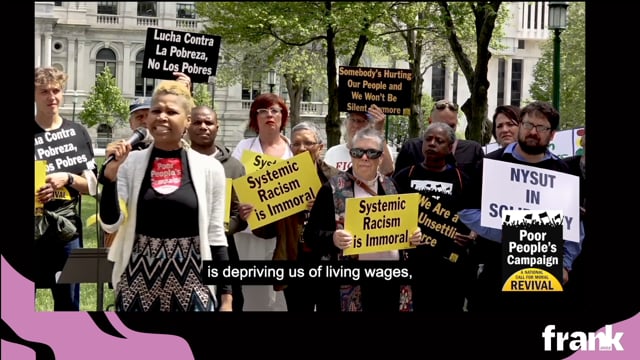 Moral Uprising with the Poor People’s Campaign
 The Unintended Consequences of Emotional Appeal