Every one of our representatives here in West Virginia told us no. We’re not going to consider policies for the poor, the underprivileged, the underprivileged, the suffering, our vets. No, we’re not going to think about them before we make a policy decision. During this pandemic, I worked as a server with Waffle House making only $3.10 an hour plus tips. But like so many essential workers, I never had sick days, I never had any hazard pay, I never had any health care. Venus was my daughter, had no primary care doctor and no medical insurance. Venus had to wait to be approved for every medical procedure she received. They lapsed into her coma and she finally got that cascaded that she needed and they found two tumors in her brain, one had ruptured. The next day we gathered around Venus to say I would goodbye and we unplugged the tube and Venus died. No parents should have in America. She had to bury their child for lack of medical intervention. I see poverty in my own community. You know, there’s a 70% unemployment rate in the reservation right now. I’m a Vietnam veteran. I was raised poor. My only chance of going to college was joining the Army. I’m the one of the many faces representing homelessness and poverty here in New York State. There are many others like me that sleep in shelters every night, thousands like us, that can’t afford to find low income housing. We live in one of the richest countries in the world and yet people are homeless. That’s ridiculous. 51% of New Yorkers are poor or low income. People are not poor because they’re lazy and they don’t want to work. People are poor because our government is depriving us of living wages, healthcare and public assistance. That ain’t right. I’m the fourth generation family farmer. The market pressures impacting farmers and their operations are affecting not just the health of our farm economy, but also the health of those who live in rural communities. Suicides have increased amongst farmers. As an undocumented person, I just want to reiterate that the national emergency that is being put out there, it’s not at the border. It’s here at our doorsteps. It’s here when we have children that don’t have quality air to breathe. It’s here when we have parents like myself struggling to pay rent. It’s here and we need to make sure that people know that these 140 million people that are living in poverty today in the United States are rising up and saying no more. I want to be able to say that this campaign and you alongside with us were able to change the direction that this nation is going towards. And I want to be able to look at my daughter in the face and say we did this because of you and we’ve continued to change because our children need this change. Thank you. Forward together. Not one step back. What you just heard and saw are some of the very leaders building the Poor People’s Campaign today, who in the stories that they tell and the solutions that they put forth demonstrate the plight, the fight and insight of those most impacted by poverty, leading the way to justice and freedom. In the 1968 Poor People’s Campaign, one of the mule-trained caravans from Marx, Mississippi had written on it, Don’t Laugh Folks. Jesus was a poor man. Another said, I had a dream. The last campaign that Reverend Dr. King waged was called the Poor People’s Campaign. He proposed uniting and organizing thousands of poor people from all over the country into a force to be reckoned with. He suggested that the Achilles heel of racism and poverty and militarism was to unite millions across race and geography and issue area into a campaign to lift the load of poverty. Dr. King was killed before the Poor People’s Campaign was launched. When he was assassinated, much of the power of the campaign was assassinated at the same time. In fact, over the past 50 years, poverty has increased by 60% at the same time as there has been virtually dead silence on the issues. And so, as I come before you today, there are 140 million poor and low-income people in America. 15 million families that can’t afford water. Tens of millions of workers making less than a living wage, not one town or city or county anywhere in the country, where a full-time minimum wage worker can afford to rent even just a two-bedroom apartment. Consider these facts that 43.5% nearly half of Americans are poor and low-income. That includes 39 million children, 26 million black people, 38 million Latinos, 2 million indigenous and Native people, 8 million Asians, and 66 million poor white people. And in this, the richest country in human history, the United States spends 53 cents of every dollar on the military, but less than 15 cents on anti-poverty programs combined. In such a time as this, people are called to come together, build a movement of the people, by the people, and for the people. Because, indeed, a movement led by those most impacted by injustice involving people of all walks of life has been the only thing that has transformed this society from the better. Over the past four years, the Poor People’s Campaign has built coordinating committees of poor and dispossessed people, moral leaders, advocates, activists in more than 40 states. We have met with tens of thousands of people, chronicled their demands for a better society. We’ve spent time in Lowndes County, Alabama, where families have no access to sanitation services, are living with raw sewage in their yards. We’ve been in Crosset, Arkansas. A whole town was poisoned by a paper chemical and plywood pan, and grandparents have to meet their grandkids 80 miles outside of town just to protect them from the toxins. It includes Pacoima, California, where one in four kids, most of them native and indigenous, at Telfer Elementary School are homeless. And Altoona, Pennsylvania, where kids are being taken away from their parents because they can’t afford to pay their water, their utilities, or their rent. So in 2018, leaders from these towns and many others organized the largest and most expansive wave of nonviolent civil disobedience in U.S. history. In 2019, we pulled off a Poor People’s Moral Action Congress presented a Poor People’s Moral Budget to the House Budget Committee. In 2020, we organized the largest social media gathering of poor and low income people in U.S. history. We then reached out to more than 2 million poor and low income voters who turned out in record numbers to vote for candidates that promised to raise wages and expand healthcare and address systemic racism and climate change and more. In 2021, in the midst of a pandemic, we safely engaged in moral direct action to defend our democracy, promote economic and environmental justice. And on June 18th of 2022, thousands will gather for a mass Poor People and Low-Wage Workers Assembly, a moral march on Washington and to the polls, to declare to the nation that we must develop the compelling power to fully address poverty, low wages from the bottom up. Drawing from this deep engagement, we’ve developed a moral agenda to eliminate the evils of systemic racism and poverty, ecological devastation, the war economy, militarism. Yes, more than just cursing the darkness, we’re shining a light on what is possible and necessary to lift the load of poverty. Many people tell us that we’re being far too ambitious, that our demands are politically impossible or too expensive, but this is just not true. The benefits of this agenda by far outweigh the costs. In fact, it’s the cost of continuing immoral policies and misguided priorities that we as a nation, as a world cannot afford. Child poverty costs the United States $1 trillion last year. Unstable housing costs $111 billion every year. Unjust immigration policies keep $123 billion out of our GDP. And our government subsidizes the low wages that corporations like Walmart and McDonald’s and Amazon and Starbucks pay to the tune of $153 billion every year. We need a moral revolution of values that places the needs and the demands of the poor and the planet at the heart of our budget, at the center of our national discourse, at the core of our structures and policies. This, this will create more jobs, build up our infrastructure, strengthen our economy, protect resources for future generations. This will redound to the benefit of all instead of a few. When you lift from the bottom, everybody rises. I want to invite everyone here, if you haven’t already done so to join us, there is a moral uprising. You can have faith that we can take action together. Movements begin with the telling of untold stories. And as Mrs. Yara Allen sings in the anthem of our movement, somebody’s been hurting our people. Been poisoning the water. Been evicting the homeless. It’s gone on for far too long. But we won’t be silent anymore. Thank you.



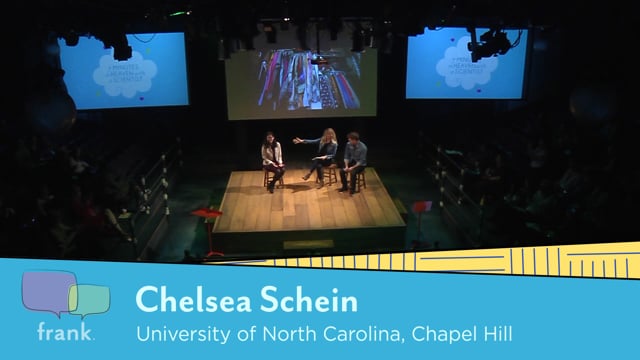 Seven Minutes In Heaven… With A Scientist
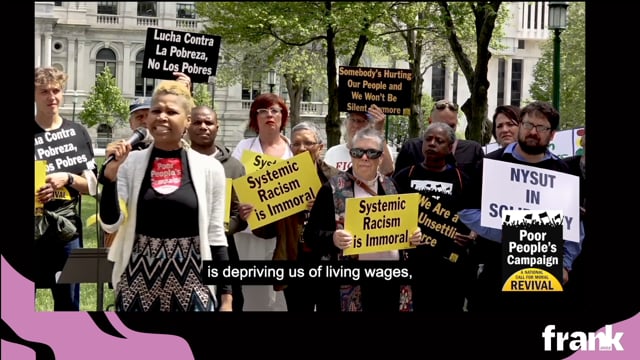 Moral Uprising with the Poor People’s Campaign
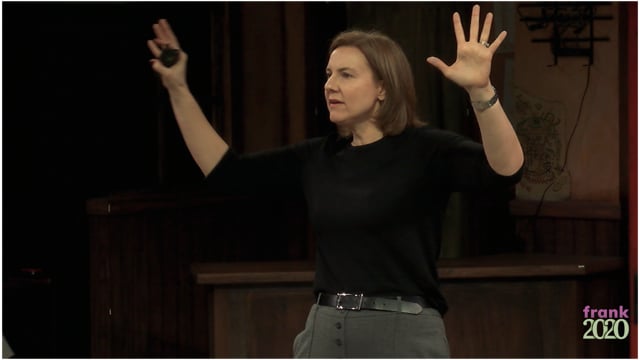 The Unintended Consequences of Emotional Appeal