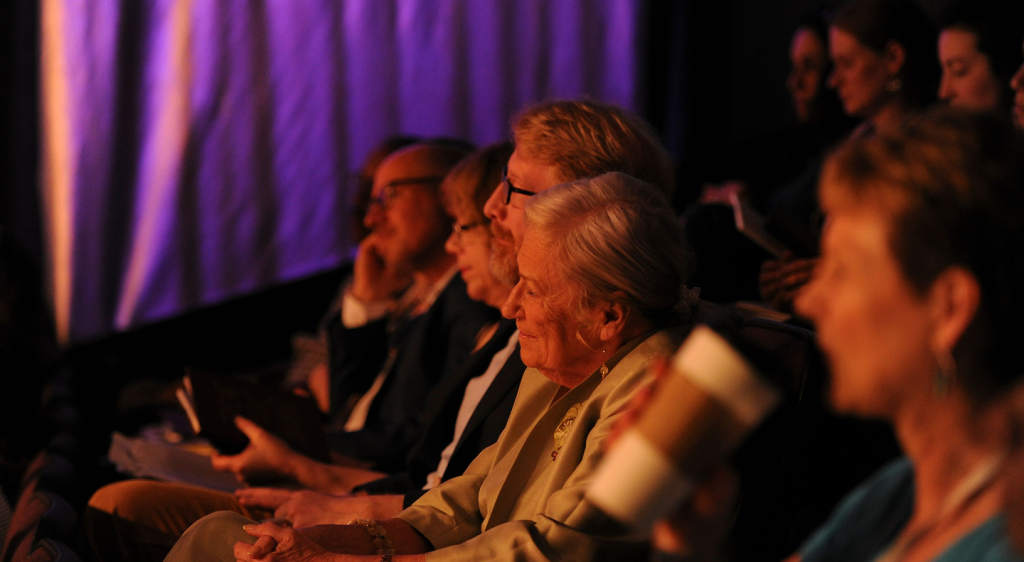
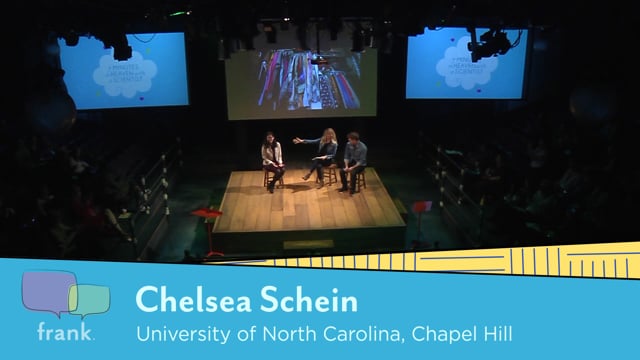
So regarding our finalists, we have a surprise for you today that we have been eagerly waiting to share with you. But it definitely needs some context. So let me start with a story, although I’m not a good storyteller, but I’ll try. You’re a great storyteller. Thanks, Lauren. I’m leaving you. You’re my best friend. Story time now. Okay. So one day, Lauren and I were sitting in Anne Cristiano’s office talking about our research crushes. These are researchers who we are embarrassingly in borderline and appropriately obsessed with. For example, yesterday I got to meet one of my academic crushes, Dr. Paul Slovic, and I think I made him uncomfortable when I shouted at him that he’s the Beyonce of science. And I’m sweating right now thinking about that. He’s like, okay, who’s Beyonce? So we thought, wouldn’t it be amazing if we could sit down and have a one-on-one intimate conversation with these researchers that we love, that we just can’t get enough of their work? So after lots of discussion, lots of wine, we concluded that yes, that would be awesome. And it should be in a closet. Yeah, he said closet. So Thust was born, our brand new podcast, Seven Minutes in Heaven with a Scientist, because everyone, including you, is a little bit curious. You all remember the game Seven Minutes in Heaven from middle school where you had to go into a closet with someone for someone on one time, right? Although I kind of get the feeling we were never the ones, this group were never the ones invited into this. We were the ones in the turtleneck and the score, holding the timer. That was all of us, right? I don’t know what you’re talking about. That was definitely all of us. So taking a page from the junior high playbook, we created Seven Minutes in Heaven with a Scientist where we go into a metaphorical closet with our favorite researcher and get to know them a little bit better in an informal, fun, and accessible way. And this is the surprise. We are launching that podcast here today with three live recordings. I know. Pretty cool. Historically, prize finalists would present their works and talk similar to what you’ve seen so far. However, this year we invited our prize finalists to be our first ever Seven Minutes in Heaven guests. You can imagine how that went when I said, you’re a finalist and you’re going into the closet with one of us. So over the next few days, I’ll sit down with our new academic crushes, our prize finalists. We’ll talk with them about their research, we’ll get to know them, and we’ll start our brand new podcast, Seven Minutes in Heaven. So are you all ready for the first ever Seven Minutes in Heaven with a Scientist? That was pretty good, but I think we could get a little bit better. Are you all ready for the first ever Seven Minutes in Heaven with a Scientist? Yes! All right. Lauren, how do you want to do this? I think we should go with the old standby, Paper, Scissors, Rock. All right. Let me put this down before I have to do too many things at once. All right. All right. You ready? I’m three. One, two, three. Go. Dang it. All right. We didn’t plan that. That was totally natural. Well, let’s bring these out. Thank you. We have to get our seats ready, of course. Good luck. Have fun. Thank you all. Lauren, everybody. All right. So our first ever Seven Minutes in Heaven guest is one of my new favorite crushes, academic crushes. One of the reasons is because she has excellent fashion taste. You’ll see in a second. We look exactly the same. We’re twins today. But she is amazing. Her name is Dr. Julia Frostino. She’s an award-winning media and communication scholar. She recently took a position with West Virginia University Reed College of Media. She teaches and studies, yes. You know. She studies and teaches courses in strategic communications campaigns, social media strategy, public communications campaigns, social networking, risk communications, ethics. You name it. She studies it. She’s a great lady. For Clem to thinking about talking to her. Let’s welcome to the closet our very first guest, Dr. Julia Frostino. Hit it. Hello. If you’re feeling lost and you don’t want to let go, need someone to trust, someone to talk to. They never room in the heaven with a scientist because everyone. Everyone. Everyone is just a little bit curious. My husband, everybody. Literally, that’s my husband. He’s been in the closet the whole time. He does that at home too. So, thank you Julia for joining us. We are so happy that you could be here. Is that our buzzer already? Okay. So let’s just get into it, Julia. What are you passionate about? Oh, I’m passionate about communities. I’m passionate about communities and community resilience especially. I’ve always been drawn to strategic communication and ethics especially. But it really solidified for me in graduate school when my hometown where my husband and I still own our first house flooded. And it was devastating. It was really hard to see the tragedy and the confusion and the miscommunication. But at the same time, it was really uplifting to see my community band together and recover from this disaster. And that really sparked in me a lifelong commitment to community resilience. So whether it’s in my teaching, I do service learning or it’s in my research, I am definitely committed to communities and community resilience. Amazing. So what is the research question that keeps you up at night? Well, at its most simple, I guess, it’s related to that. How can we ethically and effectively communicate with communities to help them better prepare for and respond to and recover from disasters, especially in today’s evolving media landscape? It can be difficult. But rewarding. So can you tell us a little bit about your paper? What it’s on, what you found? Oh, I would love to tell you about my paper. My paper with my co-author, Leon Ma, is called CDC’s Use of Social Media and Humor in a Risk Campaign, Preparedness 101, Zombie Apocalypse. It’s published in the Journal of Applied Communication Research. And some of you might be familiar with this campaign. The CDC took a tongue-in-cheek approach to disaster preparedness by detailing everything that we need to know to prepare for zombie overtaking. They put this in a blog. And they used the tagline, get a kit, make a plan, be prepared. Because if you are prepared for a zombie apocalypse, you’re prepared for any emergency. And that was kind of the premise. So this went viral. It went viral on social media. It was picked up by traditional media. They generated more than 3.6 billion media impressions in just a few months. Yeah, astronomical, right? So this was really successful. And it spawned a lot of interest in similar campaigns ranging from elementary school curriculum to last year, the governor of Kansas declared October zombie preparedness month. So this is a really interesting campaign. I was fascinated. It had a lot of questions. What was CDC’s goal with this? And did they think they were successful? And if they were successful, was that because they launched on social media? Was it because they used humor and zombies or a mix of those things? What is success? And furthermore, did people get a kit, make a plan, be prepared? Did they go for more information? I wanted to know this. So we interviewed a campaign manager and we looked at the CDC’s evaluation documents. And we read an experiment. And when it came to the awareness-based outcomes, they were vastly successful. All of those media impressions, new audiences, and they met their goal to start discussions and reach newer people, get newer followers, and that happened. So people were definitely talking. But were they taking action? So we ran an experiment with a sample of college students. And we exposed them to variations of the CDC’s blog. Some with zombie references, some without. And the findings were startling. So the students who saw the zombie references, they reported that they were significantly less likely to intend to get a kit, significantly less likely to intend to be prepared, to make a plan, to even go to CDC for more information in the future. So it backfired. Yeah, it kind of backfired. Do you know why it backfired? We didn’t measure this directly, but prior research gives us some insight here. So the problem is science just doesn’t tell us yet the full story about the humor in strategic communication. On the one hand, it can be really effective in a variety of contexts, like funny ads make people like brands more, and funny teachers make students like them more. I should work on that. But on the other hand, and especially in health contexts, humor can work to trivialize serious topics. And the consequences, the perceived consequences of those topics. And one thing that science does tell us, and so does common sense kind of, is if you don’t think something serious, you’re not going to prepare for it. So what does this mean for communicators then? Okay, for communicators, this means we have what I’m calling a zombie dilemma. We have a zombie dilemma, right? When you have to choose between awareness-based outcomes and behavior-based outcomes in the same campaign. So when I say zombie dilemma, I mean what do you do when the very strategies and tactics that might grab you widespread attention at the same time might be making your audiences less likely to act? A zombie dilemma. A zombie dilemma. So why does this paper matter so much? It matters because risk and disaster communicators are constantly trying to break through media clutter, and there’s a lot of other noise to reach people, and they’re trying to reach people with what could potentially be life-saving information. But this is really difficult. I mean, okay, show of hands in here, and don’t lie, like you did with those gold coins yesterday. How many of you have an emergency kit? How many of you have a detailed evacuation, home evacuation plan? Okay, this is very few of us, and many of us are public interest communicators in the health sector, right? So imagine trying to reach younger audiences, which are traditionally, and my research has shown, other research has shown, way underprepared for disaster. So we’d be trying new tactics, new media, humor, zombies. This seems reasonable in this context, right? But there could just be this mixed result, and that could be a problem. You know, mixed results for CDC, great awareness, maybe not in the behavior. So zombie dilemma. So what is the one thing you wish people would do differently based off of what you’ve learned from your research? I don’t want to discourage people from using social media or humor in their campaigns. I just want science to be able to provide some guidance for you to think about the pros and cons of using these kinds of strategies, and weigh out what is best for you in your situation. Goals, awareness, behavior, think about it. Remember the zombie dilemma. Remember the zombie dilemma. This should be a hashtag. Hashtag zombie dilemma. Start it. Yeah. Frank, social media team. Yeah, thanks. So what are you working on next? So I’m doing some follow up. I’m really interested in this trivialization hypothesis, but I’ve also been really interested lately in the role of visuals in disaster communication. Science really needs to catch up, especially with the emergence of so many social media platforms that are dedicated to visuals. You have YouTube and Snapchat and Pinterest and all of these. And I think that we need science to help guide effective ethical strategic communication that can promote resilience on these kinds of platforms. Wow, that’s awesome. So last important question. Okay. If you can go into the closet with anyone other than me. Well, I was going to say, I’m glad you won because can we just switch spots? I would go in the closet with you. Oh my gosh. If you could go in the closet with anybody, who would it be? I think, okay. Elise Andrew, the British bloggers, she started the Facebook page and the website. IFLS. I’m not, okay, my students are having a watch party, so I’m not going to tell you what that’s about. It’s the I fucking love science. I don’t need that meme to go. It’ll all never live in them. We know. I would go in the closet with her. She’s fascinating. We’ll have to get her number. Yeah, do it. Well, thank you so much for joining us. Dr. Julia Frostino, everybody. Go for it, please. If you like Julia.



 Seven Minutes In Heaven… With A Scientist
 Moral Uprising with the Poor People’s Campaign
 The Unintended Consequences of Emotional Appeal