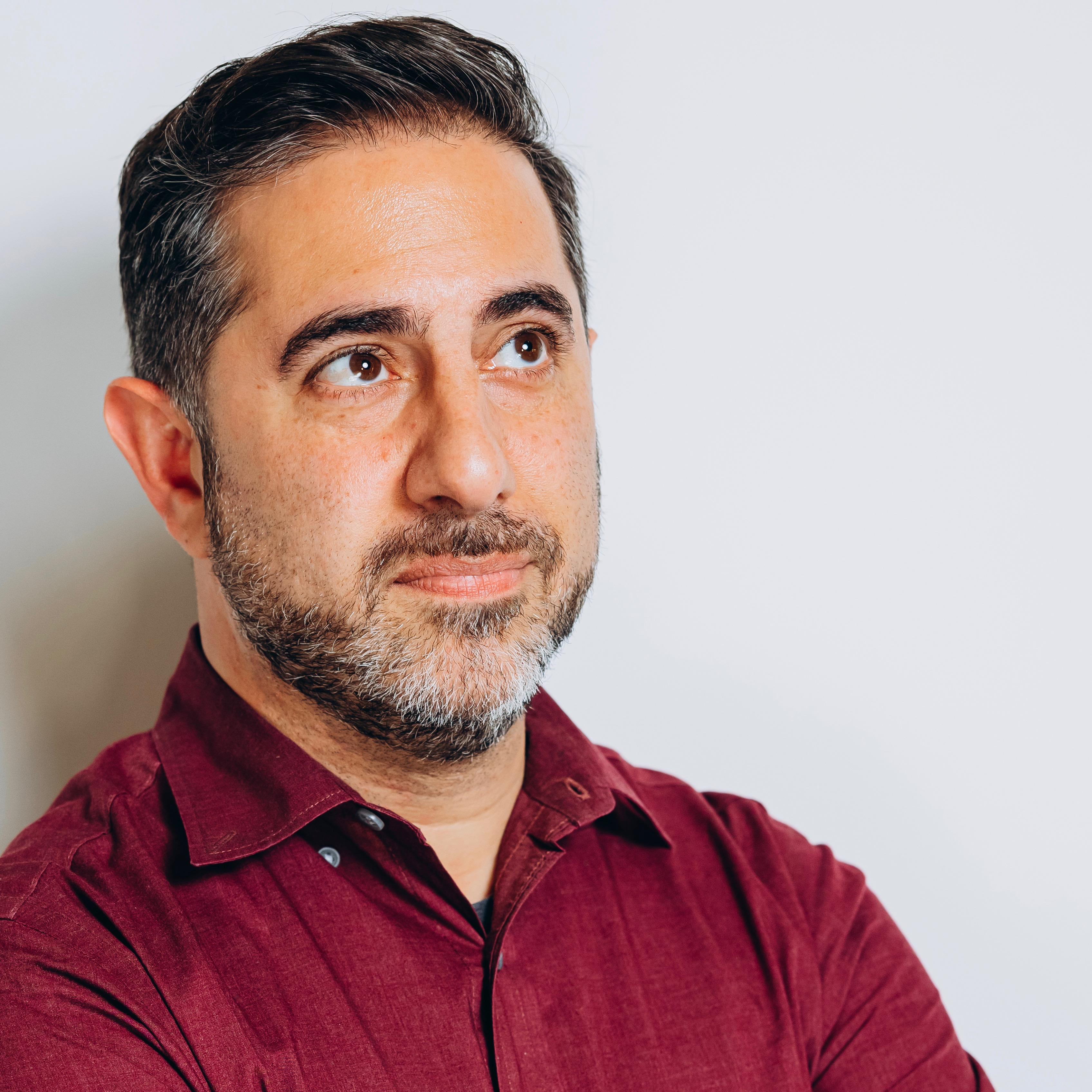
Good morning everybody. How are you doing? Are you all recovering from that epic show by Charles Bradley last night? Yes, the captain and I partied a little too hard at the Charles Bradley show. So we are going to hear from our final finalists today. Before I introduce our scientists that we’re going to spend seven minutes in heaven with, I just want to remind you, as Liz said, we are going to be voting today. Right after one of our finalists speaks, we are going to put up the polling information. You can text in your vote or you can go on a web, we’ll put up a link and you can vote via web and you only get one vote. So make a count and I’m sorry other finalists, you can’t send your name in a bunch of times to win the $10,000. Okay, so we are going to hear today from one of my all-time academic crushes. His name is Dr. Troy Campbell. He is an assistant professor in marketing at the University of Oregon. He studies how political ideology and identity shapes people’s beliefs and consumer behavior. His research has been featured in Wired, The New York Times, Scientific America. The project you’re going to hear about today holds the record at Duke for the most viewed research press release of all time. He was a Disney Imagineer. Oh my gosh. And this month, Pacific Standard magazine listed him as one of the top 30 thinkers under 30 that you need to know. Pretty cool. Okay, let’s hit the music and bring out Dr. Campbell. Well, you don’t know what to do. Need someone to trust someone to talk to? Everyone. Everyone. Let’s just a little bit hung over. I told you. I think we got back around 4.30 last night. I think I was asleep though for half of that time that we were out. Oh, Dr. Campbell. You do all the right things. You really know how to win over a lady. Thank you. Can’t wait to see what this is about. Thank you for joining us for the first seven minutes in heaven. I hope you’re really enjoying Frank so far. I am. So, I’m going to ask you what I have asked everybody so far. What are you passionate about? So my passion starts from a story. And in the story, I’m 14 years old and it’s a beautiful Southern California day. I’m on the fourth floor of a building. I’m looking out at the sun. Disneyland is that way. There’s a Starbucks that way and there’s the ocean behind me and I should be so happy. I’m in heaven. But I’m not because as I’m looking out that door on the right side of me, my doctor is diagnosing me with hypoglycemia. And he’s explaining this is why I’ve been depressed lately and that I’m at risk for very, very severe long-term health. And the thing is I immediately deny this. On my own little microcosm of science denial, there I was denying scientific fact. But the important part here is understanding why I was denying it. I wasn’t denying it because I was worried about being sick at 45. I was a 14-year-old. What was 45 years old? I was denying it because I knew what the solution was. And that was I’d have to give up one of my favorite things in the world at that time, which was a caramel frappuccino. I did not have a lot going on for me at 14. It was frappuccinos and Harry Potter. And I love this thing, but it was more than a drink. It was the only time that this nerd could go to a place and feel normal with people. And that sounds incredibly dumb, but it was true. And so what I was suffering from is something that we call solution aversion. And it’s when people deny a problem, not based upon the problem itself, but because of the solutions. And we think people are denying things often based upon the intrinsic properties of the problem, but it’s often the solution. And the important thing here is that my doctor realized that. He immediately didn’t tell me about the health benefits. He talked about how if I was on a protein-rich diet, which I ate regularly, I could occasionally have a frappuccino. And I’m a happy and healthy person today because of him who occasionally gets to have a frappuccino. And he was a great scientist because he got the facts right, right? He was the first person to diagnose me, but he was a great psychologist and community player because he knew how to communicate with me. And I’m passionate about being with Dr. Mel, well, Fernandez, what’s for me in 2002 that I want to be for the world at large. Amazing. So then what is the research question that keeps you up at night? So I’m really interested in why people deny problems. So I’m really interested in, more or less, what is the frappuccino in front of everybody’s head that you need to get through? What is the real reason people deny environmental science? Why do people of all genders deny that some forms of sexism exist in this world? That’s my question. Wow. So can you tell us a little bit about your paper? Yeah. So the project is on solution aversion done at Duke University with Aaron Kay. And what we wanted to do was empirically test for its existence. If we found it, canonize it as a concept and then see if it mattered to some of the most important issues of our time. And what we did is we looked at climate change and we said, maybe this is solution aversion because one thing we know about climate change other than the science is the reaction to it. The Democrats are much more likely to agree with the science than conservatives. And when we look at climate change, solution aversion sort of makes sense why it might be the thing that’s causing this divide. We have a big problem, but we have a dominant narrative solution, which is we need to use government restrictions. So we have a solution that is more aversive to one of the parties. Now logically, the aversiveness of a solution should not affect your belief in whether a problem actually exists. But let’s see what happens in the data. So what we did was we brought conservatives and Democrats and Republicans in and we showed them climate change science. But what we did was we paired it with a solution. And when the solution was government regulation, the dominant talks about emission regulation, Democrats had high agreement and Republicans had low agreement, which makes sense. This is the solution that we’ve seen. Oh, we’re told about all the time and this is what the polling data has looked like for the last two decades. But when the solution was free market friendly, where it emphasized doing things that would help the economy, Democrats were high and Republicans greatly went up and the political divide was greatly attenuated. And so there’s a lot of reasons people have to predict why this is happening. Lots of people say it’s awareness and other things. Those factors probably matter somewhat. But none of those explanations can really explain this pattern where all we changed was the solution. And so what we’re able to see is that solution aversion is can and probably does play a role in climate change. And in follow up studies, we provided more evidence for this in addition to providing evidence that it’s at play in many of the other large issues of our time. So it’s obvious to me, but can you tell us why this paper matters so much? So this paper has the great fortune of being the most viewed press release in Duke University history. And I know we all have not the best relationship with the internet. We tend to write about sort of controversial things and the comment section below the things we write can be a wasteland of criticism to put it nicely. But this was a beautiful relationship with the internet. So on one hand, you had the New York Times wired all my favorite outlets, Obama’s regulatory advisor and science people from my own field writing about. So the powers to be in policy and science start to promote and act on it. And they still contact me all the time about this paper. But the thing where I saw the real true wonderful aspect of it was actually in the comment section. So when I looked at the comment section, I saw doctors taking solution aversion and applying it to their own issues. I saw grassroots advocates, parents and educators taking solution aversion and personally and socially making it theirs. And as a person who loves to do action ready research, it’s a dream come true. I was able to provide a concept where it illuminated people’s thoughts a little bit on an issue and clarified things such they would take that and make it their own. So people were taking your research and putting it to action in their real life. Yeah. And explaining to people this is why we’re unable to accomplish these things in these areas. And this is the change we need to make though maybe it’s not the one we want to, but it will actually accomplish what we need. So what does this mean for all of the communicators in the room? So I think what it means is that what we have is this concept of implication management. Is that we have a fact and we think people deny things because of the intrinsic properties of the fact, but it’s often these things that surround it. So solution aversion can be one of them. Identity threats can be another one. Just feeling so paralyzingly bad about the issue that you have to deny it. And so what I want to do is really build a playbook of all the different ways to manage implications. One of the ways we’re doing it is this is in sexism right now where what we’re trying to do is make the problem less threatening to people, but not by downplaying the issue. Show the issue in its blisteringly painful clarity, but communicate it in ways that manages sort of the negative implications that may lead people to deny it. So that’s going to be empowering change narratives. One causes that emphasizes that to some degree we’re all the victim of masculine hierarchies and patriarchy’s 14 year old Troy with a Starbucks was. And other things like using comedy or daily show clips so people can laugh along with it and see that, oh, I’m not on team bad. I can be on team good. So communicate the problem as is, but in a way that actually is going to make people accept it as is. I’m going to ask you anyways, whatever. That doesn’t mean anything here. What are you working on next? So what I’m working on next is trying to build out this implication management framework. So it starts with solution aversion. It moves to things like one cause and change narratives, things like humor and all the ideas that I’ve been talking about with lots of you here already. And so one of the reasons that we need to build out this big implication management framework is because some of the time we can’t use just one of these strategies. So with solution aversion, sometimes you can just change the solution. It’s wonderful, but sometimes you can’t. Sometimes the solution to pollution in a city is you need government sponsored public transportation and that is the answer. And we can’t back down from that. And so we need other strategies. And an army of solution of implication management techniques, this sort of framing 2.0 type stuff, can help us get there by saying, okay, we can communicate this idea, but what is the real reason behind the solution aversion? Is it something about transportation or is it something about identity and ideology? How can we use other strategies like humor or one change narratives or one causes to get there? I want to make one clarification before the last question is that I’m not saying that there isn’t a time for hostile communication. So I’m not saying that there are not sometimes to just throw all this implication management that I’ve been talking about out the door. There is a time for the middle finger. There is a time where we just put up the middle finger and we say, forget you, you’re wrong. I’m calling you out on your BS. There’s a time for the punk rock song. There is a time for a march where we walk together and we put our middle fingers in the air and when it is that time, call me up because I got a middle finger of my own and I’m going to use it. But there is a time to put the middle finger away. And even when we think we’re putting this middle finger away, we have to remember what this implication management research suggests is that our middle finger might be out or it might be perceived to be out still with the solution that we don’t see as aversive but other people do, an underhanded comment that we didn’t mean that’s going to be turning off people. And so when it’s time to put this middle finger away, which is not all the time, but it’s going to be a lot of the time, implications management is going to be fundamentally important to any activism activity. That’s my answer. Amen. That’s awesome. So last question, who would you go in the closet with? So a month ago I would have said a man named Jonathan Haidt. He’s a, yeah, Jonathan Haidt. Great. Yeah. So Jonathan Haidt is a researcher who talks about how we move forward in a world of, in a world where we have different values. How do we balance this and still be able to communicate and move forward? And so he actually is one of the reasons that inspired me to be in this field. He came and gave a talk at my undergraduate to a passionate yet confused 20-year-old who was so worried that he’d never do anything to make the world better. And Jonathan Haidt came and talked about this research. I’m like, oh my gosh, I could do science to do this. And I say one month ago, because one month ago I gave a talk at one of the big psychology conferences and right before I was about to start talking, in walks tall, crazy handsome Jonathan Haidt. And he walks up to the front of the row, sits down, pulls out his notebook and takes notes throughout my entire talk. Like, are those good notes? Those good notes? Those good notes. And he comes up to me and at the end he says, Troy, I love the solution to version stuff. This is great. And I have a bunch of ideas on how to extend implication management. And then we spent much more than seven minutes talking about how to do that. And so if 20-year-old Troy, who was confused knew that he’d get to be on the front page of Reddit and Jonathan Haidt would be talking to him and he’d get to talk to all these special communicators, I think that kid would have been a lot happy. And I wish he could go back in time to tell them, but I can’t. I’m here now and thank you very much. Great. Thank you, Troy.




 Seven Minutes In Heaven… With A Scientist
 Moral Uprising with the Poor People’s Campaign
 The Unintended Consequences of Emotional Appeal