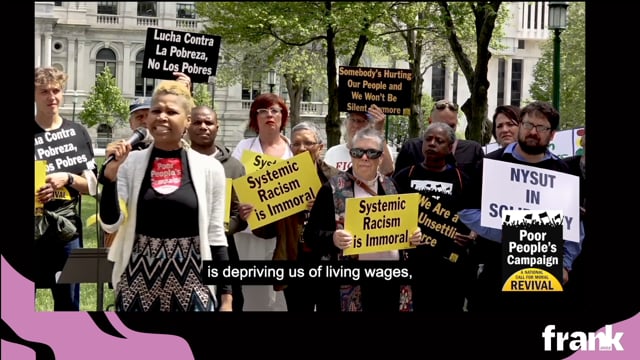
A central question in political science is how do the few control the many? I wanted to ask a different question about how those at the margins of society, subordinate groups like Act Up or Black Lives Matter, persuade often hostile majorities against nearly overwhelming odds. To explore this question, I studied the 1960s civil rights movement with particular attention to the ideas advanced by activists. A key debate at the time was about tactics. Could non violence really topple segregation? Was armed self-defense essential to black liberation? And how would these tactics be understood in the larger world? Activists like Byrd Rustin argued for non violence as a way to build broad coalitions. He argued neither the civil rights movement, nor the country’s 20 million black people can win political power alone. We need allies. Rustin was a key architect of the March on Washington that brought a quarter million people to DC. The New York Times described the day as the greatest call for a redress of grievances that the Capitol had ever seen. Though powerful, many in the black freedom struggle were concerned about the limits of non violence. What about self defense, they asked. Angela Davis grew up in Birmingham, Alabama, where the Klan engaged in a campaign of racist terror, detonating more than 50 bombs, one of which killed four little girls at the 16th Street Baptist Church. Davis has said some of my earliest memories are the sounds of dynamite exploding. But for men like her father, who sometimes took up arms in self defense of their neighborhood, white vigilantes would have only further terrorized her community. What about black dignity, they said. Stokely Carmichael later Kwame Toure had been a protege of both Byrd Rustin and Martin Luther King. All three understood non violent civil disobedience risk injury trauma, even death. After his 27th arrest though Carmichael said, I ain’t going to jail no more. We’ve been saying freedom for six years and we ain’t got nothing. What are we going to start saying from now on is black power for Carmichael and others the cost of non violence, we’re ultimately too high and progress too slow. And what a white indifference. One other challenge was that peaceful protests could appear to the rest of the country, like system of segregation was still fair you had a First Amendment you could peaceably assemble the system was working maybe as it should. And I helped organize a march in Hattiesburg, Mississippi. When a leading New York Times reporter saw this unprecedented picket line he remarked, it’s a dull story in such situations, blood and guts are news. With all these limitations many asked, can non violence really work. I studied thousands of protests between 1960 and 1972. And I found non violent protests predicted about a one to two percentage point increase in the Democratic vote share of nearby counties, enough to tip some of the presidential elections in that period toward the pro civil rights coalition. I collected 175,000 front page newspaper headlines, and found despite widespread media bias against African Americans, a non violent protest yesterday predicted a headline about civil rights or voting rights today. I looked at public opinion over decades, and found as non violent civil disobedience activity increased respondents and surveys were much more likely to state that civil rights was the most important problem in America. Across a wide range of statistical tests there was evidence non violence could be effective. But how was it working. The Pulitzer Prize winning book the race beat reports movement leaders were studying the press, how it reacted, what made news and what did not. One thing was unambiguous, the greater the violence, the bigger the news, especially if it could be photographed or filmed. It turned out protests were not most effective when they were simply a redress of grievances. They were most effective when they were engaging in a kind of highly strategic political theater. In the words of the late representative john Lewis, protests were staged, and they had to dramatize injustice. There were many ways injustice could be dramatized. One aspect of that staging, been thinking about what we might call casting. According to the book the race beat civil rights leaders found news organizations were especially drawn to stories of a dramatic clash between an appealing protagonist and a tyrannizing antagonist. Young people and organizers knew a children’s crusade in which hundreds were arrested and jailed sometimes for days would be more likely to produce sympathetic national news coverage, like this political cartoon from the Christian Science Monitor. The dramatizing injustice through political theater also meant selecting cities where police chiefs were known to have a hair trigger for violence. The resulting spectacles of violence would heighten the contradictions of Jim Crow in the land of the free. For example, Birmingham was intentionally chosen because bull Connor the police chief was almost certain to engage in brutal repression protesters intentionally made themselves targets of state violence for the larger cause. Those demonstrations, along with images like this photograph by Charles Moore helped transform public opinion. Leaders considered endless details to maximize media coverage. In addition to having a vicious police chief for example Selma, Alabama was picked as a site for voting rights protest for its proximity to the new television network affiliates in Montgomery, Alabama. Andrew young another key advisor to King had previously been the host of a Christian youth TV show. And as a result, he happened to be one of the few people in the country who deeply understood the interest and logic of the new medium of television. Young said the movement did not cause problems in Selma, it just brought them to the surface where they could be dealt with. Sheriff Clark had been beating black heads in the back of the jail for years. And we’re only saying to him that if he still wants to beat heads, he’ll have to do it on Main Street at noon in front of CBS NBC and ABC television cameras. In short movement leaders understood that dramatizing injustice was a form of asymmetric power that by capturing the attention of national international media, they might be able to deliver a death blow to Jim Crow. So how do these lessons translate today critically making oneself a target of violence is not the only way to create drama celebrities can create drama larger demonstrations can create drama and events like act up where members poured, like an act of event where members poured into the ashes of loved ones who died of AIDS onto the White House lawn can create drama that draws attention to the larger cause. The key is that when the media are watching tactics are more than just self defense or self expression, every protest is a means to tell a story to the world, and every activist a storyteller. So I want to end today by asking, who’s story are you going to elevate. Thank you very much. Thank you Dr was so for sharing this really important work. So in the conversations heading up to today, you mentioned that you’ve been working on this paper for over a decade. Can you tell us a little bit about kind of the epic quest to get this paper out there. So part of the roots are this are in my family, my both my parents had been active in the civil rights movement, my father was part of the cohort of young people, along with Goodman Cheney and Schwerner who went to Mississippi to register people to vote and so, in some ways, it had been a question since I was a kid of sort of how did we get from the victories of the civil rights era to the rise of mass incarceration and after having been an entrepreneur and having you know school reform. I still had this question at the back of my head of like how do we understand the post civil rights era, the politics of the post civil rights era and so that that that took me back to school, and that was kind of a fuel that that you know this is I was. It was a burning question for me, you know, from my teenage years, and that meant that even as the paper got rejected, or there were just all sorts of ups and downs along the way. I was learning, I was getting a better understanding of that era and the moment and how it succeeded. And that was enough to kind of keep me going, even when there were modes I thought they may not get published in the academy but but but I care enough, and I’m learning enough that it’s worth continuing. So one of your findings is that social movements can push issues to the national stage through these protests. Can you talk a little bit more about that dynamic and how it happens. Yeah, one of the things that you know it might be obvious to many people but it took me a long time to come to realize that if we think of society is organized with a sharp hierarchy right there are people with power and their people trying to, you know, at the margins trying to get their power out of their power, they’re not aware of. There are actors like the media, they’re often aligned with the state or with the leads or with people who are wealthy, but they have interests that are somewhat apart from that. They are interested in scandal they’re interested in drama they’re interested in conflict. And what the civil rights leaders figured out in the 1960s was that that was a potential wedge that that that the media’s taste for conflict, could be a way to elevate and to the level of concerns of voices that had historically only been paid attention to by the black press. And so there was this very strategic and intentional set of tactics that allowed the issue of, you know, Jim Crow repression and segregation and the brutal violence of Jim Crow to become a national issue and that by essentially shifting the theater of contestation by going making taking a local issue and making it a national and an international issue. They were able to dismantle and overthrow Jim Crow. So, this year, we’ve again seen so much violence and injustice committing against black and brown communities. Black Lives Matter protests have been people peaceful the largest in history, and despite massive support for the movement. Many are still frustrated by the lack of justice and action. Some have turned to other expressions of protest that might not be so peaceful. Can you kind of reflect on this moment and how your work applies to the current situation. So I think of every protest as a kind of contest between self expression and persuasion, and that that’s there’s always a tension right you know when Eric Garner was killed. I went to a protest in midtown Manhattan and you know I was angry and other people were angry, and there’s a kind of boiling over in the country where you just want to be able to express that anger. And at the same time, expression may not map always to persuasion, and that’s that that’s a real tension in movements that that that can be very hard to to manage and to channel and to have be effective. And I think that it’s it’s you know part of what movement and leaders and organizers and other kinds of, you know, kind of capacity building can do is help people understand that one way to kind of have expression and persuasion work together is through the kinds of things we saw in the 1960s but also now where, you know something like a die in or something like a that is both sort of can capture the attention of the media body express people’s rage or their anger or their mourning that those sorts of tactics allow that tension to not be fully resolved but potentially be channeled in a way that they can achieve both ends people get to to mourn and it can move the larger agenda forward. So that’s a really interesting distinction that kind of helps give some language to attention that’s that’s always there. So what are kind of the insights that you’ve gleaned from this work mean for this community thinking strategically about narrative power and change. One thing that I alluded to in the talk is that just for me there’s this core insight which is to think like a camera I mean if if not all protests are organized around catering to the media and not all movement building is focused on, you know media work, but for the work that’s media targeted for that kind of communication, it’s really critical to think like the, you know, trying to adopt the interest or just to appreciate what are the interests of the media. So for example, in one in the film, how to survive a plague. There’s a line from one of the people in a media training which is don’t talk to the media, talk through the media. Right. And the key is to really understand that there are things that that that you know, media cares about what’s visual television cares about what’s visual. Things like conflict are helpful things that are theatrical, but may not be conflictual helpful and that that there are ways in which activists, particularly with some forethought and training and and planning can use to their advantage. And I think one of the, one of the hardest most kind of bitter aspects of that is state violence. Again, can cause injury trauma and death, but also can do an enormous amount of work to put an issue on the front page and to force and kind of shock the conscience to use the phrase from 1960s to shock the conscience of the country. So your paper looks historically at how the civil rights movement who built power. What can we learn from that research for today on how to build the capacity of activists and movements working in the current era. You know, Zeynep Tufetchi who’s written a book Twitter and tear gas talks about how in the modern era with internet activism across nationally. What we see is that it’s possible for movements to kind of spring up. And so almost instantaneously because the cost of communication is so low. And in an earlier era and something like the Birmingham bus boycott there were women handing out flyers to get people to participate right and there was there was a kind of central organization, and that was a way to kind of keep a little bit more kind of coordination and coherence in the message. That’s a real challenge for movements today. And I think there could be a lot more investment in capacity building for activists so that even if 99% of the people who are showing up at, you know, a kind of pop up protest, have no background. There is that one or 2% who are there who can help to make sure that the protest is most effective. What are you working on next what should we keep an eye out for. So I’ve been working on a book that takes this research and carries it forward to the current moment, thinking about what degree protests and the kinds of tactics of political theater staging and you know the other things I talked about. To what degree do they continue to be useful ways of understanding political activism. And so that’s the protesters dilemma is the book I’m working on, and, and thinking about the hard trade offs because it’s not, you know, there are real challenges as I as I describe in employing some of these tactics as well. Wonderful. Well, we’ll all keep an eye out for it. Thank you so much for presenting your work and everyone give up some silent zoom props to Dr was so Thank you so much for this opportunity.



 Seven Minutes In Heaven… With A Scientist
 Moral Uprising with the Poor People’s Campaign
 The Unintended Consequences of Emotional Appeal