Very humbling and a little bit scary to come on at the end after so many amazing speakers have been before me. I’m really grateful to Frank for bringing me over and I’m also really grateful for them setting up the stages of bar to make the Irish guy feel at home. It worked. Yeah, so I’ve popped over from Europe to talk to you all about hope. Hope as a smart strategy for change. Not hope as blind optimism, but hope as the belief that tomorrow can be better than today. And hope doesn’t come naturally to me, actually. So to answer your question, I usually say that I now do hope for a living, but I’m still pessimistic in my spare time. But this is, come on, slides. Wrong button. So this is usually how I communicate. So in the last two years, I’ve completely changed the way I see my job as a human rights communicator. I used to see my job as exposing, suffering, and promoting the work of my colleagues who are investigating and exposing human rights abuses, telling people about the nightmare. And in the last few years, it felt like a nightmare. Besides the things happening here, we’ve got looking at what’s happening to the Uyghurs in China, to the Rohingya, Myanmar, to Yazidis in Syria, to Libya, just to horror what’s happening to migrants in Libya. And talking about the nightmare really comes naturally to me, because I come from a family of holocaust survivors. And so I grew up in a home really full of anger and cynicism and despair. And so the way we do communications in the human rights world is called name and shame, right, that we will get these abuses out in the open, and we’ll expose them, and we’ll shame the leaders. But in the last few years, we’ve had to ask ourselves a question. How do you name and shame leaders who have no shame? And so we had to really change things. And seeing what was happening, particularly in Europe, that those words, human rights, and the words never again seem to lose their meaning, was really like a moment of despair for me personally and for a lot of my colleagues. And then along came sort of a hero to say the day in the shape of a Natshenk Rosario. Do you ever know a Nats? Yeah. She said, actually, when you guys are talking about this more dangerous world, you’re pushing people into the hands of these populists, these tough guys who offer this false security. And I had literally just written a press release where I said, we now live in a more dangerous world. And it really made sense to me, actually, that I was just failing with my rational arguments and my facts. Refugees are not terrorists. And I was repeating over and over again the messages of my opponents. And I wasn’t speaking to their fear. So I started looking at a lot of the neuroscience that we’ve seen this week. And what really appealed to me was this idea of when we appeal to that downstairs brain, our messages of anger and fear that reflected basically my own anger and fear was creating the exact opposite response. I had to ask myself, what’s the emotion I want to trigger when I tell these stories of suffering? And it’s empathy. And this idea that empathy is triggered in the upstairs brain. I mean, I was just reaching the completely wrong part of the brain. I wasn’t triggering the emotions I wanted in the audience. But these findings that were discussed this week, this idea that we’re more likely to get that empathy when people feel good, happy, safe. How do we do that in human rights? This is a real challenge for us because there’s all these horrible things happening that we have to bring to light. And so what we realized was we can’t just always talk about the inhumanity. What people want from a human rights organization is not actually just to know about the inhumanity, but also to see the hope, to see the humanity. And we have to show the world not just as we don’t want it to be, but also as we want it to be. We have to celebrate the behavior that we want to see more of. If we only talk about the inhumanity, that starts to become the new normal. And also we see that actually people who feel hope are more likely to welcome refugees. So we started doing something really unusual for the human rights world. We actually listened to our audience. And I tried to figure out what makes people join a human rights organization. And the answer surprised us, because actually people didn’t want to necessarily need to know everything going wrong with the world. They wanted to know how does change happen? And they also wanted to feel that they were part of something successful. And so based on that insight, our Amnesty International France made, ran a different kind of campaign than had ever been run before in the human rights world. It was called A Thirst for Victory. Well I run to the rock, please hide me, I run to the rock, please hide me, I run to the rock. I said Lord, hide me, please hide me, please help me all on that day. So that says when we fight together, we win together. And so when we had done social listening around the words human rights, the dominant emotion was despair. And so this is about showing people, we can say that human rights work is full of joy, but we can say that’s the promise of joy. If we do the work today, this is what happens when we free the political prisoners, when we win those changes. And so what we started trying to do was actually talk about what we’re for instead of what we are against. So we were really, and it’s actually kind of scary, it’s really hard for us to do, so working on abortion in Ireland, we were really afraid of saying we want women to be able to choose to have abortions when they want. And so we limited our ask, we kept saying just give us exceptions, rape, incest, fatal fetal abnormality, we don’t ask for too much, but basically we were almost accepting in our framing that it’s a bad thing that we just want a little bit of. And then when the campaign made a really brave decision, they actually said, no, we just want full abortion. And they left behind the framing of life versus choice, which I’d spent 10 years trying to failing to convince my friends. Strangely enough, a left-wing Jew is not the best person to convince Irish Catholics to change their mind. But they framed the debate with three words, compassion, care, and change. So talking about what we were for, and I know so many people who still think abortion is a sin, but this framing made it easy for them to change their mind because it was about taking care of their friends and women in their community. And what I think is really relevant from here is when George Legoff says the progressive worldview is built on empathy, care, and hope. And I think that’s what was practiced there. And I would add one thing to that worldview on a more global level is also shared humanity is part of that worldview. So he says, you know, we need to stop using the conservative worldview of fear. And even if it feels hard or naive, we have to use that worldview, that belief in care, to make the case for what we want. So I had to ask myself from an Amnesty perspective, what does human rights actually look like? Not injustice, but justice. What does it look like when you have human rights? And what do we stand for when we stand for human rights? So I used our fundraising, our membership growth to run AB tests to see what values message will actually make people join us. And we made animations because I wanted to run them all over the world in Africa and Latin America and Europe and everyone being able to relate to them. And we had the old fashioned message of attacking governments and so on. But actually the message that worked best, it was most effective, was one of shared humanity. And another thing that really surprised me here, I didn’t actually like this content, but it performed really strongly organically. So I learned two things from that. One was there’s actually a real hunger out there for just simple things that make people feel that sense of belonging, things that connect to values. And I also learned not to trust my own intuition anymore, but actually test things. And this is such a really powerful tool, I think for all of us actually. It feels really hard to stop talking about so human rights abuses in the economy and actually just kindness and empathy as reasons for doing things. And humanity then became the core of the Amnesty brand. It’s not like a logo or a slogan, but a belief that we’re all human. And that we need to identify more as human than other kinds of identity. And actually when we think of ourselves as human, we’re more likely to accept refugees, rather than thinking of us as say American and they’re not American. And so the idea is to bring this idea of shared humanity to life through stories. So in this picture, this is the most successful piece of social media content Amnesty’s ever run. It’s called Look Beyond Borders. It’s five minutes long. Frank would kill me if I showed it to you now, but I really recommend watching it. But it’s basically a moment of positive social contact between a newcomer and someone who’s already in Europe. And the key thing here is, first of all, it’s basically building the empathy muscle. But we’ve seen Trump and other populace be so good at using social media, using these tools to divide people, to spread hate. And we need to be as good as they are at using those same tools, but to spread hope and empathy. So the idea is we could take this video and take fine people like that woman on the right and show them that video. So showing people someone like them changing their mind. Essentially re-humanization. And the key thing here is when you suddenly start to think of it that way, actually human rights work becomes not about just laws and policies. What’s the end goal? What is a world where human rights are enjoyed by all? It’s actually a world with more empathy and kindness. And if that’s our goal, then sure we still need to work on laws and policies and issues in our reports. But shouldn’t we also be using behavioral science to actually change human behavior and interaction right now? And if that’s the case, communications work actually is no longer just raising awareness about the great work of our colleagues. It’s actually right at the heart of making that change happen. And it’s about finding the stories that show that humanity. And I feel a hopeful vision of humanity. The idea that human nature is not to be individuals, but actually to take care of each other is really necessary for that progressive world view to thrive. And if we can’t find the stories, then we can make the stories. So Amnesty International USA ran a campaign here called A Bigger Table. When people come, we don’t build walls, we build a longer table. But again, I’ve done workshops now where I ask people what does the world look like that you wanna see? And all over the world, people are drawing a picture like this. Just people welcoming refugees and sitting down to dinner. So actually, I’m thinking maybe the future of progressive protests is less demonstrations and more dinners. Because they’re angry, right? When we show anger in our protests, but actually, why don’t we need more empathy? So I’ve been trying to think of how to, as a good sort of public relations guy, how to get more of my colleagues thinking this way. And I just came up with five simple shifts because those visions are not to come from me, but actually from all of us. And so I find these are really five simple questions we can all ask ourselves about our campaigning and our content. If we show our audience the problem, we thinking about the urgency, but there’s also the risk of despondency. We have to show them the solution and make them believe it works. We’re very good at talking about the things we’re against, anti-capitalism, anti-racism, a world without a death penalty. What does it look like when you don’t have those things? What’s the behavior we want instead? And instead of using guilt or threat to our audience, these could be your human rights, can we give our audience an opportunity to be part of historical change? Which is what that ad was trying to do. And somehow this idea is really resonating in the human rights world. So I’m trying to open up this idea so anyone can get involved. And basically anyone can take a Hope-Based Communications pledge on HopeBased.com. I just want to end out with one story because two weeks ago, I’ll talk about a different Frank. Two weeks ago was Holocaust Memorial Day and I went to the Anne Frank House for the first time. It was a story that was very close to me growing up. And Anne Frank said something I think is very relevant for us. She said, I mainly wanted to look out the ceiling, the skylight in the Anne Frank house because she said, she talked about how we can find balance in the beauty and nature. And she said, as long as this exists, this sunshine and this cloudless sky, and as long as I can enjoy it, how can I be sad? How can I be sad? So I think the lesson from Anne Frank for us at Frank is that there’s hope in every story and our job as communicators is to find it. Thank you. Okay.



 Seven Minutes In Heaven… With A Scientist
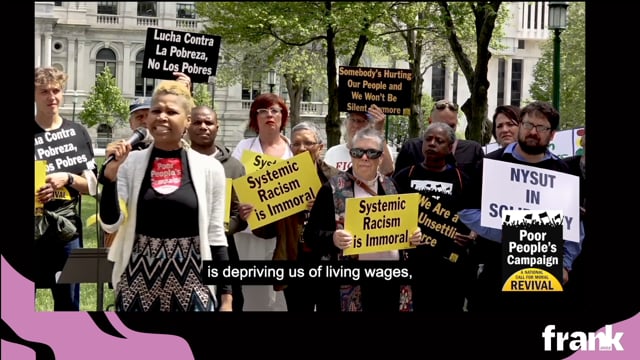 Moral Uprising with the Poor People’s Campaign
 The Unintended Consequences of Emotional Appeal