
Fresh From the frank Stage
Standout talks from the most recent 2023 gathering, featuring bold voices, urgent truths and unforgettable moments.

Amahra Spence
Liberation Rehearsal Notes from a Time Traveler

Shanelle Matthews
Narrative Power Today for an Abolitionist Future
Nima Shirazi
Irresistible Forces, Immovable Objects
The Speaker
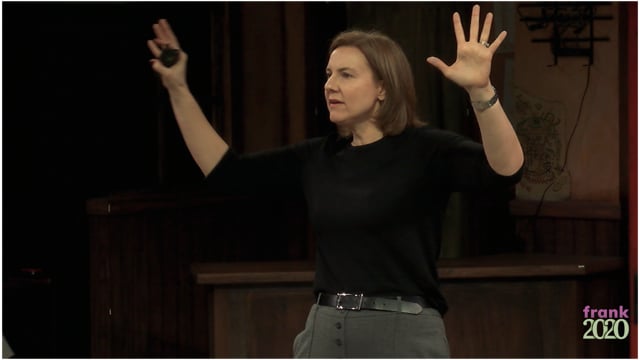
Heriselda Begaj-Viotti Senior Manager, Participant Media
Heriselda oversees impact campaigns at Participant Media where she works across sectors with non-profits, multinational companies, government agencies, foundations and others to raise awareness and mobilize viewers around film and episodic content.

Watch Next
-
 Seven Minutes In Heaven… With A Scientist
 -
 Moral Uprising with the Poor People’s Campaign
 -
 The Unintended Consequences of Emotional Appeal
Anger to Action Through Storytelling
ArtCreativityEmotional IntelligenceFilmProblem SolvingPublic ServiceStorytelling
Transcript
My name is Harisalda and I’m an impact producer at Participant. Participant is a film and TV production company that you might recognize from Roma, spotlight, RBG, when they see us. At Participant, we believe that a good story, well told, can change the world. And we sit at the intersection of art and activism to do that. So if you take a look around, you probably recognize that we’re living in angry divided times. Our world is on fire. Australia is literally on fire. The UK left the European Union. And the state of our own union, according to polling, is divided at best. And the things that happen in our world make us feel angry. And we have a right to be angry. There is so much happening. And in some cases, anger can move us into action and can mobilize us and bring us out into the streets. But in other cases, anger can also drive us into our corners, making it harder to address some of the big pressing social problems in our world. So what do we do in those cases? In the work that I do, I think a lot about the cultural dynamics that are involved in the big inequality, climate change, criminal justice issues that so many people in this work think about. How do we change narratives? What is the role of stories and media to reshape systems to help create change? What’s one of the best ways to do that? Storytelling. So at Participant, we produce films and TV content. And in some cases, that content deals with these big issues that I just named. In those cases, we have a department that’s dedicated to basically using the art as a powerful tool for activism to mobilize audiences to do something about those issues. So to give you a sense of what that looks like, I want to play a short little clip that’s not from American Factory that I hope you’ll enjoy nonetheless. Five, four, three, two. What is it that has brought this big family of strangers together? I created Participant because I believed in the power of storytelling to inspire mass audiences to social change. The name Participant stands for commitment, passion. They transcend politics. Their stories about people and their stories about issues. That feeling, that voice that often doesn’t get heard. I think when you see yourself up there on the screen, your story is reflected and you feel empowered by that. Participant’s work doesn’t stop when a film is released. It goes well beyond the life of a film. They really stand at the intersection of art and activism. We can’t understand the problems, the issues, the day-to-day realities of so many people without stories to help us get closer to those communities. We always work hand-in-hand with impact partners whose on-the-ground commitment to these issues is already creating change in the world today. Partnering with advocacy groups, NGOs and community organizations, we use art to create a shift in public consciousness. It’s changing the hearts and minds of people, people who are looking for ways to act. There is a moment when you have to choose whether to be silent or to stand up. The reason why stories are so powerful is because they could show us the world as it was, as it is, but also how it could be. If we can leverage the strong emotions that storytelling is so powerful at creating, maybe we can help our audiences, start to see things in a different perspective and connect them with ways to take action. We do that by considering a number of things. One of those six core things that we think about when we consider how do we build impact around the content is emotion. The way you are left feeling after experiencing a story affects what you are willing to do about it. If you are left feeling happy and inspired, fantastic, you probably just watch something great. If you are left feeling angry, we find that that could be a great motivator for wanting to do something more than just watching the content. The way that we then try to mobilize our audiences is threefold. One, we want to inspire them to see themselves as change makers and to see a pathway to action. Two, empower them with ways to get involved. Three, connect them to others so they can be a part of collective action. What does this actually look like? Let’s move to American Factory, which was a documentary that we released last year with Netflix and Higher Ground. Fingers crossed for Sunday and Oscars. If you haven’t seen it yet, it is on Netflix. You can check it out tonight in your hotel room. There is Netflix. American Factory tells the story of an old GM plant in Dayton, Ohio that was closed down during the recession, only to be reopened years later by a Chinese billionaire who came in, rehired some of those old local workers, but also brought in Chinese workers. What it does is it takes a really human, personal, local look at big, frightening issues like future of work and automation and globalization that are playing out in communities all over the world. The film came at a time when inequality is on the rise. The nature of work is changing. Livelihoods are under threat. People are angry. When we started to work on the film and the impact campaign, we heard over and over that anger was the strongest between labor and business, between the workers and unions and CEOs and managers who were angry at each other for not adapting fast enough, for not prioritizing the right thing, but it also meant that conversations were siloed and these complicated issues were seeing no progress. So we thought, how is it that we can use a story not to solve these issues? I don’t think we can come in and say, hey, guys, we solved the future of work with a film, but how can we use the story to create common context, to start conversations, to design experiences that at least bring different sides to the table as a starting point, knowing that there is no turnkey solution. But the answer to dealing with the global economic realignment that’s happening in our communities can’t be, I’m too angry to deal with it. So we started from a place of it’s not us versus them. At the end of the day, we’re all workers. So how can we design experiences around the film that bring these different people who are dealing or involved in these issues somehow to the table? So we brought the film and the campaign all around the country on a national tour from Detroit to Pittsburgh and Indianapolis and Louisville with the idea of creating common context, shared vocabulary, starting with a screening of the film, but also designing community experiences that included music and dinners and just shared experience so that we could remove the label of worker, manager, whoever. The idea was bring everyone, bring those people, but bring the artists, bring the educators, bring the faith leaders from the community together to have this shared experience. And then let’s start talking about these issues from the perspective of Jill and Bobby and Wong in the film and from the experience of Dayton, but really we start to talk about what’s happening in our own community and in our own lives. And what we learned in doing this is that while we engineered these experiences, we didn’t engineer the connections that came out of the fact that people started to see each other as human beings. We didn’t engineer that our guests reported that they then had other dinners with their table mates weeks later or that they reported understanding the issue from a different perspective. We didn’t engineer a guest telling us that these are the types of connections and experiences that reshape paths in the best possible ways. Now, I’m not going to be naive and tell you that stories are going to fix the world, but what I do want to leave you with is as you’re thinking about the big issues that affect your work every day, how is it that storytelling and media can be helpful? And I want to leave you with five takeaways. One, stories, whether they’re fictional, your own or those of your organizations are powerful and they can be really important to creating change. Two, shared vocabulary creates common ground. Talking about future of work and robots taking over your jobs, that’s really complicated, but talking about what you saw on screen as a starting point can help serve as an entry point. Three, an undervalued tool is breaking bread. So our community events had dinners and we deliberately sat people where we wanted them so that the rank and fell factory worker was seated next to a CEO and suddenly they were talking about how their grandads were both union members over mac and cheese. They were just human beings. They removed the labels, just break bread. Where and who convenes matters because you want everyone to have a voice and space to feel comfortable and be a part of the change you’re trying to make. And lastly, this is something that I always try to remind myself when working on big issues like the refugee crisis of future of work. These issues are large and they’re scary, but they’re playing out on a grassroots level and it’s the local leaders who are angry or inspired or hopeful who are going to continue to see change. So let’s think about how we use their stories and the stories of their change they’re making and support them and support each other in doing this work. Thanks very much.
Watch Next
-
Seven Minutes In Heaven… With A Scientist
-
Moral Uprising with the Poor People’s Campaign
-
The Unintended Consequences of Emotional Appeal