
Fresh From the frank Stage
Standout talks from the most recent 2023 gathering, featuring bold voices, urgent truths and unforgettable moments.

Amahra Spence
Liberation Rehearsal Notes from a Time Traveler

Shanelle Matthews
Narrative Power Today for an Abolitionist Future
Nima Shirazi
Irresistible Forces, Immovable Objects
The Speaker

Yoo-Jin Kang Assistant Professor of Communication, University of Maryland
Yoo-Jin Kang is a communication scholar exploring storytelling, culture and representation. Her research examines how participatory media empowers communities, strengthens identity and drives meaningful social change.
Watch Next
-
 Seven Minutes In Heaven… With A Scientist
 -
 Moral Uprising with the Poor People’s Campaign
 -
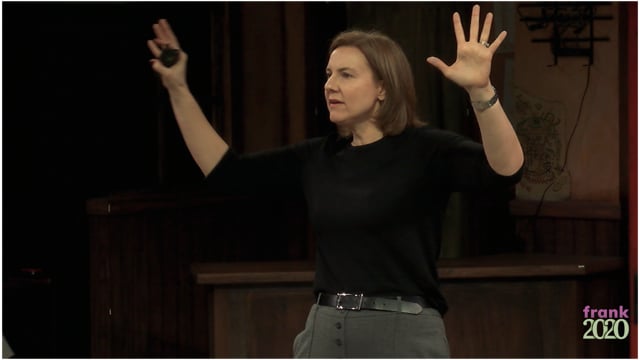 The Unintended Consequences of Emotional Appeal
Beyond statistics into the human stories
CommunicationsEducationFamilyHealthcarePublic InterestStorytelling
Transcript
They’re waiting for you. Oh my goodness, thank you so much. It’s such an honor to be here sharing the stage with you. So my name is Yijin Kang and I just wanted to say I made this Twitter just for this conference. So there you go. Wow, so as my time as a Corral fellow there was always just one question that I always seemed to get. And I’m going to show you once this starts working. Oh, did it work? Okay, good. Okay, so it’s what is public interest communications? This is a question I got a lot. So I get this question. Okay, good question. I was like, yeah, what is it? So before the conference I really couldn’t tell you. I remember googling through countless web pages, what is public interest communications? What are the 10 things I need to do to be good at it? And as you probably know by now, it’s not that simple. There are so many different ways to make an impact through public interest communications. And today I’m here to tell you about my experience at Transfer America’s Health. So Transfer America’s Health is a nonprofit in Washington, D.C. and they’re committed to disease prevention and health equity. And I was really excited when I found out about my placement because this seemed to really line up with my values and what I’ve been doing in my undergraduate work, which is focused primarily on intimate partner violence or relationship violence and sexual assault. So this is something that’s really important to me because I am also a survivor and I know lots of other people and I’ve met and loved so many other people who are also survivors of all genders and ages. So I was super excited. So in my mind, violence is a public health issue. It’s not just a woman’s issue. It’s not an issue that stays at home. Violence affects way more beyond the individual who is going through it. Violence affects families, communities, other relationships and the accepted cultural norms that are passed down through generations. So as you can see, I was so excited because Tifa, so Transfer America’s Health, I’m going to say Tifa for short, they seem to be really honing in all this idea of disease prevention. We shouldn’t wait for a problem to become a problem to talk about it. And so I also wanted to talk about how public interest communications also allows for us to go beyond the statistics. You know, a lot of the time when we talk about social issues or even health issues particularly, we seem to focus on statistics. What are the hard facts? And we sometimes forget that these hard facts and statistics in the end are about people. It’s about your personal stories, the lived experience. There’s nothing more valuable than that. And I’m sure that when I just shared with you that I’m a survivor, some of you might have felt a little bit uncomfortable. And I’m here to tell you that that’s okay. You know, a lot of the time we hear about these uncomfortable things and we want to shut out. We want to just shut down because it’s hard to hear. But you know, I’m here with you and I’d like for you to be with me through my journey. So public interest communications. So when I first met my supervisor, Laura Siegel, who’s here today. Hi, Laura. I was so excited. I was just like exuberant. And I was talking to her and I was like, okay, explain to me what you do through public interest communications. And she talked about being, it’s more pragmatic. And it’s something that in interdisciplinary studies we call bridging the explanation action gap. So this is why I made this little bridge. She talked about how, so we get the research on health issues, social problems, et cetera. We do the grunt work. And we go translate it over to policy makers, to influencers, to the general public to tell you why it’s important, why this matters. So this is how we’re bridging the gap. How can we talk about it? What can we do about it? So over here, there’s a lot of research I’m sure that you’ve heard. Oh my gosh, this is so important. Why aren’t more people paying attention? And the thing is we don’t want to overwhelm people with some of the hard facts. We want it to be translatable so that people can know, okay, this is going on. What can I do about it? Why does it matter? Right. What do you want me to do about it? So I just couldn’t wait to start. And when I first started working on my project, my issue was child abuse and neglect. And so this is another thing that’s kind of hard to talk about. It’s kind of unsettling. And I was like, okay, let’s take this on. So I spoke with Laura and she was like, okay, all you have to do is get all the relevant literature about child abuse and neglect. I’m like, okay, got it, got it. This is what I do in school. And do it in two pages in a summary. And at first I was like, okay. And then I was like, what? I was like, wait a second. You want me to get all this literature and then two page summary? I’m like, single spaced? She’s like, no, double spaced. And so I was like, what is happening? So what I realized is that in public interest communications, we grab all the literature, we communicate to include, not to exclude. So this is something that is in academia. I was really surprised because in academia as an undergraduate student, especially in the humanities, a lot of the time we write to expand. Sometimes I’ll dust off my dictionary and add some new word like indubitably just to make it seem longer. And public interest communications is not that. It’s to grab all the information and to include people. It’s a community. Now I’m just throwing off because I’m looking at that picture. Okay. So it’s saying, let’s not only talk about the issues in our society, but let’s do something about it together. It’s actionable. So through my experiences as a fellow, I’ve learned so much about the field of public interest communications and my possible role in it. And something that was inspiring to me is that I’ve actually pursued a path in public health inspired by my undergraduate experiences as well as my internship, which was super awesome. Not only did I get to write and go from confused to Beyonce, I also got to go to conferences in DC talking about early childhood abuse and neglect and speaking to the people who were actually doing the work. And that was so rewarding to me. So as I just conclude, I wanted to share two key insights that I learned about the fields. So we are all connected. And I think from all the frank talks that I’ve been hearing throughout the week, they’re all different issues and it goes about a way that I think it reinforces this point that we are all connected. And through this acknowledgement, I think public interest communications allows us to pursue work that is greater than ourselves. So thank you so much for having me. I’d like to thank my mentor, Laura Siegel, as well as Bernès, my parents, the fellows, Shandell Ayala, and all of you for your attention. Thank you so much.
Watch Next
-
Seven Minutes In Heaven… With A Scientist
-
Moral Uprising with the Poor People’s Campaign
-
The Unintended Consequences of Emotional Appeal