Thank you, everybody. Hello. Thank you so much for, oh, my brain, okay, there it is. Sorry, it’s the first time I’m seeing these slides in this format. Hello, everybody. Thank you so much for having us here today. I’m delighted to be here, and in the frank style, I’m going to tell you everything that you need to know about how to conduct innovative research that develops empathically attuned persuasive communications for social change in just 11 minutes. So really what I’m going to do is outline our approach, share some key insights, and then I look forward to talking with folks later today about whatever catches your attention and intrigues you. I also have to call things to my frequent collaborator, Robert Pretz, who’s right here, who is well versed in this work and would also be delighted to talk with you. So feel free to grab him as well. And I also want to thank my colleague who’s not in the room, Phyllis Watts, who’s another frequent collaborator and really important contender to our work. So first, I love BrainForn. I will tell you when you Google it, make sure you put quotes around the whole thing, or it will take you a very long time to get to something that actually is a link to a brain. All that stuff that they write about no affective research and all this pretty multicolored map to the brain. It’s really exciting who needs Freud and FMRI does the job much better. So what does the proliferation of BrainForn books and articles and blogs have to do with persuasive communications that are in the public interest? A lot, it turns out, if you’re a practitioner like myself. So I’m also going to say I’m an amalgamator. So I am not an academic. I don’t have to prove anything that I do. I don’t have to say that my ideas are better than somebody else’s. I just get to take all the ideas. I take the ones that are interesting. I put them to work. The ones that I think are wrong I ignore. It’s a really great, great, great way to have to be able to do stuff. I did have somebody ask me like, what’s your dependent variable? What’s your yadda yadda yadda? And I said, wow, it’s winning elections. That’s my, that’s how I know it’s working. So I’m going to talk about a range of things. But I do want to say one of the things that I’m going to emphasize is the work on marriage for same-sex couples, because that is something that I spent years working on. And I was the pollster and the researcher for both the Maine and the Washington State campaigns in 2012. So I’ll talk about that more. So, okay. Why do certain issues need a different messaging approach? There’s a lot of issues that don’t, that you can just do straightforward polling, straightforward qualitative research. But some issues really do need more. And the reason that they do is that they are emotionally complex. So they’re not simple. They’re not straightforward. There’s internal conflict for people. So they, people feel on the one hand this on the other hand that, and when you elevate certain feelings or emotions they’re having, they can be with you. But when the opposition elevates other feelings or emotions they’re having, they’re going to be against you. And so we need to understand a lot more about the landscape that they’re in. There’s also important, if you’re really trying to make change, to understand that there’s a worldview disconnect, which I’ll talk about a lot more, between advocates and their audience. So if the audiences were where we, if the audience saw the world in the way that we see the world as advocates, we wouldn’t have to be working on the issue, because that would already be the policy. But they don’t see the world in the same way, and that’s our real challenge. And then there’s also that people, this misunderstanding that for some, oftentimes for the audiences we’re trying to reach, it’s not that people won’t change their point of view or won’t change. It’s that they can’t. They just emotionally, psychologically, they’re not able to yet, and we’ll talk about that more. So I want to say that there are a lot of ways to make social change, and the work that I do is very particular. Researching these emotionally complex and socially controversial issues. It’s marriage for same-sex couples. It’s healthcare access for transgender people. It’s aid in dying in the final stages of your life. Climate change, school reform, racial inequality, these are tough, tough issues to make progress on. My focus is on making attitudinal and cultural change to enable behavioral change. That is, we work to help our target audiences move to be supportive of our positions so that at the end of the day, we can have a majority of people being in support of what we’re doing, so that if it does go to a ballot box, then we actually can win and hold our position in an election. This is the public, and these are the advocates. So this is the gap that’s really important, and we’ll talk a lot more about. There’s this chasm between them, and we have to bridge. One of the things that we’re doing is we’re creating a Venn diagram. Somewhere in there, there’s an overlap of shared values and shared beliefs, and we have to find that overlap because that’s the narrow space that we can effectively communicate within. So this is how both our audience and our advocates react when we don’t communicate with them effectively. They shut down, they can’t hear us, they put up the hand, talk to the hand. So that’s what we have to get past and find a way to get past. One of the things that’s hard for advocates is that they want to go from zero to 60. They want to get people already where they are, but you can’t get people to go from zero to 60. They have to go like this. So that’s one of the things that we really work on. So I want to talk about marriage messaging. So you may all know that in 2004, some of you may be too young, in 2004 there were bands all over the state, all over the nation, state-based bands on marriage, and it was a battering ram, which we’ll talk about in a moment. So now, obviously the landscape changes, and every time I update this map, it’s changed again. It’s really exciting. Yeah. So where we were, political sledgehammer for the right. This is 2004, right? So now you think, oh, same-sex marriage, yay! But it was a very short time ago that that is not what was happening. Okay. In my lifetime, I’ve seen discrimination, and I see it again in Proposition 8. 8 would be a terrible mistake for California. It changes our constitution, eliminates fundamental rights, and treats people differently under the law. Proposition 8 is not about schools or kids. It’s about discrimination, and we must always say no to that. No matter how you feel about marriage, vote against discrimination, and vote no on 8. Okay, so that was our side’s advertising in 2008 in California, when we, in retrospect, not surprisingly lost Proposition 8. What did you hear? No matter how you feel about marriage, literally we paid millions of dollars to put that on TV. Ouch! Okay, marriage as discrimination, marriage as rights. Whoa, okay. So let’s look at what we came to in 2012 in Maine, after a lot of hard work from a lot of different people working together and collaboratively. We had four generations of our families sitting around this table. Dottie and I’ve been together for 59 years. I flew in the last battle of World War II. I couldn’t see how anyone who had been in combat could ever be cruel to anyone ever again. It takes a great deal of bravery to be a lesbian. I’m so proud of Katie and Alphys. We’re pretty proud of you. Oh, good. Marriage is too precious a thing not to share. Having it in my life, I would really like to be able to see Katie and Alex get married quickly. This isn’t about politics, it’s about family and how we as people treat one another. Thank you. Thank you. Thank you. I will say that was a Mother’s Day gift for me. Among many other things we did in our research. Well, I see I have two minutes, so I’m not going to tell that story. Anyway, I love that. So what you see here is a profound shift in the message frame. And while that may seem common sense now, and that’s because it is actually empathically attuned, it was a bumpy and hard journey to get us there, both advocates and everybody else. So we had to shift the frame significantly, which is what we did, and how did we get there? My brain map, my pretty colors. So the key point I want to make here is that how we are feeling, the brain impacts how and what we’re capable of hearing, feeling and processing. When we’re calm, we can pause and reflect and aspire to be our best selves, which is a very powerful motivator for doing good. But when the downstairs brain is triggered, when the amygdala is triggered, the upstairs brain shuts down, and this reptilian instinct to protect your egg takes over, and you cannot reflect anymore. So in that state, you’re literally not able to get access to the better part of yourself. And what that means is understanding is very key, because it means that when we’re thinking about effective communications on these issues, we need to think deep what are the emotional and psychological tools that we need to equip our audience with so they can come back to their reflective self. What behavioral cues can we provide to them, and which messengers can reach people when they are in that state? So you have to meet your audience where they are, you have to understand where they’re starting from. And I want to say that it’s very important in order to affect external change, we have to affect internal change. As researchers and social change makers, we have two audiences. There’s the conflicted voters we’re trying to reach, and there’s also our advocates, because you see advocates have amygdala too, and when they get triggered, it’s just as challenging as when audiences are triggered. That’s how my clients feel a lot of time when I talk to them. So advocates often have a very difficult time being empathetic to their target audience. They see people who oppose them as bigots or haters or the enemy, and there’s a way in which advocates fear that genuinely understanding their opponent’s point of view is endorsing it or validating it, but it’s not. Empathy is understanding, it is not agreement. So how did we get there? So I first started really developing this in a very difficult environment in 2005, and it’s collaborative, I’m running out of time. Okay, so basically we really worked together, we rooted everything in science and understanding, we did very innovative research, we had to work extensively with our advocates on adoption and implementation of the messaging, and we do all these cool things that you can talk to us about, and I just want to encourage everybody who is thinking about doing this kind of work to think about being an iconoclast. We are able to develop this approach and move away from traditional political communications in this environment because we as a team, we see possibilities where other people don’t. We see pathways where people see blocks. We are willing to deal with clients who aren’t happy with us, and with people who are skeptical about what we’re doing, and we’re persistent in terms of really pushing people to be able to take a new fresh look at how to communicate and connect with people who they ordinarily don’t want to connect with. And I’m going to stop there. Thank you so much. Thank you.




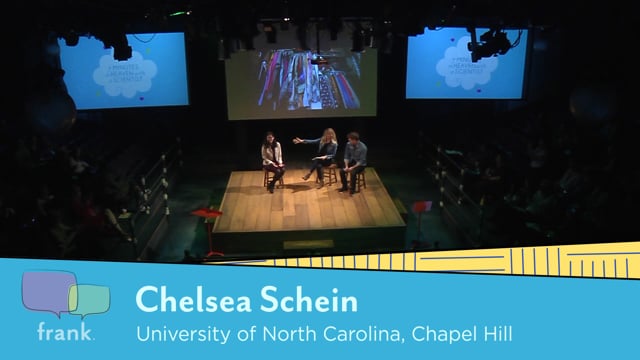 Seven Minutes In Heaven… With A Scientist
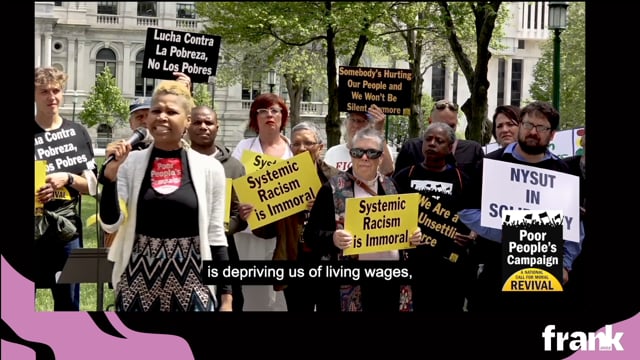 Moral Uprising with the Poor People’s Campaign
 The Unintended Consequences of Emotional Appeal