Okay, well, thank you so much for having me here. I can guarantee that I will be played off just like our first speaker. And forgive me if it sounds like I’m rushing because I have a lot of stuff and I’m not used to fitting it into a 17-minute window. I wanted to talk a little bit. I was told that the theme was curiosity. And so I’m very curious now about this moment in politics and media and race. And I bet you are too. So I wanted to talk a little bit about how race, media, and politics seem to be working in the age of Trump. My curiosity, of course, is how the hell did we get here, right? I mean, don’t we remember Paul Ryan saying that certain statements from a person was racist? Don’t we remember Mitt Romney saying a certain person was saying racist things? And then they’re having dinner with them and then they’re standing behind them during a congressional address and talking about how great they are. How did we land here? It feels like our national dialogue about race and media and social justice has taken this weird left turn, right? All of a sudden, all these ideas that we thought we had resolved, we thought we had sort of settled, are now back on the table. Is America’s strength really in its diversity? I always thought we knew that. Can the US acknowledge and root out its systemic prejudices and truly make the country a level playing field? I thought that’s what we all wanted, but apparently not so much. So I wrote this book called Racebader that came out a few years ago, where I talked a lot about how race and media and politics kind of work together. And I had a lot of assumptions when I put that book together. And the first one was that you can reduce racism by just exposing people to the racism and things, right? If you explain to them how a system is prejudiced, that they’ll go, hey, that’s not cool, we shouldn’t do that, right? That America is inexorably moving towards this culture that embraces diversity. As we get more diverse, we value diversity, we see the value in diversity and we embrace it more, right? I assume that. And I also assume that journalists could help in this transition. We could root out facts, we could tell stories that would prove all this stuff, and people would believe us. That was my biggest mistake, right? All these ideas have been challenged by life in the Trump era. And it’s been particularly challenging for journalists. And it comes down to one word, and we’ve talked about it and mentioned it already today, trust, right? Now there’s a typical procedure for political journalism. You do the journalism, you root out the stories, you expose it to the audience. And then the audience decides. And most of the time, we thought we knew how that would work. We mean journalists, right? We tell you about corruption and you go, hey, that’s corrupt, that’s not cool, right? You believe us and then you act on it. But we have a president who seems to be immune to that kind of coverage. And why is that? Why is that? I think because a lot of his core supporters don’t trust the news media that are delivering that information. And my proof was that looking at the campaign and looking at his presidency so far, the things that have hurt him the most are the things that he said in an unfiltered way, right? When he went after Megyn Kelly with tweets and in interviews, his popularity took a hit. When that Access Hollywood video came out where he talked about grabbing a cat, right, he was talking about grabbing a cat, right? His popularity went down, right? When he attacked the Gold Star family, his popularity went down because people could just see what he was doing and the news media wasn’t interpreting it or filtering it, it was just kind of saying, here’s what he’s done, right? Our problem as journalists is that most Americans don’t trust the mainstream news media and they haven’t for a while. 32% of Americans now think that the news media can be trusted to report things fairly and honestly and accurately. It’s down from a high of 72% in the mid-70s and the percentage of trust has been below 50% since 2005. But guess who really doesn’t trust the news media? Republicans, right? We’re down to 14% with the Republicans. And I’m thinking some of those people are really closet Democrats that kind of snuck into the poll and tilted it. I bet it’s even closer to five. But Democrats trust is at 50% and then independence at 30. And what’s interesting is how people consume media, right? The Pew Center looked at this and found that consistent conservatives, people who call themselves consistent conservatives, trust one news media outlet and maybe an ancillary one or two besides that. And 47% of them trust, you guessed it, Fox News, right? Consistent liberals tend to trust a range of news outlets, including CNN, The New York Times, and, hey, NPR. That’s kind of cool, right? But what that has allowed is for conservatives to build this alternative news media structure that constantly reinforces their worldview. And it’s built around Fox News and some of the ancillary media outlets that are connected to Fox News, including Breitbart, including The Daily Caller, including The Weekly Standard, including The Wall Street Journal, Opinion Section. There’s this whole alternative structure out there that’s reinforcing what people are saying. And it’s harder to break into that because the people who are consuming those news media sources don’t trust the sources that are outside of that framework and they don’t consume them regularly. And I’m sure you guys have talked about this too. Identity is also key. How do you see yourself and how does that affect the news that you choose to believe and the political choices that you choose to make? There was a study that looked at the Brexit vote and found that people who identified as Britons, 40% of them voted for Brexit. But people who identified, self-identified as English, 70% of them voted for Brexit. Because it fit into their conception of themselves. So what does your vote say about who you are? And what do your perceptions about media, your perceptions about politics, what you will believe and what you won’t believe when you see it reported? How does that fit into your identity? And so as journalists, we got to learn that too because we’re trying to communicate with people and we got to figure out how to get them to trust us and believe us and consume our information again. We’re also facing this democratization of news, right? I always talk about how social media takes power from the gatekeepers and brings it down to the front lines. There’s not some distant editor necessarily determining what it is that you see. There’s some college kid parked in front of their Snapchat or Instagram feed or God forbid Facebook. And they’re controlling what you have access to or they’re determining what pops up in your news feed or what you may see. And in a lot of ways, that’s a cool thing, right? We’ve seen how some news stories have become national events almost through their own volition, right? Hannibal Burris, this young black comic, cracks a joke about Bill Cosby being a rapist. And the next thing you know, Barbara Bowman, a woman who said that she was assaulted by Bill Cosby, does an op-ed in The Washington Post. And the next thing you know, there are 50 plus women on the cover of New York Magazine talking about their allegations that this superstar sexually assaulted them. And his career is damaged incredibly and we’re all sort of reconsidering how we feel about celebrity and media and sexual assault. We had just down in Miami, a guy who was taken care of a mentally disabled guy. He was trying to convince the police that he didn’t have a weapon. He had his hands up, he was unarmed, and he still got shot. And the only reason we know all the details of that story is because it was captured on video and it was released apart from what the police tried to say happened, right? So the democratization of news can be a good thing. But there’s also some bad things wrapped up in that. First of all, I think expertise and experience and knowledge is being diminished. I cannot tell you how many times I’ve gotten into Facebook arguments and Twitter arguments with people about media who don’t know anything about media. I covered the Oscars and race in the Oscars. And I’m in this long conversation with this guy who seems to be politically conservative about whether or not the Oscars dipped their standards to give awards to a bunch of people of color. And then the guy told me he had not seen a single movie that had been nominated for Best Picture. What? I’ve been covering media and pop culture since 1995. I’ve seen all of these movies. I interviewed half the people in them. And you’re trying to argue with me. I could not believe it, my head popped off. Anyway, what we’re also seeing is that opinion and factor are being presented as equal things, right? Ideologically focused news and more objective reporting is being equalized. And we’re seeing that it’s harder to figure out the difference between news reports and opinion reports. And that’s the dark side of this democratization. Buzzfeed did a great story looking at how fake news performed on Facebook and found that fake news outperformed real news and it was more often pro-Trump or anti-Clinton. And I think that connects back to what we talked about in terms of media consumption, right? If you don’t graze the news as much and you see something on your Facebook feed that fits into your identity and tells you what you want to hear and as part of this alternative news media structure that you’re already a big part of, you’re more likely to believe it, right? Part I think of liberal’s identity is that we want to believe that we’ve seen a lot of different news sources, we’re well informed, we’ve read the New York Times, we’ve consulted Liz to tell us what we think about things. And we have a well-rounded view of what’s going on, right? So I think news consumption habits and trust are all playing into this fake news phenomenon. So what can you do in the face of this? What can you do to console poor Anderson Cooper realizing that a lot of people don’t trust him anymore, right? Well, media literacy is important. I always talk about media consumption as being like a media diet, right? You’ve got the New York Times at the bottom, really just a trusted print outlet because it’s really great about verifying data and we’re seeing great scoops from the New York Times and the Washington Post these days. A little cable news, a little public broadcasting with NPR in there, make sure you get your NPR every day, right? Little Time magazine, little news magazines in there, some social media, you know, be careful about that. And then up at the top we have the Daily Show because you need your dessert, right? But you really should think of your media consumption as a diet, right? You would never eat at McDonald’s every day and expect to be healthy no matter what that guy who wrote that book said, right? You have to think of it that way. And I think it’s important to be vigilant about fake news. In the middle I have the image of a Google search on the results of the election that said that Donald Trump won the popular vote. This was at the top of Google News the day after the election. It’s a fake news story. But if you went to Google News and looked for the results on the election, that’s the first thing you saw, right? So one of the things we’ve got to learn is there is not necessarily a trusted source. You see a link, follow that link, actually read the story. Nobody actually clicks on a link and reads a story anymore, but click on the link and read the story and see where it went and make sure it’s not fake. Normally when I do a talk like this, I show this image and ask people what’s wrong with it. They’re all smart people, so you probably know what’s wrong with it. Donald Trump tweeted this a while ago as some sort of, hey, look what’s going on out there. He’s quoting crime statistics that are fake. This crime statistics bureau doesn’t exist as far as we know. At the time he tweeted it, we didn’t have crime statistics for 2015. You look at crime statistics for 2014 and they’re very different. What you find is that people of the same race tend to kill each other because they’re, we still a segregated society and we kill people who are close to us. The bottom line is that even the president is retweeting fake news and retweeting fake news that has a lot of racialized prejudice built into it, right? So it helps to bird dog this stuff and get a sense of where it’s coming from. I advocate self-care. Moderate your cable news and online news consumption, please. Because you’re going to watch it and you’re going to get upset and you’re going to throw things at the TV and if you don’t have one of those geek squad things, it’s going to cost you a lot of money. Just, you know, my girlfriend gets up in the morning, puts on CNN, I’m like, turn it off, baby. Just turn it off, right? So my final curiosity is can we have conversations about racial issues that acknowledge the perspective of Trump voters and conservatives and people who are in that alternative media structure that I just talked about while also pushing to challenge systemic racism, white supremacy and racial prejudice in society? That’s really the big question for all of us and I look forward to learning from all of you about how to do that. So thank you very much. I ended two minutes early. How about that? How about that?



 Seven Minutes In Heaven… With A Scientist
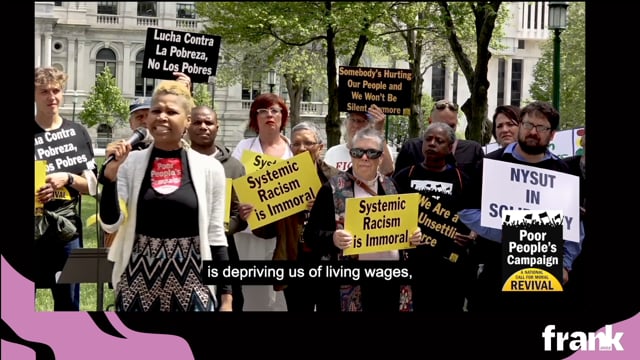 Moral Uprising with the Poor People’s Campaign
 The Unintended Consequences of Emotional Appeal