
Fresh From the frank Stage
Standout talks from the most recent 2023 gathering, featuring bold voices, urgent truths and unforgettable moments.

Amahra Spence
Liberation Rehearsal Notes from a Time Traveler

Shanelle Matthews
Narrative Power Today for an Abolitionist Future
Nima Shirazi
Irresistible Forces, Immovable Objects
The Speaker
Watch Next
-
 Seven Minutes In Heaven… With A Scientist
 -
 Moral Uprising with the Poor People’s Campaign
 -
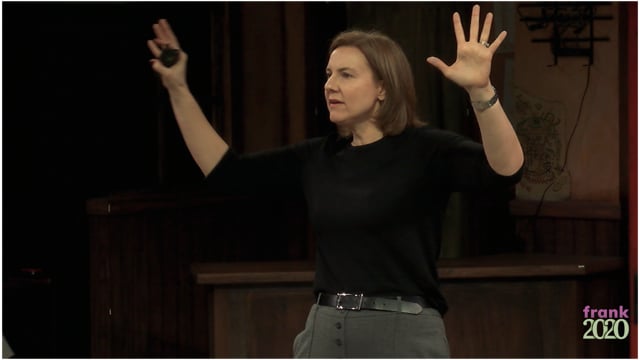 The Unintended Consequences of Emotional Appeal
Combatting Stigma By Giving Voice
Behavioral ScienceCommunicationsEmotional IntelligencePublic ServiceStorytelling
Transcript
How is everyone today? Great. All right. So as Liz said, my name is Jackie Salg. I was a Cruella fellow this past summer and not surprisingly, I found myself returning to the concept of storytelling. So today I want to start out with a story. I’m going to introduce two characters. They’re both 21 years old, both my age. And let’s see. There you go. The first young woman belongs to a low-income family. Her father is frequently in and out of jail, which is problematic because that leaves her mom as the single mom, the head of household, and she makes less than $30,000 a year. And she also has two younger siblings. So her family relies and has relied on her local support services, such as clothing banks, food banks, soup kitchens. And her mother has also recently applied to public housing. She’s a first-generation minority student who started her college career at Community College, where she received full financial aid. So take a second, and in your head, think about how this character looks like. How would you describe her, her life, her future, her opportunities? Okay, you have that image in your head? Yes? So the second character is also a young lady who currently attends a private liberal arts college. She lives in an off-campus apartment. She’s able to afford her expenses. She’s having a good time. She grew up volunteering at her own local food bank and soup kitchen. She’s even able to apply for unpaid internships, and soon enough she’ll be applying for graduate school. So again, think in your head how this young lady looks like. What does her future look like? How might she compare to the first character? How might their future be different? How might their opportunities be different? So you have that in your head? All right. So I have one word to describe these two characters. Me. Although it’s easy to assume that both of these characters might have belonged to two different types of communities, might have grown up with different types of privileges, the fact is that I simultaneously belong to these two different communities of people at the same time. I grew up belonging to a population of low-income families, and thanks to our supports and opportunities such as attending Franklin Marshall College, a meet-and-need institution, and also being Corral Fellow, part of a program targeted at minority students, I’ve become part of a more privileged population, one that looks very different from the one that I grew up in. Even though my family circumstances remain the same, my personal privilege has developed. So why does this matter? While I found that my dual membership provides me with both an insider and outsider perspective, an insider perspective on low-income families and an outsider perspective, and also a perspective on the field of communications. And through this, I identified two issues that I wanted to address. The first is lack of voice. Before I got back, I often felt like I didn’t have voice. I felt as though no one wanted to hear my voice or my story, that it didn’t matter, and the best thing that I could do was try to blend in. The second building off of that is the stigma and level of embarrassment that I often felt using my local support services. I felt embarrassed that I went to my local soup kitchen. I felt embarrassed that my family used food stamps at the grocery store, and I especially felt embarrassed as a little kid, getting my reduced-price bright pink lunch ticket at school. And when society talks about us, it doesn’t help. They use really demeaning language, really hurtful, disrespectful language that makes us feel further ashamed of our circumstances, and it’s easy to lose confidence in yourself and believe that your story matters. So this past summer, when the Corel Fellowship matched me with Martha’s Table, I was really excited. They have three initiatives, healthy start, healthy connections, and healthy eating. So I felt like I could really connect to what they wanted to do, and also I could connect to the people that they were trying to help. Halfway through the summer, my mentor has invited me to attend a Witnesses to Hunger meeting. Witnesses to Hunger, as described by Martha’s Table, is a national advocacy project featuring the voices and photography of parents who have experienced poverty and hunger firsthand. Its goal is to ignite a dialogue about the issues facing parents working to make ends meet in the nation’s capital and beyond. During the meeting, I sat there and I learned about how these women’s photographs help them to tell their own day in the life stories. They’re photographs to pick the scenes that they see regularly in their day to day lives. Kim Williams took a photograph on the street that she grew up on, the street that she was raised on, now overtaken by condos that she can’t afford to rent. She also took a picture of her young boy when he hurt his head and had to get stitches. She expressed to me the anxiety she felt about getting a hefty ambulance bill and having to decide whether to pay the ambulance bill or whether to put food on the table. So you can imagine how emotional I was in that meeting, right? There I am feeling so connected to Kim and these other women who are telling their stories of themselves and their children, but I also felt really connected to my mentors who could use their skills and communications and beyond to help the Witnesses and their mission. And not only are they given an opportunity to be storytellers, my mentors help train these women to tell their stories and talk about them in an effective, articulate, compelling and persuasive way. So this training allows these women to build confidence in themselves, in their stories, in the power they have in communicating the stories, training that could produce moving stories that possess the potential to influence policy-related debate. And so it was then, sitting in that meeting and connecting to these two groups of people, that I finally saw a way that I could address the two issues that I pointed out before. I saw how communications can work to combat stigma by giving people a voice and also helping them learn how to use their voice and stories effectively. I saw how communications can frame or change the way a conversation is conducted, as well as inspire people to share their own stories. It certainly built my confidence and my story, and I’m very grateful to share it with you all today. And more importantly, I want to ask everyone here today to consider hiring individuals who belong to the communities that you are trying to help. The people who know the most about stigma are those individuals who have lived it or continue to live it in their day-to-day lives. Be sure to have these people alongside you. Be curious about their perspective. Be sure to have these people alongside you in your meetings. Be sure to have them alongside you while you brainstorm in your strategy sessions. Make sure these individuals have a seat at the table. People like me, that is people who still belong to communities in need, have valuable insight to provide you communicators with. But we also have the ability to become powerful communicators ourselves. And so as I continue to explore the possibilities within public interest communications, I am so eager to see just what role I will play. Perhaps as an ambassador for these two groups, and I hope to do so in a strong, powerful, loud, and proud way. And don’t forget, your constituents may be thinking the same thing. Thank you.
Watch Next
-
Seven Minutes In Heaven… With A Scientist
-
Moral Uprising with the Poor People’s Campaign
-
The Unintended Consequences of Emotional Appeal