

Fresh From the frank Stage
Standout talks from the most recent 2023 gathering, featuring bold voices, urgent truths and unforgettable moments.

Amahra Spence
Liberation Rehearsal Notes from a Time Traveler

Shanelle Matthews
Narrative Power Today for an Abolitionist Future

Nima Shirazi
Irresistible Forces, Immovable Objects
The Speaker
Erica Rosenthal Scholar
Erica Rosenthal is the Director of Research at the Norman Lear Center, a research and policy center based at USC’s Annenberg School for Communication and Journalism. Her passion is for using media narratives as a vehicle to challenge stereotypes, move people to action and generate lasting culture change.

Watch Next
-
 Seven Minutes In Heaven… With A Scientist
 -
 Moral Uprising with the Poor People’s Campaign
 -
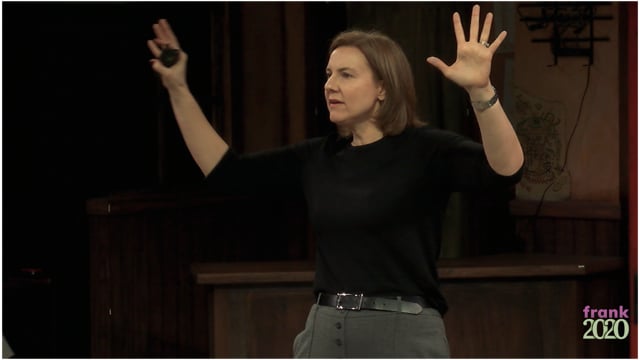 The Unintended Consequences of Emotional Appeal
Emotional Intelligence: How can we Harness Emotion to Promote Social Change through Storytelling
AdvertisingBehavioral ScienceCommunicationsEmotional IntelligenceProblem SolvingPublic InterestStorytelling
Transcript
We’re constantly fomarded with messages from various sources, all competing for our limited attention. Our brain can’t possibly process all these messages, so we rely on various mental shortcuts, among which is emotion. Stories are so persuasive precisely because of their ability to invoke strong emotion and write through the clutter. Advertisers have long understood these mechanisms and part of stuff to self-proposal. In my graduate research, I looked at the effect of emotional ads on our ability to critically examine these messages, what we sometimes refer to as media literacy. I found that emotional ads were persuasive by their ability to invoke trust in the messenger. In so doing, they’re able to bypass rational processing entirely and persuade us even without our conscious awareness. Communicators, artists, activists, and others in social change must take a page from the advertising label and harness the emotional power of storytelling. Before I get to the good stuff, why entertainment? At Frank, we say, don’t settle for small change. And entertainment is nothing but not big. It’s essentially storytelling on steroids, both massive emotional power and massive reach. The sheer urgency of the problems we face from climate change to the rise of authoritarianism around the world to systemic injustice, demand immediate and macro level solutions. At the Norman Lear Center, we both study and shape the impact of media and entertainment on society. We do this at four levels, understanding the narrative context, inspiring media narratives, studying the science of narratives, and measuring their impact on audiences. So first, we need to understand the narrative context, which we do in a couple of ways. For example, our 2019 study, Are You What You Watch? Examine the relationships between audiences’ ideological values and the entertainment they consume. We also do content analysis to understand the nature of existing media messages and how they’re framed. Our Hollywood Health and Society program, as Liz mentioned, has been inspiring media narratives through partnerships with the creative community for nearly 20 years. We’ve focused primarily on health issues. We’ve expanded in recent years to address a variety of policy relevant issues, including climate change, nuclear weapons, and criminal justice. To truly understand the impact of narratives, we first need to understand the science, the factors, and the mechanisms that enhance or impede their influence. And finally, we measure the impact of media narratives on audiences’ knowledge, attitudes, and behavior. So now I’ll share some examples from our research that shed light on the interplay between different emotions. In 2015, we did a study of a Royal Pains storyline on USA involving a transgender teen character. And this was particularly interesting in that we found that hope can override the intense emotion of disgust. Other viewers, unsurprisingly, were more likely to experience disgust than other viewers. Disgust was associated with less supportive attitudes toward transgender people, but didn’t actually have any impact on attitudes toward relevant policy issues. Hope, on the other hand, was associated with both more positive attitudes toward transgender people and related policy issues. Another thing in this study that was kind of interesting was the timing. It aired right around the same time as the Caitlyn Jenner transition was in the news. So we looked at the impact of this storyline in relation to the news stories about Caitlyn Jenner, and we actually found no effect of news exposure to Caitlyn Jenner or otherwise on attitudes toward transgender people or policies. But this 11-minute storyline had such an impact. Now I’m going to preview some new research that we’ve been working on with Define American. We studied the impact of three immigration storylines on Madam Secretary, Orange is the New Black, and Superstore. We found that negative emotions such as sadness, anger, disgust, and empathy were associated with more inclusive attitudes toward immigrants, as well as low-level actions such as seeking more information or posting on social media. Happiness, on the other hand, predicted high-level action taking, such as joining a volunteer group or even contacting an elected official. We were further interested in understanding the role of empathy in response to these storylines and particularly the limitations of empathy. So we looked at it in relation to two types of motives for entertainment consumption. Hedonic motives refer to the drive for pleasure or enjoyment, whereas eudaimonic motives refer to a search for meaning. So what we found was that the effect of empathy on attitudes depended on the extent to which viewers had hedonic or pleasure-driven motives for their entertainment consumption. In other words, for those who were low in hedonic motives, not primarily driven by pleasure, those who experienced empathy had much more positive attitudes toward immigration than those who experienced no empathy. And when we look at the high hedonic group, those who were primarily pleasure-driven, that effect of empathy disappeared entirely. Who here was a fan of Game of Thrones when it was on? You feel like it kind of tanked in the later seasons? So Zaneb Tufeki published a piece in Scientific American last year arguing that Game of Thrones went downhill in the later seasons because its storytelling style shifted from sociological to psychological. She writes that how we tell our stories has great consequences for how we deal with the problems in our world. Traditionally, emotional stories are told from a psychological approach, focusing on individuals. Sociological storytelling embeds those individuals within the larger institutions, systems, and structures. It’s not about erasing the individual experience, but about understanding the factors that influence individual behavior. It encourages the audience to put ourselves in the place of any character, not just the good ones, and imagine the choices that we might make under similar circumstances. The wire was another show that did a great job of sociological storytelling. So this is really the essence of the challenge for storytellers and communicators who are interested in shifting the narrative around issues of injustice and inequity in the world. How do we make stories about systems and structures emotionally compelling? So what can communicators do? First, don’t do tragedy porn. As we saw on Inside Out, the most powerful moments are those that balance the positive and the negative. And positive emotions such as hope and happiness may be more likely to motivate behavior change than sadness and empathy. Second, tailor emotional appeals to your audience’s motivational needs. Empathy may work for some, but not for those whose entertainment choices are primarily driven by the need for pleasure. And finally, embed stories about individuals in a larger sociological context. Individual agency still matters, but these stories require a broader lens. I’d like to thank my colleagues at the Norman Lear Center as well as our funders and partners who make this work possible. For more research-informed storytelling strategies, we have a set of tip sheets which you can find on our website at mediaimpactproject.org. Thank you.
Watch Next
-
Seven Minutes In Heaven… With A Scientist
-
Moral Uprising with the Poor People’s Campaign
-
The Unintended Consequences of Emotional Appeal