
Fresh From the frank Stage
Standout talks from the most recent 2023 gathering, featuring bold voices, urgent truths and unforgettable moments.

Amahra Spence
Liberation Rehearsal Notes from a Time Traveler

Shanelle Matthews
Narrative Power Today for an Abolitionist Future
Nima Shirazi
Irresistible Forces, Immovable Objects
The Speaker
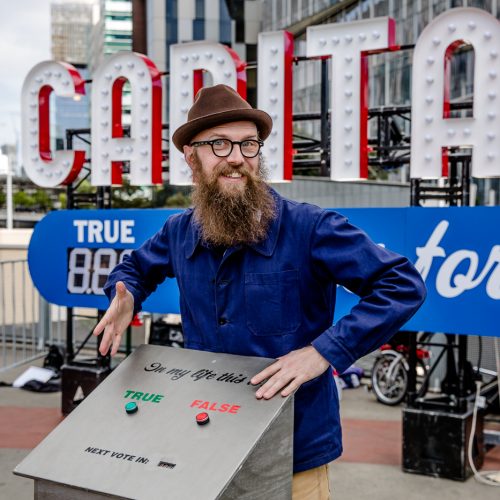
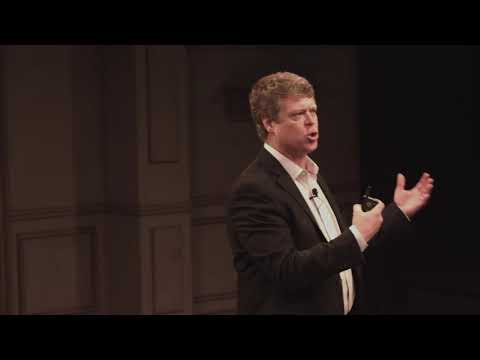
Steve Lambert Co-Founder, Center for Artistic Activism
Since co-founding the Center for Artistic Activism, Steve Lambert has worked alongside artists and activists in 20 countries on 4 continents helping them to effect power through creativity and culture. Over the past ten years they have focused on helping artists and activists.
Watch Next
-
 The Ethics of Button Pushing: Using biometric and AI for Media Effects Research
 -
 It All Adds Up
 -
 The Play’s The Thing
From Anger to Utopia
ArtBehavioral ScienceCommunicationsCreativityProblem SolvingPublic ServiceSociology
Transcript
So on July 18th, 2016, I was in this auditorium of about 15,000 plus people. My collaborators, I were a small group at this really huge event, and we were trying to change the conversation, and it was not working. I’m sure you can relate. I’m sure you have felt locked out of discussions and policy change, forced to watch from the sidelines, loud, angry, still unheard. My name is Steve Lambert. I am the founder of the Center for Artistic Activism, and we help people use their creativity and culture to affect power. This is the advocacy team at SWET. SWET is the sex worker education and advocacy task force. They’re based in South Africa, and they work on the decriminalization of sex work. Now, decriminalization is an evidence-based approach to increase safety and decrease the transmission of HIV. The problem is because of stigma and judgment, a lot of people don’t want to hear that evidence. So we worked with SWET for years, and they called and they said, can you help us with the 2016 AIDS conference? And if you don’t know, the International AIDS Conference is the largest health-related conference in the world. There are medical professionals there. There are advocates and activists there. And there are governments and doctors, right? Governments and health ministers, I should say. This is the room where it happens when it comes to AIDS policy. So I asked SWET when we got together, what do you guys want? The number one thing that they said, first thing they said, most important was that if people on the stage, the topic touched on sex work, they wanted them to mention sex work. Just say sex work or sex worker. This seems like a pretty minor victory, right? Just to have the word sex worker said out loud. In 2012, the AIDS conference happened in Washington, D.C. Sex workers were not allowed to attend. They couldn’t get visas because they were considered criminals. In 2014, it was in Australia. They were allowed to come, but they felt excluded. They felt like their proposals were rejected. They felt very unsupported. In 2016, it’s in South Africa. It’s in SWET’s backyard, right? Where sex workers are being attacked and murdered every year. And so they said, at this event, you’re not going to shut us out. When there is a topic that hits on sex work, we want you to mention sex work. We want to have a presence. We’ve waited for this for years. So the question is, how do we make that happen? How at this huge event where the people speaking are like way, way, way over there, how do we get the people on stage to mention our issue? Now, when you are trying to work creatively, this first stage, this is where the anger comes out. When you’ve been marginalized, the impulse can be to come back really strong. To get, just put it in their faces. When you or your friends have been abused by the police in your country, you want to fight back. You want representation and you want justice. When your friends have been murdered, you grieve. And the first stage of grief is denial, and the next one is anger. So it’s a very natural response to feel anger. So their first idea was, we’re going to charge the stage, we’re going to hold up banners, and we’re going to be as loud as possible. Now the thing about working creatively is like, you need more than one idea. So now we could have done this, right? And in fact, this is a picture from 2012 in DC. Charge the stage, banners. This is from 2010 in Austria. Charge the stage, banners. And I could go back decades at the AIDS conference and show you pictures of people charging the stage, putting up banners, and making noise. But if we were to have done this, what would be the result? So doing this first idea, we risk turning audiences against us. When we interrupt the people on the stage, we would become a disruption. We would become an interruption that can be seen as rude. The other thing is when you’re presenting anger and you’re being angry, people don’t see you. They don’t hear who you really are. The other thing is that it’s completely expected. It’s like part of the tradition of the AIDS conference, and in that way it would be totally unmemorable. So how do we get people on the stage to mention our issue? Now we’d worked with SWEHT before. We knew they know how to take the cultural terrain of the AIDS conference and develop a creative solution. Can we do this in a way that wins over the audience? Can we do this in a way that incentivizes and rewards the speakers? Can we flip this, right? So together we came up with this, which was a count up clock for speakers. And it says, you’ve been talking for this long without a mention of sex work. Whenever they would start, we would start the clock. And those are my legs. So we just silently walked around with this sign. And if someone mentioned sex work, we were prepared and we would flip the sign over and thank them. So walking around, making our way around the audience, and no one mentioned sex work. The first speaker doesn’t mention sex work. The second speaker doesn’t mention sex work. We’re 40 minutes into the program and no one has mentioned sex work. And I’m like, maybe this is not gonna work. We must ask- Then this happened. Who is vulnerable? Throughout the world, sex workers and their clients. So she is mid-sentence. This is aired on South African national television. And I’ve timed it. There’s a 30 second applause break. It’s still going. And after this, I’m gonna go back to the program. I’m gonna go back to the program. I’m gonna go back to the program. I’m gonna go back to the program. I’m gonna go back to the program. After this, nearly every speaker mentioned sex work. I found out later that they were backstage rewriting their speeches. And every time they mentioned sex work, there was just this explosion. You’d have to stop your speech because the whole place would go crazy. Our action became the iconic image of that event. I can guarantee you the audience had more fun. And the speakers felt rewarded and included. So this was one thing that we did at the AIDS Converts. We did about 12 different projects. And SWEAT went on and continued this work. We did about 14 creative tools and methods that came out of the workshops and the work that we did together. This is one example. They came up with new audience engagement strategies. They welcomed people in. They also tried really wild ideas like a satirical campaign where they ran one of the sex workers for president. This is one of their campaign videos. They created their own political party. And this creative approach, combined with traditional advocacy efforts that they had been doing for years, has made significant progress. The ANC changed their policy on sex work. C.O.R.R. Moposa, their current president, made a promise to decriminalize sex work. This is a complete 180. So that sustained effort is helping them achieve the larger objective, which is decriminalizing sex work in South Africa. The Center for Artistic Activism helps people use their creativity and culture to affect sex power. We have worked, as I said in the intro, 20 different countries, four continents, 1500, maybe 2000 people, I’m not sure. Every single one of them is angry. I’m angry about a lot of the stuff that we’ve worked on. That doesn’t really go away. But one of the things that gives me hope and makes this work sustainable for me is seeing how those participants have put these ideas into practice and changed their neighborhoods and their cities and their countries through creative methods of reaching these outcomes. And making progress that they wouldn’t make otherwise. This is why we started the Center for Artistic Activism, because we know that artistic methods are what make activism effective. We are doing a breakout at the recess tomorrow. I would love to talk to any of you about this some more. Thank you for your time.
Watch Next
-
The Ethics of Button Pushing: Using biometric and AI for Media Effects Research
-
It All Adds Up
-
The Play’s The Thing