
Fresh From the frank Stage
Standout talks from the most recent 2023 gathering, featuring bold voices, urgent truths and unforgettable moments.

Amahra Spence
Liberation Rehearsal Notes from a Time Traveler

Shanelle Matthews
Narrative Power Today for an Abolitionist Future
Nima Shirazi
Irresistible Forces, Immovable Objects
The Speaker
Maytha Alhassen Co-Executive Producer and Writer at Ramy
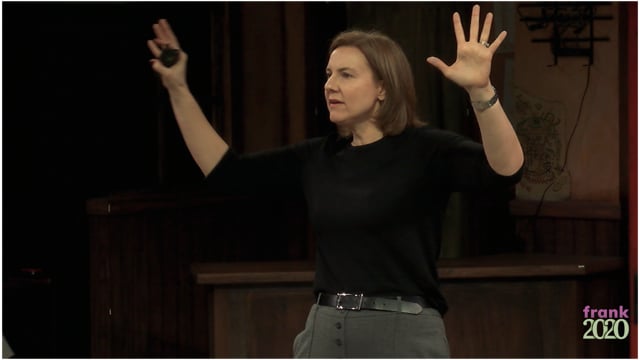
Maytha Alhassen, Ph.D., is a historian, writer and producer exploring justice through storytelling. Co-Executive Producer of Hulu’s Ramy and founder of the Center for Story Justice, she lectures at Stanford, fighting for cultural accessibility and studies representation across media and identity.
Go To BioWatch Next
-
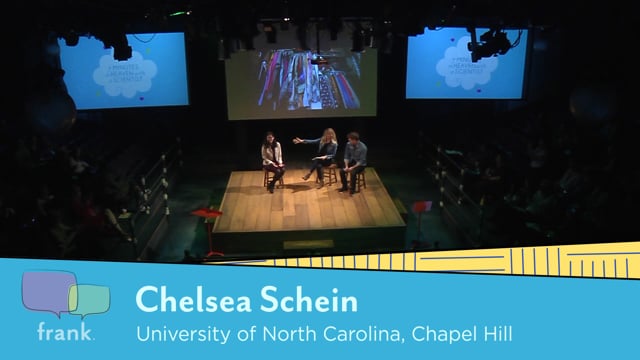 Seven Minutes In Heaven… With A Scientist
 -
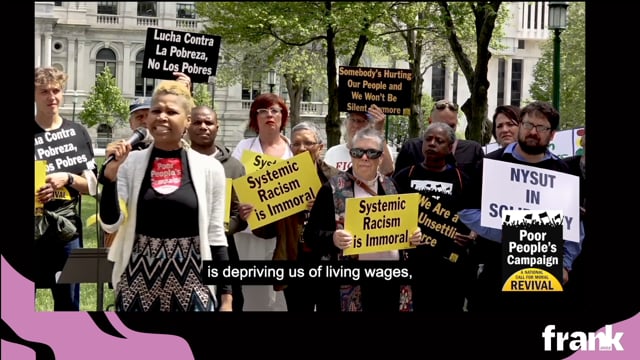 Moral Uprising with the Poor People’s Campaign
 -
 The Unintended Consequences of Emotional Appeal
From Real to Represented
Behavioral ScienceCommunicationsFilmGlobal StoriesStorytelling
Transcript
Thank you. Oh, fancy. Thank you. Good morning, Frank. As-salamu alaykum. Good job. Good job. We are making Trump angry every day. This is so exciting. Today, I’m going to invite you to sing along if you know the next song, if it comes on. Do I come from a land far away? Where the caravan camels roam. Where they cut off your ear. They don’t like your face. These are back. But they are home. Yeah, it’s bar back. But hey, it’s home. The film Aladdin came out November 25, 1992. And it’s riddled with problematic elements, including, I guess there’s a little bit of a delay here, including the fact that for an Arab Muslim girl growing up in Southern California, that’s me over there, Jasmine was the only available image I had of somebody that looked like me. And I also grew up in an environment where I was bullied daily. I was put in ESL classes because I spoke English and Arabic. And had I not been professionally trained as an expert in self-hate, there would probably be a little bit more available to me. And had my father not taken me to political rallies, fundraisers, city council meetings, protest, and at the age of eight introduced me as his future congresswoman, I’m not one, by the way. So I don’t know if actually I didn’t end up living up to his dream. But I had other moments of interventions that happened a week before Disney’s Aladdin came out was the film Malcolm X. November 18, 1992, Spike Lee produced based on a James Baldwin screenplay. And this was not only transformative for me to see somebody like Malcolm X, somebody like Betty Shabat, who was strong, poised, powerful woman, a Muslim woman, on screen, but for all Muslims, black, non-black Muslims, and actually a lot of people converted to Islam based on this film. Now, all these examples are before 9-11. So try and think up things. OK, so there’s a huge history of Muslim tropes that exist, not for the couple of decades before 9-11 and afterwards, but there’s a century of them. And I studied them for pop culture collaborative. And I developed this triangulation. Hollywood, political drivers and public opinion are always in conversation with each other. Sometimes public opinion pushes Hollywood, and sometimes political drivers do, and they have an effect on public opinion. And that’s how we see some of the policies that we have today that are kind of hateful towards Muslims. But this intervention is also something we need to look at and we don’t talk about a lot. We talk about Islamophobia being anti-Muslim. But another scholar came up with a theory. His name is Edward Said. It’s called Orientalism. And it’s the theory that the Orient, which is not East Asia, which is Middle East and Northern Africa, was something that Europe used to compare itself to. So it was the superior West that was superior to the inferior East. And the East was defined, or the Orient was defined as oversexed and indulgingly sensual, queer, psychologically weak, and thus inferior. It also operated on an axis of contempt and fascination. So I came up with this idea called the mystical moor. And you’ll see it come up throughout the history of representation of Muslims. But it very much resembles the noble savage within the American cowboy Indian framework. Talking about us, where is this? Anybody? This is the Coachella Valley. And it’s all white people. Now, before it was famous for a music festival, it was famous for a date festival. Literally, from the 1920s on, and before it was Bechella, it was the date festival. Now, remember that marching band photo? There is a Coachella Valley High School that has the Arab as its mascot. Yep. And if you thought that was offensive, check this out. There is a place called 29 Palms, and that’s in the same area. And they have a simulation of an Iraqi village called Wadi-e-Assahar, where they train for sending troops over to Iraq for war. And really, it’s one of the places where Arab actors can get cast, because the films that are based on us in the early 20th century were all white people. And these are some examples. And where did that leave Arab women? In this time period, we were sirens, or we were silent. We were abundant black as media scholar Jack Shaheen called it, or we were just the waist down a belly dancer. Now, for the men, the Arab and the Iranians were entomarch. They were inferior. They were the stars of some of these feature films, true lies, predictable one-note characters who were terrorists and hijackers. And they represented the wars that the US was involved in in the Middle East. And more insidious is that kids were portrayed as also violent and threatening the largest military in the world. Now, there’s another trope. It’s called the Shake. And that represented, in 1973, the OPEC embargo and the fact that the US was mad that they couldn’t get the oil that they rightfully deserved. And so these guys had to be bumbling fools who didn’t deserve the wealth, but also wanted their women. Now, what’s dangerous about this idea is that it imported another European trope. So this is the prison guard from Aladdin. This is the shake from Kenan Baltu. These are Nazi propaganda images from 1937 at the bottom. And this is a film from 1940 based on the trope called The Eternal Jew, The Wandering Jew. Very similar sentiments here. Now, there was another intervention. Like I said, Malcolm X and black filmmakers created a seismic shift in the way that Muslims were portrayed. And even non-Muslim black filmmakers do that. And Muslims in their films were the moral and political compass. Julie Dash’s gorgeous film Daughters of the Dust opens up with a call to prayer. Now, America still saw Muslims as anti-American. And so here’s a still from a Mike Wallace special called The Hate That Hate Produced About Black Muslims. And as we know, Muhammad Ali, citing religious reasons, refutes to go to war in Vietnam, and he was silenced. Now, up to 9-11, we recycle a lot of these images of the bad Muslim. But there was an innovation. It’s called the good Muslim. And the good Muslim was the one who was kind of an assimilationist figure. They were tasked to be a martyr for American militarism. And the other thing that they were supposed to do is capture and nab the bad Muslim to prove how good they were. So the good and bad Muslim was a framework that came out of George W. Bush’s speech. A couple days after 9-11, so he said, you know, Islam’s a religion of peace. And then he said, they hate us for our freedom. And this showed up in Homeland 24. A lot of shows where they thought that they were doing a twist and cast a Muslim as a CIA agent or an FBI agent. And they were supposed to capture the bad Muslim who was a traitor. Now, interesting enough is that 9-11 was disrupted by 11-9. In 2016 was the day after the election. And something really amazing happened, which was filmmakers in Hollywood and show runners realized that they contributed to the election, to the Muslim ban, to the hateful rhetoric about Muslims by producing shows like 24, Homeland, American Sniper. Howard Gordon, asked directly by The New York Times reporter, do you think your show helped influence the election? And his show is Homeland. He said, absolutely yes. So this time period, we called the reckoning. But it also created opportunities for Muslims. And you know, Hassan Minhaz’s special was mentioned. That came after 2016. My friend, Rami Youssef, he has a series with Hulu coming up. And there are even more. Nizhla Mutman directed and produced a film about growing up as a black Muslim teenager. That won a prize at South by Southwest. There are Muslim characters on some of our most beloved shows, like Orange is the New Black, Grease Anatomy. And Muslims, this is more exciting. To me, Muslims are creating their own web series. And the pop culture collaborated, helped support one called East of Lebréa. And that was picked up by Paul Feg. And now they’re premiering at South by Southwest. So this is what happens when we support Muslim creatives and filmmakers to be a part of their own storytelling. However, as exciting as that is, we still have the Muslim ban. We are still involved in wars and sanctions in the Middle East, Africa, and other Muslim lands. We are still aggressively surveilling and enacting state violence against black Muslims in the US. All these things, and we have these beautiful stories. However, storytelling isn’t enough. We have to change the narrative system that these stories live in. A narrative system where these beautiful stories that is anti-black, orientalist, homophobic, transphobic, patriarchal, and xenophobic and classist, that doesn’t change policy. So we have to change the narrative system. And I’m going to leave you, OK, we can go back, because I’m not going to go into the recommendations right now, because I am an academic and I did an hour and a half talk in 10 minutes. And I want to direct your attention to the report that this whole presentation is based in. And we have recommendations as well. So www.huckhaqq, which means truth, and hollywood.com. Go there. Be involved in the shifting narrative of Muslims that is going to take more than just supporting filmmakers, but supporting a structural, systematic, institutional change. Thank you. Thank you. Thank you.
Watch Next
-
Seven Minutes In Heaven… With A Scientist
-
Moral Uprising with the Poor People’s Campaign
-
The Unintended Consequences of Emotional Appeal