Oh man, all I know is that my earliest musical memory is being a kid listening to the radio. I mean, I remember sitting with my tape recorder just waiting for the DJ to play Hall and Oats. And I also remember having a very strong emotional connection to music as a kid. I mean, I can remember crying when I heard Mandy by Barry Mandler. And also feeling genuine joy when I heard I’m Alive by ELO. Now, I’m giving away my age by telling you this. All I know is that my entire life, whether it’s been Depeche Mode or Otis Reading, music has always connected with me on a very deep level. And I have been studying it as a result pretty much my entire life. So I did my undergrad work in music education where I intensely studied music theory. And music theory is just that. It’s the theory of how music works. And we’ve learned that if we follow the rules of this theory, we have a better chance at communicating something in emotion more effectively. Now, I will never forget hearing my music theory professor say that music is all about tension and release. And that if we learned to sequence certain notes and melodies and chords, we could literally move someone. So ever since then, I’ve had this obsessive fascination with pulling apart and analyzing songs that I love because I want to know why I love them. Now, I’ve also been an electronic music artist pretty much my entire life. Ever since I was 10, I got my little Casio keyboard. And then I played in 80s synth bands. I’m a remixer. And so very much later in life, I decided to go to grad school to study music production because I wanted to teach it at the university level. And there I heard another very impactful phrase that as a music producer, I’m actually in the emotion business. And that it’s my job to now take technology and choices like which microphone I’m going to use or which vocal effect I’m going to use or which instrument could also reinforce an emotion. So science has certainly shown that music very much stimulates the emotional core networks in our brain seen here in red. And this particular study goes on to talk about musical expectancy and tension. And they found that the parts of our brain that process and trigger that cycle of tension and then release, those parts of our brain are stimulated by certain chords in certain contexts. Now, when I found out that I was going to be coming to speak here at Frank, I knew that I was going to be speaking on music and emotion, but I was trying to find some way to francify my talk, for lack of a better phrase. And I never been to Frank, so I checked out the website. And it said that this was a gathering for people who changed the world. So I knew exactly what I wanted to do. I decided to analyze, I analyzed over 80 songs that had either been written for or used for some sort of movement of change. Now, not just limited to social change, political, environmental, anthems, rally cries. I just wanted to know why. Why did those songs move us? And I realized you cannot read this, but at the end of my talk, I’m going to have the link to my website where you can access this playlist. So I analyzed these songs, and I’m just going to share with you some common threads that I found in my research. So the first thing that I found, we’re going to call these emotion reinforcers. The first thing that I found was the use of atypical chords. So the research that I referenced earlier says that our brains are actually always trying to predict the next chords, these combinations of notes that we’re going to hear, even if we’ve already heard the song. So when it hears a chord that it doesn’t expect in a certain key of a song where it doesn’t belong, it is surprised and very much stimulated. And I found that in these songs for change, the two most common atypical chords used were the three and seven chords, which I realized may mean nothing to you, but understand that those chords actually do reinforce a sense of unexpected strength when we hear them in this context. Now the next thing that I found was use of very strong plagal cadences. So here’s another quick crash course music theory lesson. A cadence is simply think of it as a punctuation at the end of a musical phrase. And a plagal cadence is specifically moving from a four chord to a one chord. We label chords in music theory by number. Now a four chord is certainly not rare in pop music, but in this context it’s interesting. Because moving from a four to one chord is informally called the amen cadence, because throughout history at the end of hymns, that’s the same two chords that you hear when you sing amen. So for those of us who relate to that culture, it can bring out a feeling of peace and of calm and of resolution when we hear it. Now the next thing that I found was use of brass instruments. And I know that as a producer when I put brass in my song, it is going to be the loudest thing in the song. It’s going to cut right through the mix. I also know that I can use it to symbolize confidence and power and strength. Now I also found the use of string instruments. I know that when I use strings, it can evoke warmth and compassion. And what’s interesting about the use of things like strings and brass is that somewhere in our brains, we tend to associate these types of instruments with what we kind of loosely refer to as classical music. So that when we hear these things kind of cross pollinated in other genres, we tend to feel form and order and resolution and reassurance when we hear these things. Now the next thing that I found that I think is the most encouraging is I found the use of gang vocals in these songs. And in the industry, this just means multiple voices. I mean what an amazing audible symbol that we are not alone. All of these voices coming together in unity and community, singing together. Now I’ll show you the numbers here. And really the most important one that I want to focus on is that 56% of these songs actually used five or more chords. Now here’s why I think that’s interesting. This past year I did another study. I counted the number of chords used in current pop music because I’ve had a sneaking suspicion through passive learning and listening that we are using less and less and less chords in our pop music. And it looks like it’s true. The past ten years we’ve seen a tremendous dive where on average maybe we’re using three or four chords. During the past decades it’s been more complex. Now the reason why I think this is interesting is that the less chords, the more static and predictable our songs are, the less chance we have to feel a resolution to tension because there’s simply not a lot of tension to resolve. So 56% of these songs for change had at least some compositional intent to move us. And I will tell you some of these songs have been in the last decade and they did buck those compositional trends. So what’s to be learned from this? What do we have to learn from these songs that bleed strength, hope, authenticity, resolution? I’m certainly not going to stand up here and tell you that I think the solution is some sort of formula or recipe. I simply think part of my job when I research things is to highlight, observe, connect dots and just start a conversation. I’m also not suggesting that pop music needs to straighten up and save the world. I mean pop music represents several different emotions and all are valid. I mean the emotion of a song of dancing the nine of ways absolutely just as valid as the emotion of heartbreak or grief. All I know is that while I can appreciate the depth and the complexity of Bohemian Rhapsody, I also know that I’ve had a very stressful week and I have listened to a lot of Beastie Boys. It has helped. I’m just simply trying to suggest that as musicians, producers, songwriters, that we not forget the value of the vehicle we are driving. See it’s really fun to pull donuts in the parking lot, but we can take that same vehicle and we can drive it down the coast at sunset. See it’s not too late. Musicians, we do have superpowers. It’s not too late to use those powers for good. It’s not too late to view our music as medicine and not just money. Because you see the most common, important common thread that all these songs have is that just for a few moments, they helped us feel the hope of the change that we long for. And if that feeling of internal resolution is strong enough, it might just move us and motivate us to an external revolution. So my favorite band of all time is U2. And I’m usually the Uber fan that’s right down front on the floor every tour. And this past year tragedy struck and I ended up in the very top row. I have a good excuse, U2 fans, I have a good excuse. So usually, I mean no one stands on the top row, usually no one. But towards the end of the show, they did the song One. And that song has been used in many campaigns over the years. And all I know is that I have to stay under in that song. And I just remember doing this. And I just remember singing. And I remember feeling the vocal chords in my throat. I mean I remember feeling them stretch. And I remember feeling the tears run down my face. And all I know is I felt better afterwards. All I know is I felt hopeful afterwards. I felt unified with the people around me that were singing at the same time. And I don’t know about you, but in this dark world, I need that. We all need that. And if all we have is just that moment in a few minutes, if all we have is that hope of the change that we long for, if all we have is that in a song, then I say when we hear it, we should stand up and we should sing together. Thank you so very much.





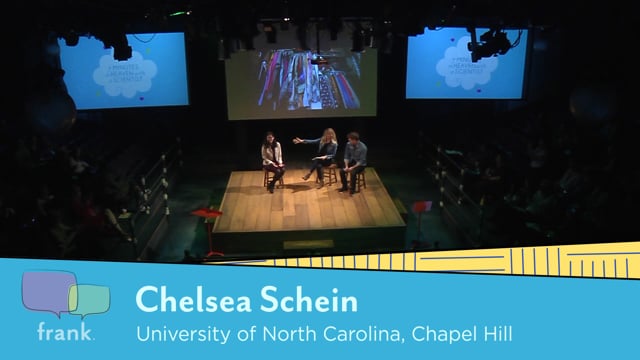 Seven Minutes In Heaven… With A Scientist
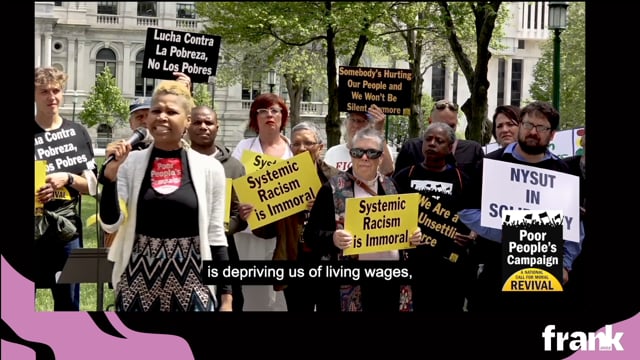 Moral Uprising with the Poor People’s Campaign
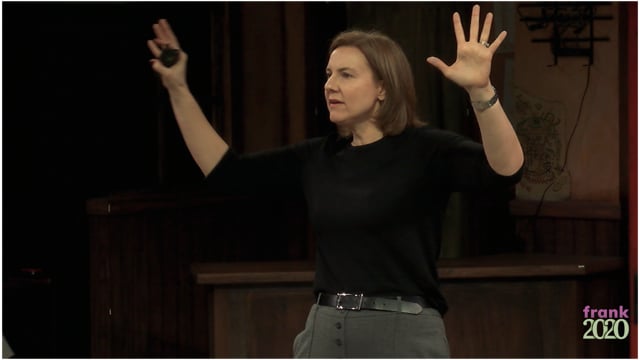 The Unintended Consequences of Emotional Appeal