
Fresh From the frank Stage
Standout talks from the most recent 2023 gathering, featuring bold voices, urgent truths and unforgettable moments.

Amahra Spence
Liberation Rehearsal Notes from a Time Traveler

Shanelle Matthews
Narrative Power Today for an Abolitionist Future
Nima Shirazi
Irresistible Forces, Immovable Objects
The Speaker
Watch Next
-
 Seven Minutes In Heaven… With A Scientist
 -
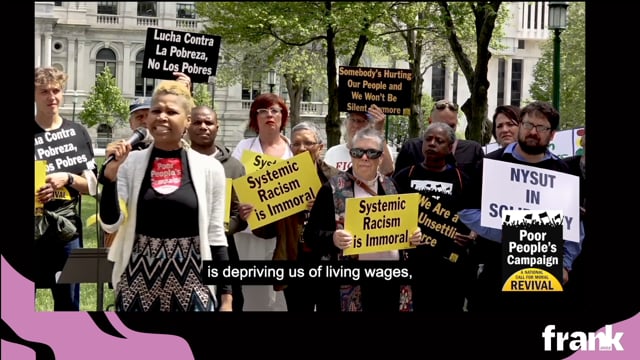 Moral Uprising with the Poor People’s Campaign
 -
 The Unintended Consequences of Emotional Appeal
The Speaker
Untitled
Getting Beyond the Choir
Behavioral ScienceCommunicationsFarmingFilmPublic ServiceStorytelling
Transcript
Thank you. I’m Christina. I’m Marge. And we’re very excited to be here and to spend the next couple of days being surrounded by folks who deal with the same challenges that we do every day, which is how can we take these worthy causes and the amazing people working on them and help them do a better job of reaching out to the public. It was that desire that got us into this business. As the magic filmmakers we wanted to know, how could we apply our talents to help highlight visionary solutions and get the public to act. So we came here with a burning question that has been perplexing us for the last couple of years. With all the smart communications work that’s being done out there, with the incredible stories that lie at the heart of all of these causes, why do so many public interest films still look like this? 40,000 children die every single day from hunger, hunger related diseases. That’s over a million children a month. 15 million children a year. The problem is out of control. So much so that you’ve probably learned to ignore it. There are three things I’d like you to know about MAP. Our mission to promote creativity, environmental awareness and community. SWAP is a broad based group that brings people of diverse backgrounds together to work on issues of common concern. The words in most mission statements can sound vague and easy to gloss over, but the words in our mission statement have all been carefully chosen and are meaningful. We have a vision of an America where we all strive together. The single most important thing about fly, I would say is hope. When kids in the juvenile justice system come to us, they’ve given up on their dreams, they’ve given up on their lives and our programs and our people instill hope. What happened? The people working on these causes are amazing. The work they’re doing is profound. The stories they have to tell are incredible. But this is the story that they’re still telling. Act one, depress and overwhelm your audience with great facts and realities that make them feel powerless and maybe even guilty. Act two, have an executive use lots of jargon to explain a mission statement, cram in a couple of talking points and maybe list some programs. And finally, act three, in which we tell you that the work that we do, none of which you’ve actually been able to experience, truly creates hope and changes lives. Now all of these organizations are being funded by major foundations that see them as leaders in their cause space. They’ve had smart communications work done and yet these are the films they’re making. And basically, if I didn’t care about any of these causes already and I saw these films, I would have clicked away within seconds because they just weren’t interesting to me. Why is there such a gap between strategic communications and the films in this space? How can we get beyond the choir of those core supporters, stop new audiences in their tracks and draw them towards these solutions and new ideas if this is what we’re still using is bait? Last week when we were wrapping for this talk, I stumbled across an interview with Michael Moore. Somebody had asked him how to make a documentary that folks would have thought the same. And here’s what he said. He said, don’t make a documentary, make a movie. Nobody enjoys being preached to. Nobody wants to be told that he must care about the plight of this and that. If you want folks to listen to the issues around nutrition, then make a movie and supersize me. Movies draw us in because they tell us really interesting stories that have levels of deeper meaning. They make us feel specific things, ask ourselves some hard questions, look at something from a different point of view. They take us on a journey that actually brings us someplace very different than where we started and they allow us to draw our own conclusions. Movies allow us to connect with these deeper universal human truths and find ourselves reflected in them. And there is no good reason why the films in this space can’t do the same. You see, your films not just there for that spot on your web page. It’s not just there for that time slot on your conference agenda. These kinds of pittifly low expectations don’t begin to scratch the surface of what a film can do to really grow your cause and shoot your message out way beyond the choir. So we have a simple plea. Please help us, help these amazing causes and people. Stop making public interest films and start making films that are interesting to the public. So how do we do it? How do we tip around? This is Krista. You met her earlier. For the last ten years, Krista spent most of her days hanging out on the blacktop of some of the roughest gang neighborhoods in San Jose. Honestly, she feels very at home there. She’s the executive director of an organization called Fresh Lifelines for Youth, Fly. And she’s devoted her career to transforming the way that the juvenile justice system deals with kids. She’s an Ashoka fellow, a James Irvine leadership award winner, and honestly one of the savviest people in the college space we have ever met. But when we started a project with her, she was totally frazzled. She had her ten year anniversary coming up. She felt like she needed a new film for the gala, and she was completely out of her depth. She sat down with us and handed us a giant pile of strategic work. And it was a complex theory of change, a brand strategy document that talked about things like choice and safety and respected stewardship. And then a huge pile of printed speeches that had been rehearsed and spoken for many years by both her and the youth she served. And then she turned to us and she said, okay, how much will it cost to get all of that into a film? And I understand that our film has to be under three minutes, so we can do all of this in a three minute film. Alright, Krista, we said, let’s back up. Let’s not talk about how long the film should be. Let’s talk about Fly. What’s the biggest problem in the organization right now, we asked? Which is getting in the way of your growth. So she kind of looked confused when we asked her that question, but she answered us and she said that California was coming under these budgetary constraints and we’re about to get a lot of funding cut and 70% of our funding comes from the government. But what does that have to do with making a film? And then of course she went right back to talking about all the dramatic details that we needed to highlight and asking us if we’d be able to coordinate with the web designer to make sure that the file worked on the website. And we said, okay, hang on a second, let’s go back to that funding thing. Why are you so dependent on government funding? Why don’t you have private funders? And Krista told us something heartbreaking. She said that people are willing to invest in at-risk youth, but the minute a kid commits a crime, people don’t want to invest in them anymore. They think these kids are too far gone to help and they consider them throwaways. Now we don’t want you to get us wrong. Her complex theory of change and her brand strategy document had done a lot for her. It had helped her win over judges, lawyers, even the most hard-nosed probation officers working in the field. But beyond that audience who was already deeply entrenched in juvenile justice, she obviously wasn’t able to reach the one audience that she actually needed because the funders were still overlooking these kids. So Marge and I looked at each other and we said, okay, that is a problem that a film can help Krista solve. And that became the beginning of the film strategy. Let’s address these funders head-on, accepting these biases that they have about these kids, and let’s design a story that takes them down a totally different path. So now we are not making a Gala mission video film for Krista. We are making a movie to change perceptions about the way people look at kids who have committed crimes. Here is the first two minutes of the ten-minute film that we made for Krista. When you see me, what did you think? Did you see me as the black seed or the gorgeous rose? Did you look at the surface or did you dive deep into the Pacific Ocean? I call my soul. My demeanor is strong and solid. My eyes are sharp like the edge of a sword. My fists are rocks and my smile will bring bliss. My heart and my heart will attract love that will be cherished and protected. You have a gift. Are you getting that? Are you starting to realize that? I think so. My name is Erica. I’m 22 years old. My mother passed away when I was about 11 years old. I was passed from my sister to my brother to my father. So it’s a very hard time. For about maybe six years, I think I was not myself. I don’t know who I was. I started making bad friends. Friends who were like me, lost. That’s what started a lot of my bad habits. I didn’t know anything about the real world. Everything that I should have been taught, I didn’t know anything about. I had to learn the hard way. The first time I was in juvenile high, I was 14. When she came to fly, she had the tattoo across her chest, agony and ecstasy. She was so hard and her demeanor was so angry. She didn’t know what it felt like to be physically safe in the presence of another human being. Okay. So what we did instead was we opened on a scene and we challenged the audience from the very beginning to take a second look at these kids that they think they know. We let the story unfold in its own time. We are hearing from unscripted authentic voices that are taking place in real scenes between kids and staff. We are showing, we are not telling. These are all the tools of documenting storytelling that can be powerfully used for causes to help you engage surprise and bring new audiences into thinking about your cause. Krista’s film worked because she was disciplined in accepting that it had to have one goal and only one goal to transform the way that people thought about these kids. It wasn’t there to help with volunteer retention. It wasn’t there to get into the complexities of the programs. It just had one really clear strategy and all the creative decisions about what belonged in the film had to flow from that strategy. So what perspective was the film going to take? What scenes did we need to see? Which kids’ stories were best suited to what we needed to reach out and tell this audience? Every single one of those decisions about story was based on the film’s strategy. It’s really remarkable how commitment to a disciplined strategy to tackle one key obstacle and one target audience in one film can turbo boost the film’s impact. The trick is this. Locate the single biggest problem that’s standing in your way right now and define the audience who can help remove it. And then make a film that meets that audience, where they stand today on the issue, and takes them on an emotional journey that leaves them where you need them to be. So the question of course is, did it work? This is what Krista had to say about the film. The impact of the film was profound for Fly. People literally came up to me after watching it and said, this makes me think so differently about these kids. Regardless of the amount of money that we have raised, we have changed the perception of kids in the system and that’s a value add not just to Fly, but to the movement in general. Lovely words to hear, but did it actually help her make money? Hell yes. The first time she showed the film, it basically paid for itself. And then they started using it and within four months they raised their entire year’s funding goal in just those four months from private donors. Krista made, oh, three years later, it’s three years now, the organization has doubled in size and now their funding mix is majority private dollars. Krista made a smart investment. She changed the conversation. She got beyond that choir and now she’s able to reap the returns. So major brands like Dove are investing in these types of really well-told documentary films for the campaigns that they’re getting behind. And they’re getting a lot of attention and like it or not, everyone in the cause space is competing with those films to get people’s attention. Now when Dove set out to make their eight minute film, can we emphasize that enough? Their eight minute film, they did not load it up with statistics about the spike in teen plastic surgery in America. They didn’t sit an executive down and have them tell you that they were launching a campaign to change the way girls developed their self-image. They simply told you a great story. They brought you these authentic unscripted voices and they drew you in and asked you to redefine beauty for yourself. Our opinion is that all of us can take a leaf from that book. Let’s inspire people instead of explain. Let’s stop talking about how worthy our causes are and start finding those real human stories that can hook new audiences and draw them in. Because once you’ve got an audience on that level, then you can drive them to whatever actions you need them to take. Now of course we are realistic and we realize that not everybody has the kind of add dollars to put behind a film campaign like Dove does. So what’s a more likely scenario for a lot of causes? Well Marge and I firmly believe that if you develop a clear film strategy with a clearly defined goal and then you find a story that you can tell that has all those emotional elements to it that really unearths some deeper human truths. Not your talking points that make it feel like a promotional video but put together something that feels like a movie that you can attract the attention of mainstream press. And they will embed those films and they will write about those causes. They are looking for that kind of content every day. And once you can do something like that then you’re really getting beyond the choir. So here’s another example from the other end of the spectrum. Every day millions of people around this planet sit down to a meal of beef. They’re not thinking about how that might be destroying the planet. They’re not thinking about how it might be affecting their health. They’re definitely not thinking about the global food crisis. They’re just thinking about that burger and how they want to tuck into it. So what would happen if someone could tuck into that same burger with none of those problems? Well for the last three years Dutch scientist Mark Post has been working on that solution. It’s called lab grown beef and here’s how it works. He takes a couple of stem cells from a cow. These are muscle specific stem cells that can only fit into muscle. And then he grows those cells in the lab outside of the animal. Three months later those few cells can yield 10 tons of beef without ever killing an animal or impacting the environment. So the science is truly radical. But it sounds gross right? And we thought it sounded gross too. And the first time that we had a conversation with our clients we like created the file on our drop box and we labeled it mystery meat. Well then we looked at the press and we realized that they thought it was pretty gross too. They were writing about it calling it Frankenburger and Schmeet. Because up until this point our client had decided that in order to reach out to the public the best way to do this was to keep explaining the science. Thinking that if they explained the science that would overcome their visceral objections to this idea. The problem was that it didn’t take into consideration the journey this audience needed to go on. And it did not elevate this project to these other much more important issues. You see at its crux this isn’t actually about science. This is a massive disruptive technology that can literally change the way we feed the planet. This is beef we can all feel good about. So the film strategy for this was very clear. We had to take a skeptical oftentimes grossed out audience on this journey to understand this issue and open them up to the possibility of considering trying lab grown beef. So here’s the first two minutes of the six minute film that we made for beef. Sometimes a new technology comes along and it has the capability to transform how we view our world. I like to look at technology opportunities where the technology seems like it’s on the cusp of viability. And if it succeeds there it can be really transformative for the world. The story of human evolution is one that is intimately tied to meat. Once we started cooking meat then we could get lots of energy and that energy enabled us to have big brains and become physically anatomically human. Hunters and gatherers all over the world are very sad if for a few days at a time the hunters come back empty handed. The camp becomes quiet. The dancing stops and then somebody catches some meat. They bring the prey into the camp or nowadays into somebody’s back garden with a barbecue. Everybody gets excited to come and share the meat. It is ritually cut and passed out to people. We are a species designed to love meat. Feeding the world is a complex problem. I think people don’t yet realize what an impact meat consumption has on the planet. We have a vision in our minds of there’s this pristine farms, got a couple of cows, a couple of chickens. But that’s not actually how meat gets produced today. 70% of the antibiotics used in the United States now are not used on people, they’re used on animals and agriculture. Because we keep them in such inhumane overcrowded conditions. The first thing the audience hears is that Sergey Brin believes that this idea can change the world. And the second thing they hear is that we are a species designed to love meat. There are no wagging fingers here, just something that feels like an interesting open to a film. Once we had been able to peak the audience’s curiosity, now they were ready for a few facts about how beef production is threatening the things that they actually care about. So last summer this film opened a launch event where the world’s first lag-grown burger was introduced to the world’s press. Everybody involved in the project was stealing themselves for a very contentious Q&A based on what the press had written so far, but that never happened. Actually when the Q&A came up, they were asking questions about the global food crisis and about the problems with current beef production. So the question was, have we actually managed to transform the conversation and this is what the press looked like the next day. The sun, which is literally the snarkiest paper in Britain, the one most likely to keep the Schmeet and Frankenberger conversation, they led with the problem. Five ounces of beef that could solve the world’s food crisis. And the more respected guardian embedded the film along with a poll asking the public would they be willing to try the burger. And after watching the film, an amazing 69% of people said that they would. It’s no small task to transform these strongly held biases in the minds of our target audience, but as every one of you understand, getting folks over those preconceptions is the difference between success and failure. Each of these films succeeded because it had a clear strategy with defined goals and then it found a story that could hide that strategy in a movie. So our challenge to all of you with us this next few days is let’s have a conversation and try and figure out how we can close this gap between smart communications and the kind of emotional storytelling oriented film strategies that can help to move the ball forward for all of these causes. Let us collectively agree to raise our expectations of what short films can accomplish and let’s start empowering these visionary world changers with the movies that we think they deserve. Thank you.
Watch Next
-
Seven Minutes In Heaven… With A Scientist
-
Moral Uprising with the Poor People’s Campaign
-
The Unintended Consequences of Emotional Appeal