I’m not going to do that, but what I do want to do is in movement. I’m the director of communications for the Black Lives Matter Global Network. I’m the director of communications for the Black Lives Matter Global Network. Different than the hashtag, we are an organization with 40 chapters. We work around the world to win improvements in the lives of Black people by eliminating state-sanctioned violence. Have you heard of for state-sanctioned violence? What we do in the movement often tends to draw energy, if you say it. I’m not going to say it to you, that’s terrible. But we also chant. In Black Lives Matter and Black Spaces, we do a lot of chants. We taught it when we lived in church. I’m going to do a call and response. When I say I, you just repeat after me. I believe that. I believe that we will win. Okay, we win? Yes. Okay, so in 1982, public opinion polls showed that America didn’t think we had a drug problem. Generally, America not concerned about drugs. Then President Ronald Reagan decided he didn’t have a drug problem to create one. We think you guys could boo Reagan. Reagan, who inherited a fictitious and rhetorical war on drugs from his predecessor, Richard Nixon, led an exploitative tough-on-crime campaign, vilifying entire communities. Those communities, their humanity would be tended to the outcome of his political campaign. By criminalizing addiction and homelessness, what he did was he put these communities into a whirlwind. Later, to beat out Walter Mondale, you’ve got to remember this, we found that the white men typically tether the outcomes of their political campaigns to the humanity of particular vulnerable communities. So take Bill Clinton’s Superprimaries for Reagan’s Welfare Queens, or even the Japanese-Americans’ Dairy Deffey Arts campaign. So in thinking through how we imagine ourselves in these moments, if we use radical imagination to really push through new narratives, similar to the ways in which white men have done, oftentimes in their political campaigns, what can we change? What’s possible? If I ask each of you to imagine a world that’s different, that’s free of oppression, where every single person has what they need. And I ask you to share that with your neighbor. More than likely, you’ll imagine some version of the world that are you in this. Because fundamentally, imagination and curiosity are tethered to each other. We as adults are typically not encouraged to and often provided space to imagine. So typically, structurally and foundationally, when we imagine new things, –theoristically because of the way our brain works– we were prepared to take back something that we already know. What we are encouraged to do with Black Lives Matter is something radically different. So in thinking through what radical imagination and curiosity have in common, as a former person, as a person who formerly worked at larger nonprofits like the CLU and the Sierra Club, and then taking my new job at Black Lives Matter, things shifted just a little bit, right? So for me, when I was at the Sierra Club, I had a staff of 20 and a budget of nearly $5.5 million. When I went to Black Lives Matter, I support one staff person and my budget shrank by about 5%. What was required of me then? Today, you can take nothing else from what I say. I want you to know that social movement communications is called a budget communications. Those of us doing movement communications are often relegated to some other box, some more radical box. I’m going to tell you today why it’s in your best interest if we win, how and why you should get involved, and why each of us have a mandate and a responsibility to communicate with fervor and radical imagination. As a director of communications for Black Lives Matter, there are a few things that feel significantly different than my role, whether you’re at the Sierra Club or at the ACLU, one is the decentralized nature of our work. For communications people, if you can imagine, I create a message platform and give it out to the 40 chapters, and then they rewrite it. I just thought it would be a deal. Okay, right? So what I know to be true is that our chapters need messaging that’s reflective of their uses. So I can’t send a message platform to our Tennessee chapter and expect them to use the same messaging that California uses. What they typically say to me is, our base will respond to that. We’re talking to seven Black people, faith-based people, people who don’t believe necessarily always in access to abortion or access to univ rights, but people who are feeling differently challenged than people in California. Another thing is that I took for granted when I was working at the Sierra Club and the ACLU that perhaps we were all politically aligned in some way. That wasn’t true by an exception to the imagination. I disagreed a lot with the people at the ACLU. But here in the movement we struggle politically with each other, and Rashana can speak to this. We find it is our responsibility to understand the nuances and the work that we do, to not assume that we share the same political alignment. But then what happens? It takes a little bit longer for us to move the needle, right? So it’s brick by brick. And that’s what organizing looks like. Organizing means talking to one person at a time, understanding where they come from, building up a fee, and really stretching ourselves to know that we can’t create tactics for entire communities because we’re not monolithic. That’s not how this works. Despite what people think about Black people, we’re different. Another thing that was really different is that I had to get buy-in. I mean, we all have to get buy-in for communications work. But I had to get buy-in from the organizers that communications was an investment that they should make. And that’s often because there’s no space for people to go and learn about communications work. I mean, for me, I was a journalist, and then I went to stage of communications, and then I went to social movement communications, and through those experiences I learned all the things that we’re talking about today. But for most people, who particularly organizers, they’re working full-time. They’re doing a lot of this in their spare time, a lot of the work that they’re doing. They’re taking care of their children or elderly parents, and they have 99 problems, and they don’t need buy-in. They’re not interested, you know? So how can I get the buy-in from them while also simultaneously moving forward in the media? The thing about working brick by brick is that it seems to be a little bit patchy sometimes, outwardly. We know that we’re making progress, but how can I maintain the brand integrity of Black Lives Matter while also getting buy-in from the people I need to get buy-in to do work that I need to do? So, in terms of curiosity, I became curious when I realized that people were not more curious about us. I’m going to tell you a story that kind of sparked my energy towards being here at Frank, actually. Last year, the DC chapter of Black Lives Matter, the YQ100, facilitated a direct action. Direct action is meant to create a century-alternate experience for somebody, for multiple people. And in doing that, they took their necks, their bodies, and they fight-chained themselves to the fraternal wear of police door. So there’s a video that was semi-viral about this. They had a protest line also, and so the white man walks up to the protest line, and instead of saying, wow, wow, I take this route every day, and I’ve never seen three Black women with their necks locked to the FOP door. What’s happening here? He chest-bucked one of the protesters. I watched it over and over again. I was like, what is, well, what is, well, why? Now, why? Why didn’t you ask why? Or what are you doing here? Or, I don’t know what that means going through, but what I did know is that I didn’t want to simply throw away whatever he was stealing, because I’m not in the business of pushing racist, perhaps it’s not racist, but pushing people to express that kind of violence towards people back into the communities I’ve talked about and how to be that way. Everybody has their hypothesis about why you do not see elections. That’s part of mine. We tend to be fairly navel-gazing in movements. Self-righteous. I have no responsibility to educate you, because I’m more oppressed than you. And to some extent, that’s true. Because what time does a mother of three working 40 hours a week and making $5 an hour have to educate any of you or me? Which doesn’t. But what I know, G-Trude, is that the sharing of information, the experiences, the one on which a people is, what changes people’s feelings and orientation to them. I went to Louisiana State University and I met students that never met a black person before coming to school. All of their beliefs about me were predicated on what they saw on TV. People who, this year alone, five black transgender women have been murdered. Public opinion polls show that people don’t even know remotely what it means to be transgender. Not because I’m a woman. And then we have an expectation for people to advocate for gender rights. To me, it’s fundamentally contradictory. We don’t break picket lines in America. It’s a value that we have. We have nothing more. We did break picket lines. But for some reason, protest lines, particularly those ones filled with black bodies, there’s no dignity, there’s no value in that. People don’t respect that. So I’m curious about why. When I say black lives matter, what do you think about? Yell out anything? Burgasin. Burgasin. What else? Justice. Justice. Straight. Hashtag. Hashtag. Women. Yes. Humanity. Police with that. Police with that. All of that. People retort with all life’s matter. I’m curious about why. Fundamentally, why do people do that? What happens physically in somebody’s body when they say all life’s matter, when they get mad at me, when they were mad enough to chest bump her? What happens? One of the biggest deficits that we had last year in understanding people’s relationships with black lives matter and getting our messages out and our information out, was that we didn’t have enough people who could debate the issue on contact. There’s nowhere black organizers go to learn what it means to be a media interventionist. Not a pundit, not a spokesperson. You need to create real life interventions in Americans’ conscience around race and racism through media today. So, let me talk about it. General Black is an immersive training program that occurs in any generation of black leaders to be directly optimized in our interventions on race and racism. The cornerstones of this program, and I’m telling you guys this because when I watched that man chest bump her, I thought, we’ve got to humanize ourselves. The undue burden is on us because we’re not inherently believed. For all types of purposes, you guys could be like, Chanel’s completely full of shit. And that is what anti-blackness does in America’s consciousness. What I wanted to do was to, I have a hypothesis that we brought together a few cornerstones, including debate, bringing the best debaters to teach us how to debate, cognitive science, brought in a not-shaker Asari who spoke here, I think, a couple years ago, to teach organizers what it meant to construct messages that had impact, that made sense. They’re writing their messages from their brain on chart paper while they’re getting ready for their protest. And I’m looking at this and I’m like, how do they know that that works? Is it effective? I mean, we all do that. And to some extent, we haven’t had the money or the resources to be able to test our messages. But up until now, there were a handful of people who were representing the movement for Black Lives in the media, doing an excellent job, Alicia Garza, co-founder, one of them. But that’s not representative of the black population. Rashad is a lot of speaking too. This cohort of people are, it’s a pilot program and we’re testing it. So being in the best practices from design thinking, prototyping it, from for profit communications, from tech, and putting it all together into one program. In addition to cognitive science and debate, they go through improv training, political strategy training, and a full day in the first training of spokesperson prep with Christine Albee, who’s phenomenal, she trains up a little bit more in the personal right. I thought if we get organizers the tools to do the things, to create the universions in the media, then perhaps we can win some of it. Because for me, organizing a protest has its place. But if people aren’t changing their behavior the way they interact with blackness, the way they interact with systems that oppress people, the way they vote at the ballot, if you don’t vote in my best interest, what could have we done? And so this pilot program is happening now this year and then we will evaluate and see where it goes. Some of the issues that we run into are we can have our people prepped and trained and ready to go, but the pervasive anti-blackness in the newsroom, the bookers who tell me that doesn’t fit for you guys. Can you do this other thing? Do you have somebody who’s a little bit more angry? It is, I spent 33% of my time doing political education with reporters. Reporters who will give credit to Black Lives Matter for something that BYP100 did and tell me it’s just easier that way. For SEO, we put BLM in the headline. It’s disingenuous and it’s racist because we’re not all the same. So that’s one issue. Another issue is when working to get tested messaging for BLM, one of the biggest challenges I have is finding social science firsts who are in the best people’s hearts. Anybody know? Seriously, let me know. But we are on call around for firms who are led by Black people because I’m wondering, is it garbage in and garbage out if we all know that it’s physically be called anti-blackness in our bodies and our minds? Can I get questions that will yield messaging that works? I mean, it’s one of a thousand problems that we have when trying to think about changing people’s behavior towards Black people. The narrative is about people like me, where I come from, what my family looks like. They’re deep-seated and they’re devastating. I think that each of you has a really important role in the Black Lives Matter movement. And I’m concerned and I’ve long been concerned that because we silo people and we send them back, we say, your political alignment doesn’t match mine, therefore we can have nothing to do with each other. You go over there and I’ll go over here. You go back to the community who taught you how to be racist, transphobic, anti-Muslim, and I will continue to scream at you from over here and hope then that something changes. It’s embarrassing, for us. Why are we more curious about racism? Why people are racist? How to eliminate racism with one word? Having conversations? Why isn’t there a call line that people can call and say, hey, I don’t like transgender people, but I don’t know why? Or, I grew up racist. My mother taught me that Black people were bad. But I don’t know if I feel that way. But I have questions. Why isn’t that option in school? So, three things for you all to do. I’m tired all the time. And where I draw most of my inspiration, a few folks around the room, is right after the election, I was like, where are all the comms? Guys, what are we doing? We fucked this up. So I organized the radical communicators network, which is a network for radicals, which is a network of people working across the issue area in geography who are committed to being radical wherever you sit to win. Radicalism is about shifting something dramatically. That’s what that means. Eliminate the stigma from that word. So, for you, a few things, stay to correct action at work or within your family. If you see somebody doing something racist, doing something sexist, you have a responsibility to call that shit out. Right now. You can stay to direct action of one in the boardroom. I have to do it all the time. Don’t leave me hanging by myself. Seriously. Don’t hang up. Join a chapter of search, showing up for racial justice or BLM or BYP100 or Millions of Unities or Handhub United. Literally, there are no shortage of organizations that want your help. Get involved. Take your kids to a protest. Show them what it looks like. And lastly, it is, we have no more time to be tempered. Right? We have to be smart and strategic in working with each other. Be radical from wherever you sit, because each of us has a moral and an ethical mandate and a responsibility to communicate radically and with further to make change. Thank you. Thank you.



 Seven Minutes In Heaven… With A Scientist
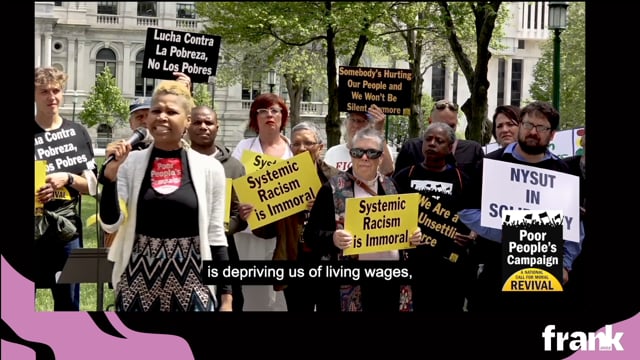 Moral Uprising with the Poor People’s Campaign
 The Unintended Consequences of Emotional Appeal