Learning New History and Telling Stories to Foster Change
Behavioral ScienceCommunicationsEducationGlobal StoriesPublic ServiceStorytelling
Good morning. My name is Cara Bohan and I’m a professor at Georgia State University. I’m here today to talk to you about learning new history and telling new stories to foster change. You may wonder why I’m beginning a lecture on my research with respect to the teaching of history with an image of Yogi Berra in a Metz uniform, no less. Well, first of all, I’m a huge Metz fan. And second of all, when I was thinking about preparing for this lecture, it reminded me of my entry into teaching in the 1990s, and it reminded me of Yogi Berra’s quote, it’s deja vu all over again. What was it like to begin teaching in the 1990s? Well, it was the midst of a fierce culture war battle. And how did that impact my teaching? Well, truly, I was so focused on teaching content that the culture wars were just a buzz in the back of my head. Here’s an image of me teaching with three boys who I coached on the track team. What kind of content did I teach in the 1990s? Well, I can remember a few things. Well, I thought that the lost colony of Jamestown had likely been submerged in the James River. Later by 1994, archaeological evidence of the buildings proved that it did not indeed drowned in the James River but was indeed on dry land. I also taught about Thomas Jefferson, who at that time was still a very popular president. But there had been rumors about his relationships and when I participated in a national damage for the manatees seminar on Thomas Jefferson, our professor told us that he likely did not have a relationship with an enslaved worker but more likely had a relationship with a woman named Maria Cosway and this was based on evidence and correspondence between the two. So am I guilty of teaching lies in the 1990s? I like to think that I wasn’t teaching lies but I was teaching the best historical knowledge at the time and I was teaching it from the consensus perspective of historians in the 1990s. It reminds me of the Hamilton musical, the song Who Lives Who Dies Who Tells Your Story. This is how we remember. But it becomes necessary to rewrite history and here’s an image of a book cover that I wrote on a historian named Lucy Maynard Sammon. She’s an important historian. She taught at Vassar College from 1887 to 1927, long before women had the right to vote and ironically she taught about American government and American history. At the end of her life she wrote a book on the rewriting of history and she had four important points that explained why it was necessary to rewrite history. The first reason she said was because it was necessary for a growing spirit of democracy at one point records and primary source documents were inaccessible to all but the elite. She was a great witness in the early 1900s, the growth of accessibility of archival materials. Think about how much she’d be amazed by digital access to primary source materials today. She also believed it was important to rewrite history to prune away waste and leave only the important kernels. Another reason she believed it was important was to correct false assumptions for statements of writers of history and a fourth reason was improvement in methods of big data. So think about how now we have supercomputers where you can use a search engine to look up information or think about something like the DNA evidence that proves Sally Hemmings indeed did have a relationship with Thomas Jefferson and had children. So we really have to rewrite history because our knowledge advances over time. So I want to quickly share with you some new history that I’ve been engaged in with my doctoral students and with some other professors. And most recently I’ve been working on something called mint julep textbooks and know these aren’t textbooks on how to make a drink that is sweet and cold and delicious. So what is these textbooks were developed for Southern audiences in the 1960s a publisher coined the term and they just generally left out images of blacks and this is in contrast to integrated textbooks where images of blacks were included. So we’re doing our research we applied this term to late 19th and early 20th century textbooks to look at how they described the Civil War and we selected three important historical figures, John Brown and his rate on Harper’s fairy John Wilkes Booth and the assassination of Abraham Lincoln and Nathan Bedford forest and the massacre or battle at Fort Pillow forest is more well known for founding the KKK but he was also a Confederate general. In addition, we looked at three northern textbooks and three Southern textbooks or mint juleps and looked at how they portrayed those events. We also looked at Mildred Lewis Rutherford’s measuring rod, commonly known as Miss Millie she had a measuring rod that established six criteria for the suitability of textbooks for Southern children. And we also looked at a later textbook by David Seville Muzzy written in 1936 which historian James McPherson has said was one of the most popular American history textbooks of all time. Our conclusions were that by the 1930s, the Southern narrative had dominated the story there’s no mention in Muzzy’s book that the war was fought to present slavery no mention that slave owners were cruel, no description of life on the plantation and no vilification of Jefferson Davis. So what does this mean. Well, what we found was that essentially the northern textbooks that in immediately after the Civil War had presented a very different perspective from the Southern textbook those original six that we looked at tended to converge on a common narrative in the early 20th century. And throughout this time period, this is the height of lynching in America, it’s when Woodrow Wilson was in the White House and enjoying birth of a nation. So this narrative that was much more a consensus around the Southern perspective tended to dominate all textbooks so in our final conclusion we believe that by the late 1930s the Southerners had indeed won the textbook for if you’re not familiar with this perspective if you’ve been familiar with the wind. I have images here of that. It’s this kind of whitewashing of the Civil War. Historian David Blythe said that the nation was essentially willing to sacrifice its historical memory, especially with respect to race in the name of reconciliation. And so we have a history teacher to do in the current and contemporary culture wars. Well, I worked with historian Robert Baker and black history education expert, Ligaret King, along with Wade Morris is the lead teacher to develop a new book on the teaching of enslavement in American history. And we took those standards across the states, both red states and blue states and large states, as well as Georgia which is a little bit smaller. We took those standards and developed nine chapters of up to date historical research, as well as up to date pedagogy, and we included with each chapter lesson plans for each. So the nine plan plans are based on inquiry design model as well as the a push document based question lessons, and they include many many primary sources. So what I want to do here is not to teach students what to think but to have them develop inquiry skills and analysis skills read to read the primary sources and develop their own thinking on enslavement in American history. And so to end amidst these culture wars. My advice would be to keep calm and love history. Love her story love their story, know that most stories are fairly complex and not all that they may appear on the surface. Consider different perspectives. In the book we have a chapter on African cultural retention where we look at the legacy of what came from Africa to America. So consider different perspectives and in the end, keep calm. Thank you very much for the opportunity to speak to you all today. This is a me with historian Rob Baker in the back corner and a group of teachers from across America, who participated in a national endowment for the man in the seminar on the teaching of enslavement. And under the Constitution. So thank you very very much.




 Seven Minutes In Heaven… With A Scientist
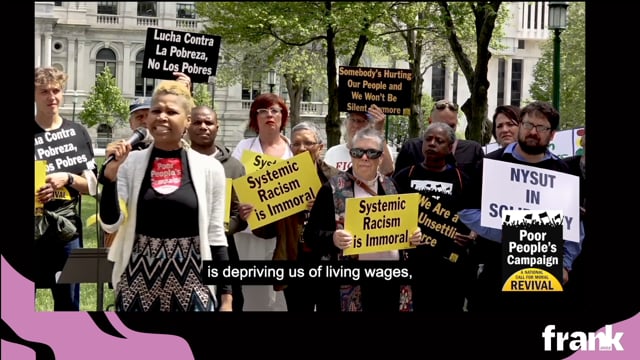 Moral Uprising with the Poor People’s Campaign
 The Unintended Consequences of Emotional Appeal