
Fresh From the frank Stage
Standout talks from the most recent 2023 gathering, featuring bold voices, urgent truths and unforgettable moments.

Amahra Spence
Liberation Rehearsal Notes from a Time Traveler

Shanelle Matthews
Narrative Power Today for an Abolitionist Future

Nima Shirazi
Irresistible Forces, Immovable Objects
The Speaker
Jill Vialet Principal at Workswell
Jill Vialet is a social entrepreneur, author and founder of Playworks, Substantial Classrooms and the Museum of Children’s Art. A longtime champion for the power of play, trust and collaboration, she helps organizations lead with creativity and purpose through design, storytelling and human-centered systems.
Go To BioWatch Next
-
 Seven Minutes In Heaven… With A Scientist
 -
 Moral Uprising with the Poor People’s Campaign
 -
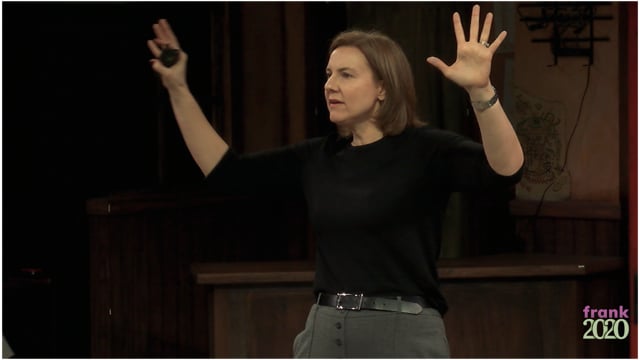 The Unintended Consequences of Emotional Appeal
Let it Go
Behavioral ScienceCreativityEmotional IntelligenceProblem SolvingPublic Service
Transcript
So I have to admit that I am not really a PowerPoint person. I like telling stories, but PowerPoint’s never been my thing. However, when I got, I’ve had this pretty inexplicable desire to do a frozen themed PowerPoint. So when I got the email saying, hey, we’d like you to come and give a talk at Frank, and the theme is that moment when. And I knew that I wanted to tell this story about something that happened to me this fall, definitely to our organization this fall. And that moment when you realized you had to let it go, and I knew that my ship had come in. So I started sports for kids 20 years ago. We rebranded as Playworks. As you heard, we believe in the power of play to bring out the best in every kid. Not much has changed in terms of our reason for being since the very beginning, but we’ve grown considerably. So today, for offices in 23 cities, we have staff about 700 people, and we’re reaching about 750,000 kids in 1300 schools through a mix of programming. We have a coach program where we have full time humans in low income urban schools, 400 schools all across the country. And then on the other end of the spectrum, we have training, trained about 900 schools, and really helping grownups realize that play is this extraordinary tool for helping kids develop empathy and teamwork and leadership and inclusion. I included the sports for kids slide. I just felt like I should come clean, that I didn’t actually naturally saddle up to the branding communication. So that was my idea of what our logo should be in the beginning. And it’s so 1980 with a four there squarely in the middle, I could really just be wearing leg warmers to make it completely clear. Happily though, about 10 years ago, we got this big investment from the Robert Wood Johnson Foundation to try and go to scale. And I’ll talk more about scale because I think we use the word scale sort of interchangeably with growth. And when I say scale, what I really mean is systems change. Anyway, we got this big grant from RWJ, and they also threw in this bonus communications thing where I had to work with all these people and I couldn’t believe I was spending money. And most of you are here now. I’m really, I was wrong, and I just want to just come clean. But anyway, we had also this communications officer, this woman, like Ann Cristiano, and she actually helped me rebrand. And so we became playworks about five years ago. DeSantis Brandel did the rebrand. What I love about this transition from sports for kids to playworks is it’s really emblematic of all the ways in which as a sort of scaling nonprofit, we’ve had the great idea at the core, but we’ve had to bring in functional expertise. And the communications really reflects that, I think. We’ve had it in finance and HR and IT. The other thing I really love about the rebrand is that it put play at the center of who we are. Now, play is this funny concept. It’s a little more complicated than you might think at first blush. I sometimes joke that it’s kind of like pornography in that you know it when you see it, but it’s a little hard to define, which makes parents uncomfortable when I joke like that. But nonetheless, the definition from the dictionary is a voluntary activity undertaken for no apparent purpose. That really speaks to me. I like that. That feels good. The thing you might not know about play is that it is a thing that generates a lot of political passion and emotion from the people who care about play care a lot. And almost in an outsize kind of way. This is the foreshadowing part of the story of the talk. So you should know that and it’s this place where the far left and the far right meet back behind in that scary place that they live sometimes. The far left really thinks that grownups having anything to do and making it anything other than pure free play adulterates it in a really bad way. The far right thinks that really grownups being involved is sort of coddling. And so my history of sort of press has been a lot of softball articles like Harvard basketball players start sweet non-profit. I’m like, ehh. But I thought that was terrible. I learned. But the comment section, and some referenced it earlier, the trolling part in the comments I learned not to read because in those I’ve been called both a recess fascist by the left and a vanguard of the Obama nanny state by the right. So I figured I must be doing something. I mentioned scale. This is my one nerdy slide. I figured I’m doing a PowerPoint presentation. I’m going to have a nerdy slide. This is really how we’ve thought about our path to scale. And there are just three things about this slide I want to point out. One is it goes from left to right. But it’s not linear. It’s like a rolling wave. So you start by piloting and you’re piloting in flagship, which is our direct service program. And then your broad adoption is training. So it’s a rolling wave. The second thing I want to point out is that each sort of segment of growth is associated with a different core capacity. So when we piloting as the program development, but then flagship, I had to get really good at managing. Like who knew management was a real thing. And then broad adoption, like we’re selling training out in the world. And then movement building, which we’ve really just started to embark upon. The communications was the core capacity. We just announced that we’ve set a goal by 2020 to be making sure that there is safe, daily, meaningful, healthy play happening for 3.5 million kids in 7,000 schools. And communication is going to be key to that. The other thing I really like about this slide is that there is this inverse relationship between impact and control. And so it’s worth noting that there are two things that I know to be true about social entrepreneurs. One is that we have a collectively terrible fashion sense. The second is that we have control issues. And I just want to, on behalf of social entrepreneurs everywhere, I realize this makes your job harder. And I’m really sorry, both things. I can’t tell you how many times Ben Milder has gone on like hill visits with me and said, are you really going to wear that? And I’m like, yes, yes. So that’s so unfair. I’ve been still here. I’m really sorry. So okay. So I’ve sort of set you all up. This fall, we’re beginning to branch out. We’re thinking about the scaling thing. And because of working with Fenton and Descender Brondell and Pritchard, and I know I’m messing with Andy Goodman, all these people, we’re ready. We’re like, we’ve got the internal capacity. I have a chief marketing officer. I’m good to go. And then there’s one of those flare ups. There’s this mom in Dina, Minnesota, whose kid has a school where they have training. And she’s unhappy about it. She goes to the school board and complains. And Dina does a survey. Everybody else besides this woman loves the program. So she takes it on the road. She goes to Minnetonka and all sorts of other incredibly Minnesota sounding places. And she’s miserable. And I’m kind of not paying that much attention. But I’m hearing that selfs is happening. And then this happens. So that’s the front page of the New York Post. And I apologize for the quality of the image. That is the actual visual that my EDs texted me that morning. And the refracted light, I think it’s the tears of hers that are just crying. There’s so much about this front page that I really could talk to you about for a while. If I was half the feminist I purport to be, I would wear that outfit. I just think that cooler heads have prevailed and I’m just wearing this instead. What I think I like best is that there’s a slight insinuation that that woman is one of our recess coaches. And I think really you just have to just for a moment imagine how different my staff meetings would be if that were the case. So I wish I could tell you that we had all this capacity and we responded by just completely zapping them. But honestly we kind of fell apart. We were trying to get them to correct the facts. We were trying to respond. We were getting all these incoming questions. And it was kind of unraveling. And about four days in, I remember Susan Promslov became our communications person at RWJ, was getting pressure from our program officers for that, like let’s put them in their place, let’s show them. And at some point all of our communications people said, you know what? No, we have to let it go. We have to just put out a statement and stop fueling the fire and we have to go back to being ourselves. And so we did. And the good news was that the storm passed. It was scary at first. But in some weird ways, New York is a market where actually any news is good news. And it was weirdly true that people would say, I’ve heard of you and I’d be like, yeah. Great. And our colleagues in New York were begrudgingly like, okay, now you’re one of us. You’ve been slammed by the New York Post. It’s all going to be okay. But two observations. One was that, you know, Playworks has gotten to where it’s gotten. I’m not a communications professional, but I recognize that I need functional expertise, experts in HR and IT and finance and management and communications to actually scale this thing. And of all the experts I bring in, I don’t think anybody in my world gets as much second guessing as our communications people. Right? Everyone feels like they’re an expert in communications. I’ve been communicating my whole life. I completely feel free to tell you why you, the professional, are wrong. And the truth is that moment when my communications professionals said, let it go. Stop. Tremendous courage. The second thing is that the whole situation reminded me of nothing so much as what I asked my staff to deal with out in the schoolyard. It was bullying, right? And what I know from working with kids is that the way you change bullying is not by directly confronting them, right? Not by feeding their anger and fear with shame and confrontation. It’s by building a more healthy, inclusive, empathic environment. So people like me need people like you. And first off, that’s really hard for people like me, right? The whole fashion challenge control issue thing. I’m unleashing my baby on the world and the thing I want, more people caring is happening, but the thing that I can’t handle, which is the loss of control, and then I need you too, like the whole thing is a setup, right? People like me need people like you to help us maintain perspective and humor, right? There is this sweet spot where we take the work seriously, but not ourselves, right? And people like me need people like you to tell us when it’s time to stand to fight and when it’s time to let it go. Thank you very much. Thank you.
Watch Next
-
Seven Minutes In Heaven… With A Scientist
-
Moral Uprising with the Poor People’s Campaign
-
The Unintended Consequences of Emotional Appeal