Hi, everyone. Oh, thank you. So, oh, good lord. All right, so I get to talk about three of my favorite things today. Movies, technology, and social impact work. I should warn you, I talk very, very fast. I have to do this all in under 10 minutes, so just hold on tight. So I run a company called Picture Motion. That’s us. Look, I’m already going too fast. All right, I run a company called Picture Motion, and our job is to make sure the films that can change the world do. We bring together filmmakers, strategists, public interest communicators, distributors, activists, and movement leaders to put together a plan, a theory of change, and then work like hell to see that through. So to give you a couple of examples, fast, fed up. So for fed up, we worked with celebrity chefs and food activists to raise awareness about our excessive sugar consumption. We created a nationwide social media strategy centered around this fed up challenge to lower obesity rates and decrease our sugar consumption. For a film called Food Chains, which actually just won the BritDoc Impact Award today, so please check it out. So this week we got to work with local organizers. We got to pull people out of movie theaters into the streets, into rallies and protests in front of Wendy’s Fast Food Chains and Publix grocery stores, all fighting for farm worker rights. Yeah, don’t go to Publix. So with raising extinctions, this meant that we got to organize thousands of house parties, all getting people to watch the film on one night on Discovery Channel and commit to doing at least one thing to help protect our environment. So I got them too fast. So my job is to connect someone with a film and inspire them to act. It’s to create that moment where someone’s worldview is widened, their perspective shifted, and hopefully their inner activist comes out. And so these moments when they can happen in mass can create actual change. And so for me, I had two big moments in my life that kind of set me on this path of media activism. The first, as you saw, I’m a millennial, is 9-11. So if you’re old enough to remember, then you’ll never forget where you were when you heard that the Twin Towers were bombed. For me, I was just walking on to my college, my high school campus. I was a senior in high school walking to a video production class. And there was a student running, student to student, to tell us that the World Trade Center had been bombed. We didn’t have text messaging, so human-to-human communication or talking was actually how we passed messages on high school campuses. But this stunned me. And it’s embarrassing because I didn’t know what the World Trade Center was. I didn’t understand what a terrorist was. I thought, is that the Unabomber I had just heard about? I was 17 and I was focused on high school. And if Brittany and Justin were going to get back together, and I lived in this very sheltered community, and if you imagine it, you have to imagine Pleasantville. And I mean, literally imagine Pleasantville because I live just outside of Los Angeles and Hollywood. And so my idyllic neighborhood was actually the setting of stereotypical suburban towns. We were actually the inspiration for the town in Edward Scissorhands. We were the actual set of Pleasantville. And we were where Romy and Michelle went to high school. And if that doesn’t actually paint the picture enough, this is an actual advertisement for my hometown when they rebranded it as Awesome Town. For real. So I say all this, you can kind of get an idea of the homogenous attitudes and opinions we had maybe in Awesome Town and why this news was so shocking. And we all kind of have our own Awesome Towns that we live in. So around this time, we’re primarily getting our news from newspapers, from broadcast news stations. If you were lucky, your school maybe had a pen pal program or a foreign exchange student. Or MTV was like your biggest source of cultural news. But then, so 9-11 happened and it shook me. And so I wanted to be a filmmaker. I was applying to film schools. And in that process, I realized how could I tell stories about the world if I knew nothing about it. So I shifted my major. I went to international relations. I traveled as much as I could. I enrolled in courses. I did internships and I thought if I get a job at the UN or maybe an international NGO or some institution that is about cross-cultural communication, I can make an impact. And then I had my second big moment. I saw the movie Hotel Rwanda. I’m sure some people have seen this. I shall also tell you I saw it via Blockbuster for those of you who don’t know. This is like Netflix, but it’s on the DVD and you just get one at a time. So this film was about a hotel manager in Rwanda played by Don Cheadle on how he was protecting Tutsis during the Rwandan genocide. And in these two hours, I was able to understand faster and more deeply what this part of our world history was. And I connected with the characters. I understood. And then I was pissed off that this was still happening. And then I got my second big moment. I figured we could use film to talk to people. It was media and entertainment. And it was a way to accelerate progress to catalyze change. But you had to do it if it was harnessed right. So I figured I could marry these two passions of film and activism. So as I was graduating college, technology was evolving. It was becoming easier and cheaper to create your own films and share online. I didn’t need years of apprenticeship to learn how to edit a film. And I didn’t need to work my way up in a studio. By the time I was entering the working world, I was an expert at a groundbreaking visual and text communications platform that was connecting people from around the world. MySpace. MySpace friends during this online yearbook called Facebook were connecting people. We were sharing videos and photos. We were getting to peek into each other’s worlds. So I started working at a nonprofit where we figured the best way to engage people was to speak to them through the language they knew on the platforms that they were on. We created over 70 videos and released them through MySpace, Funny or Die, heavy.com, a lot of websites that don’t even exist anymore. And we got over 2 million young people to register to vote. I was lucky enough to move to a bigger media company that was creating big films that Liz mentioned. We financed these films for the purpose of social change. And then we got to fill theaters with activists and influencers and launch national and international campaigns. Every film we released was paired with an action. But I’m in a room full of people who know this already. You know that film or stories particularly told through film have the power to create cultural, social and political change. But I may have to tell you that the technology has changed so fast that we have to work harder and smarter on the campaigns around these films. A record number of documentary films and social issue films are being released every year. We’re competing for eyeballs constantly. The distribution platforms have fractured and multiplied. There are so many places to get good content that we don’t even know where to start. And in order to reach audiences, there are infinite possibilities. There’s Facebook, Twitter, email, text, Snapchat. Everybody now is a creator, a curator and a consumer. So if you’re going to work in feature length film, if you’re going to want to create change, if you have a short video for your non-profit, if you’re trying VR or 360 film, you have to have an impact strategy. And so in doing all this, there are six things I’ve really learned. One, focus on the story. Don’t worry about the campaign just yet. If you have a specific goal in your mind for change, then make sure your film accurately, truthfully, powerfully makes its argument. And if you have a more character-driven story, make sure it’s a beautiful film that allows your audience to see themselves in your character or just watch Marjan and Christina’s talk earlier, just follow everything they said. But don’t rely on your campaign to make up for something that your film is lacking. And then two, know your audience. And there are two things you need to ask yourself when you are trying to figure out who your audience is. Who are the people who already support this film? Who are your activists, your influencers, your evangelists? You need to work with them. And then two, who are the people who have the power to create change? These are often the people who don’t want to see your film, but need to, and they’re going to be hard to get to. You have to find them and reach them because you can’t just preach to the choir if you want to create change. Three, don’t go at it alone. You have to build partnerships with nonprofits, with activists, with movement leaders. You are shining a spotlight on this issue in this moment for these two hours, but these people have been working on it for years and you have to work with them. Invite them to be a part of what you’re doing, collaborating. Four, create a path to action. Did I change? Action. You get the point. Create a path to action. There we go. There are very few films that have that silver bullet. Just do this one thing and everything will get better. But you can make it easy for people. Give them resources, steps to action. Send them to the websites of the people who you just partnered with in step three. And if you’re going to put at the end of your film, go to our website to learn more. You better have a phenomenal website and it better be mobile friendly because that takes us to number five. There we go. Get online. If you’re not online, you don’t exist. You need to have a mobile friendly website, an email list, some sort of social media platform. But your digital campaign should match the type of film you have and the audience you’re trying to reach. So don’t use Snapchat if you’re trying to reach people over 30 because we don’t understand it. And finally, get offline. You have to connect in the real world. That human to human communication is still the most powerful way to mobilize people. If there’s anyone here paying attention to the Sundance Film Festival this year, you might have heard about the sale of a film called The Birth of the Nation. Yeah. The film’s director, Anna Starr, turned down millions of dollars from Netflix because he knew that it wasn’t enough to just put it online. Through the film’s story of a slave rebellion leading up to the Civil War, the filmmaker connects his audience to the roots of racism in America. He compels us to connect our history of slavery to race relations we have in America today. It’s an issue that requires and deserves the full attention of an audience in the real world. It’s not something you Netflix and chill over. So I’m running over. But oh, no, wait, I’ve got something to left. I forgot. I’ve got more time than eight minutes. So the film is a really powerful medium, but you need a plan and a strategy and a team to get it out there to reach an audience to burst whatever awesome town filter bubble they’re living in. And if you can do that, if you get the honor of creating these hundreds, thousands, millions of moments when an audience member’s eyes are open and they are ignited to create change. Thank you.



 Seven Minutes In Heaven… With A Scientist
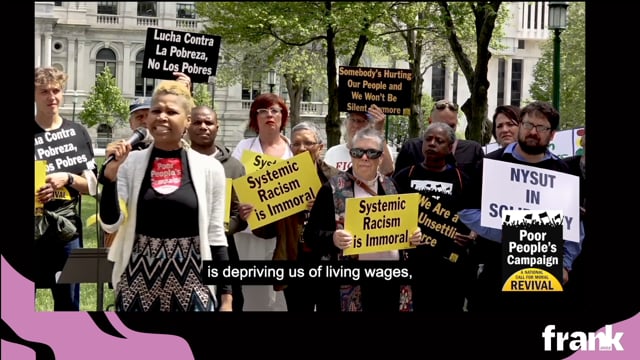 Moral Uprising with the Poor People’s Campaign
 The Unintended Consequences of Emotional Appeal