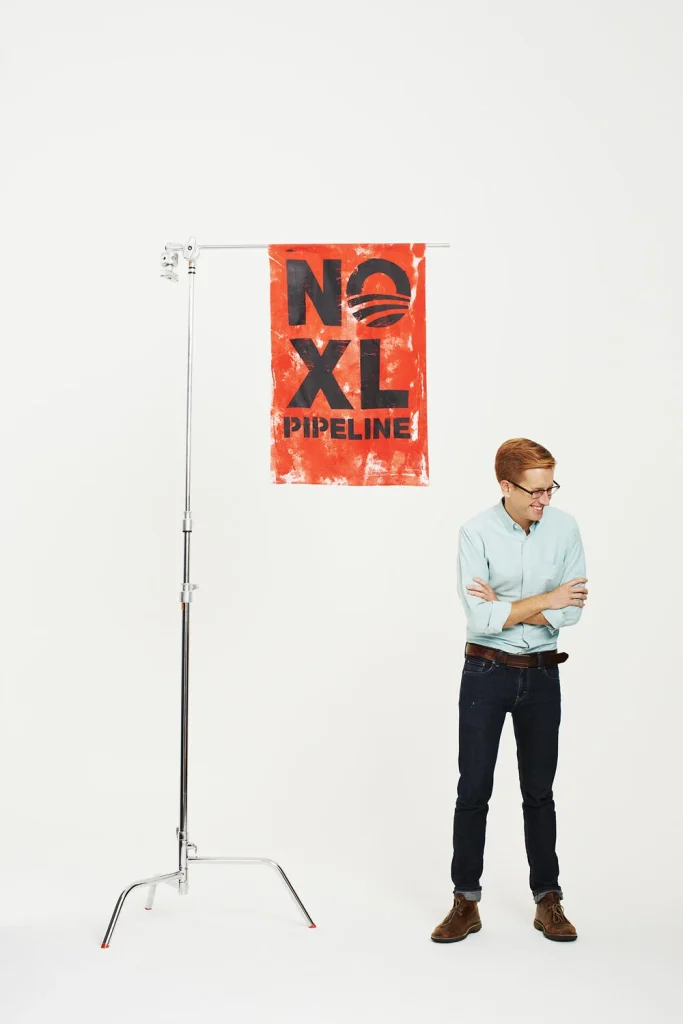
All right. Hi, everyone. Hi. Hope you had a good lunch. I get to be the after-lunch slot, so I’m going to try and keep you awake and not cause too much indigestion along the way. So as Liz said, my name is Jamie Henn. I’m the co-founder and now our strategic communications director for 350.org, which is an international climate change campaign. The name 350 comes from 350 parts per million, which is the safe upper limit of carbon dioxide in the atmosphere. Right now we are over 400 parts per million, which means that we are in deep trouble. And what I want to talk about today is that it’s my belief that the solutions that we need to the climate crisis won’t just require breakthroughs in solar panel technology and wind turbines, but actually breakthroughs in the science of communications, the circuitry of story, how we actually do our work and how we build movements in ways that can open up political space to create new possibilities. So we need all of you. Climate change won’t be solved by just Elon Musk off in his laboratory somewhere. He may get us to Mars if we lose the climate fight, but to actually make progress, we need to be the ones to get engaged in this issue. Now over the years, 350 has tried to be a real laboratory for experimenting with how can we build a social movement around climate change. We got started back in 2008. I helped start it with a group of college friends and an environmental writer named Bill McKibbin. And since then we’ve had about a decade of trial and many, many errors with experimenting with all these tactics in the toolbox that we use as social change advocates. And one of the questions that I’ve been the most curious about over the years is what actually makes for an effective campaign. And especially how do we campaign effectively when we are taking on huge opponents like the fossil fuel industry? How can we make a difference? And the more that we’ve organized days of action and civil disobedience and marches like the people’s climate march and artistic interventions and all of these things, I’ve really become sort of obsessed with this idea and part of it is looking at the word campaign and the idea of a campaign itself. So campaign. The word campaign actually comes from the word campania. Someone can teach me how to pronounce that later. And the definition when you look it up in a dictionary is often something like this. A connected series of military operations forming a distinct phase of war. Now war like metaphors have their place. I’m not saying. But when we are taking on huge opponents like ExxonMobil, this becomes a little bit problematic because huge opponents are by definition the one with the military, with the empire, with the huge armies and at best we’re the small rebel force taking them on. And yes, David got lucky with his slingshot. But the reason we know that story is because Goliath won like the 99 other times out of 100. And we have great stories about Princess Leia defeating the empire. May she rest in peace. But Leia lost her planet in the process of taking down the empire which for environmentalists becomes a bit of a problematic metaphor when we’re talking about the resistance. So the thing I want to bring today is not that we need to throw out the word campaigner. You can still be a campaigner. I still write campaign plans. But are there other identities that we can take on as activists, as advocates that give us a new way of thinking about our work and challenge us to be more curious and creative with what we do? So over the years at 350, we have assumed a number of different identities as we’ve experimented with what makes for creative campaigns. We’ve been choreographers. One of the ways we started 350 was by doing these huge international days of action where we would set a theme, pick a date, and then just let people dance. People would be doing their own creative plans. We wouldn’t talk to people. These are school children in Malay, which is the capital of the Maldives, which will be underwater if we don’t do something about it. And what we lost in control over all these events, we gained in creativity and scale and power, giving up a little bit of control and being more creative ultimately made us more powerful and effective. At other instances, we’ve been writers and storytellers. Some of our most epic work at 350.org has been helping support a movement of people who are rising up to take on huge fossil fuel projects that threaten their climate and communities. When we’ve engaged in the fights against the Keystone XL or Dakota Access Pipelines, we’ve intentionally looked for the heroes, the villains, the drama, the next episode of the fight, what’s the big win going to be, and how do we really take on heartbreaking loss by identifying and structuring our work around these narratives rather than just adding communication as a secondary afterthought? We’ve been able to really make an impact and help define some of the big fights in this country. At other times, we’ve been painters. We’ve actually worked a lot with artists at 350.org. This is from a project we did with artists to make images that were big enough to be photographed by satellite from space to talk about the impacts of climate change. And if anybody wants to talk about how to coordinate on-the-ground actions with a satellite traveling hundreds of miles per hour above the surface of the earth, do not talk to me because it was a nightmare. It barely worked. But it was a great experiment, and we made a lot of great connections with artists who we worked with to this day. At other times, as Liz mentioned, we’ve been producers. This is a photo from the People’s Climate March in 2014 in New York City. That was a march that brought over 400,000 people to the streets of New York and hundreds of thousands of more around the world. And we intentionally put on a production to tell a different story and to show different faces of the environmental movement, to help redefine climate change not just as about the polar bears, but about people, about the social justice issues that are facing our communities and about the solutions that we need to really begin to address the climate crisis. So of course, these are just names or words or metaphors, storyteller, painter, choreographer, but I think they’re important because I think that when we begin to tell a different story about the work that we’re doing, that it’s not just a campaign marching down the field of battle with our strategic plan to take on the enemy, but a dance, a painting, something more exciting, it changes the work that we do. We suddenly become more unpredictable and unpredictability is what our opponents hate. We become more creative and more interesting and as Bobby said, more cool. And that’s something that actually engages the people we want to engage. It’s not just a endless crusade to take on the big challenges of the day, but it’s something creative and exciting that speaks to people’s soul and to their spirit and to their sense that they too can be a creative person trying to change the world. So we face huge challenges today. Racism, homophobia, sexism, Donald Trump. All those things with Donald Trump. This is a resume. This is a resume. Climate change. And when you look at the science on something like global warming, it is daunting. We are running out of time. We are in the thick of it. But when you look at the art that this movement is creating, the creativity that people are bringing to the table, the way that poets and musicians are getting involved in the movement, that’s where I get my inspiration from. Because if we can start to imagine different possibilities and change the way that we work to infuse our movements with that creativity and spirit, then I think that we won’t just be better activists, but we will out-imagine people like ExxonMobil. They have no idea what is coming at them when we show up in dinosaur outfits. Or as Liz said, you show up with a fairy wand. These opponents aren’t ready for that. They aren’t ready for us. They aren’t ready for us to bring the full extent of the human spirit to bear on some of the biggest challenges that we face. So this movement is growing. It’s building. It’s working together with many of you already in this room. We need creative people. We’re going to get the solar engineers and wind turbine people. We got them. But we need you. We need the artists. We need the storytellers. We need the creative minds who can help us think up new stories that give us the vision of the world that we want to create. Thank you.



 Seven Minutes In Heaven… With A Scientist
 Moral Uprising with the Poor People’s Campaign
 The Unintended Consequences of Emotional Appeal