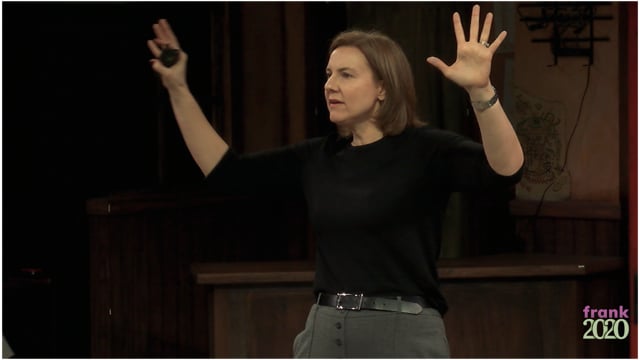
You’re here! This is so exciting! I’m so excited! Are you having a good Frank? Yes! Yeah, it keeps getting better. Can you believe it’s been five years and we’re finally getting it right? So, for those of you who I haven’t had the good fortune to meet, I’m Ann Cristiano. I’m the Frank Carell Chair in Public Interest Communications here at the University of Florida. If this is your first Frank and you’re wondering, is there a link between the name Frank Carell and Frank? Could those two ideas be connected? You’re correct! Congratulations! You have one! You have figured out the mystery. So, Frank is obviously named in homage to Frank Carell, a man who many of us knew and worked with and who endowed my position here at the University of Florida. But increasingly, as we use it with the lower case F, it has come to speak to the candor and the authenticity that marks what we do and marks the time that we spend together. So, we celebrate Frank in all of its meanings. And if you are returning to Frank, welcome home! I’m so glad you’re back. Isn’t it so nice to be around people like you who care about the same things that you do? Doesn’t that feel so good? Okay, before I’ve got a bunch of stuff I’ve got to tell you. Oh my gosh, I’ve got so much to tell you. But before I do anything, I want to extend heartfelt thanks to all of the extraordinary people who make Frank happen. Each of you are a part of making it happen. And each year, Frank is not planned, it emerges. It emerges from your best thinking. It emerges from everybody’s hard work. It emerges from anybody unwise enough to walk past one of us slowly. And I encourage you to really spend some time meditating over the thank you pages of the agenda. Because there are a lot of extraordinary people, a lot of extraordinary effort noted there. But I do want to shout out a couple of people. The first is Amylen Smith, who has been our speaker coordinator. She’s worked with all of the speaker coaches. She has gone to extraordinary effort to help ensure that all of our speakers are incredibly well prepared. And I think we’ve been enjoying the fruits of her labor. Thank you, Judy. I also want to give a shout out for Erin Richard, who stepped up into this role of chief connector in chief. Are you here, Erin? I am. Here he is. Thank you. Thank you for everything that you’ve done to help make Frank more inclusive, to make everybody feel welcome, to make everybody feel like a part of this community. If you don’t feel welcome or a part of this community, please talk to Erin. I want to thank Kristin and Erin, who always do so much work to make Frank extraordinary, who always bring fresh thinking and fresh ideas. Our incredible tech team for making us all look so good. And of course, the hippodrome, which is always such a gracious host to Frank, and creates this beautiful set. If you are curious about this set, this is for a play, The Royale, which is playing here at Frank, playing here at the hippodrome. Sorry. One track mind. And I encourage you, I think they still have tickets available for tomorrow night, but don’t go tonight because we have got stuff to do together. And I also want to thank our extraordinary students. People often say, why does Frank always have to be in Gainesville? Like, could you be a little more open-minded about maybe doing it someplace else? The Royale is no. Sorry. Our students are here. And 150 students this year were part of making all of this magic come to life. They work incredibly hard. They work very long hours. They do things that they lose sleep. It’s pretty extraordinary. Speaking of losing sleep, Ellen Nodine, I don’t think, has slept since October. Where’s Ellen? She’s sleeping. Is this like… Oh my gosh, this is like that super awkward part of the sound of music when the Von Trot family singers. But when you see Ellen, be sure to thank her and tell her how much you appreciate everything that she does to make Frank the wondrous experience that it is. So I have some other stuff to tell you. Some new stuff that’s happened since the last time we were together. Juan Carlos Muerta, who was the department chair for the Department of Public Relations, is now at some place in… He went west. Oregon. Oh, right, Oregon. But we have a new department chair. Her name is Marcia DiStasso, and she’s here with us today. So she’s new to the University of Florida, but she’s jumped in with both feet and is drinking from a fire hose. So please do… Yes, thank you. So please do say hello to her. Something else really exciting happened. We sent out the second issue of the Journal of Public Interest Communications, which is edited by Brigitte Brunner and also Kelly Churnin as the managing editor. We’ll make sure to put a link in tomorrow’s newsletter so you can check out the journal. And Linda Hahn has really led the effort on that. And then something else really exciting happened. So three years ago, for Christmas, Annie Neiman gave me this sign, and it says, Create things you wish existed. And I put it on my door and I looked at it every single day when I walked into my office. And all I could think about was how much I wanted to have a center where we could work together and focus on these issues and think about research all the time and establish partnerships with the field. And in January, the Board of Governors and President Fox and Provost Glover approved the Center for Public Interest Communications. So we organized, because this is a really big moment, we organized a fireworks show, but apparently there’s some rule about open flame in the hippodrome. So we have this. So here we go. Ready? Yes! Applause Hooray! Okay, so that was that. Good celebration. We’re moving on. We’ve got more stuff to do. I want to tell you a little bit about how to Frank. The first is if you haven’t done this yet, do this. Take your phone out. This is where you get all of the text updates. This is where you find out where all the cool after parties are. This is your link to information about Frank. So if you have not already done that, do it now. Second, recess. Our recess sessions. We’re going to have our first recess session this afternoon. We really listen to your feedback every year. We think about how we can make Frank better using your feedback. One of the things that you tell us every year is there’s too much Frank. There’s just too many speakers. There’s too much to learn. So we talked to an instructional designer named Scott Blaise. We said, how can we help people learn more at Frank? He said, you have to let them play more. You have to have recess. You have to give them time to apply. So in our recess sessions, we’ll be having some playtime with the amazing Michael Tran, who you’re going to meet in a little bit. We’re going to have apply sessions where you’re going to be able to learn new skills. We’re going to have dissect sessions where you can dissect some of the talks that you’re hearing on the main stage. We’re going to have sessions where you can recharge. If you want to go for a walk in the park or go do yoga, we have sessions for that. And then we also have study, which are our sessions where we’ll be talking about all of the fantastic research that’s being done by the scholars in the room and by the universities around the country that are involved in public interest communications. So you will have a sheet that lists the sessions each and every day, but if you’re a super planner and you want to plan your entire Frank experience, you can go on the Frank website and pick your sessions and look at all of them. Also, tonight, Frank Puzzle Hunt, it is going to be so much fun. I am so excited for the Frank Puzzle Hunt, so don’t miss that. You are going to have a great time exploring downtown Gainesville. And more than anything while you’re here, just play. Romp. These are the people that you get to see. This isn’t a place to build your professional network. This is a place… Sorry. Fortunately, nobody just got up and laughed. But this is a place to play. This is a place not to build a professional network, but to make friends. So there are so many people in this room who are now secret keepers of mine and shoulders that I cry on who were once just a Twitter handle to me. So have that experience because the work that you do is really hard and you need people to support you. You need people to connect with you over the course of the year. These are your people. Befriend them. In that spirit, I want to thank Benny Torres for telling us that we should play this year and identifying play as a theme. So thank you so much, Benny, for leading us down that path. And it really is perfect because since I came here, I’ve always sort of felt like UF was sort of an intellectual jungle gym. I feel like I get to climb around in other people’s ideas. If I want to know something, I can do a search on the UF website and find somebody who’s got expertise in that area and I can call them and be like, hey, what do you do is really neat. Can we go have coffee? And they will say yes. It’s extraordinary. I love it. I even get to, as a former dancer, I get to take dance classes if I want to. Right here on campus. It’s such a wonderful place to play. It’s interesting. I’ve been thinking a lot lately about one of my idols, Martha Graham, who was such an extraordinary communicator. She started dancing quite late for a dancer. She was in her late teens when she joined the Denyshawn School of Dance. And the Denyshawn School was this really interesting program in the 1920s that was bringing disciplines from all over the world and unifying them into this kind of contemporary dance. And Martha Graham flourished there. She was known for being an incredibly emotional dancer. And in fact, she was fascinated by using dance to convey emotion because her dad was one of the people who was a pioneer of the development of psychology. And so he was particularly fascinated by how our bodies show and display emotion. So that infused her. And this is her. She was frustrated because at the Denyshawn School, she’s the one in the middle, one of the things that dance was really focused on at the Denyshawn School was entertainment. They did a lot of vaudeville. That was the primary place that they performed. And Martha Graham looked at that and she said, I think dance owes more to the world than entertainment. It needs to be more. And so she left the Denyshawn School and went to an Eastman School of Music where she began to develop a discipline of her own. And the Graham technique is now emerged as something that is incredibly physical. It is incredibly demanding and unique. Nobody would look at this and say, that’s just like ballet, right? You can recognize the Graham technique. You can recognize a Graham dancer the moment that you see one. And I know because I had the opportunity when I was in my first year of college to go and study as a trainee at the Graham School. And I was really bad. It was awful. I was in the lowest level of classes. And the technique was really hard for me because I didn’t have that physical strength that’s required to do things like this. But I still loved it. I loved being there. I loved being in that atmosphere. In fact, my first day, I was there in 1989. And my first day in the studio, I was getting ready to leave. I had been there setting up my classes and figuring out which studio I was going to be in. And I was getting ready to leave. And the doors flung open. And they’re standing in the doorway of the Martha Graham School with Martha Graham herself. And I couldn’t believe the magic of that moment that in the first day that I was there, so excited to be in that space that I saw her. And she was there with her hair swept up as it always was. And this can’t be true, but in my memory, she was wearing a full length mink, but I know it was hot that day. And I couldn’t believe my good fortune to be able to be in that space and to be able to see her in what were some of the last years of her life. One day, we were in the main studio on the first floor of the studio. And this studio was steeped in history. It was the studio that Helen Keller visited when she came to the Graham School. I remember she said this amazing thing. She put her hands, Martha put her hands on the dancer so that she could feel what dancing was. And she said, what is a jump? And so she had the dancer jump. And Helen Keller said, oh, I see. It’s just like the mind, which is such a beautiful moment. So this, we were in this studio where all of this history had happened. And Martha Graham came in. She came in to watch class. And there she sat on the very front bench. And we were amazed because we were the lowest level students in the school. Like why was she paying attention to us? And it was just this amazing moment. So we’re dancing and we’re doing this combination from the corner. And she holds up her hands and she stops us. And she gestures. And I’m just kind of like, oh my gosh, oh my gosh, oh my gosh. And then one of the people standing next to me, she’s knocking at you. Yes. And she pulled me over. And I leaned down to listen. And her voice was so frail. And I nodded like I understood. And I had no idea what she said. And it’s bothered me every day. I think that when you brush up against somebody who is so great and who is so transformative, you want that to be this really memorable moment. And it wasn’t. In fact, when we did the combination again from the corner, she looked at me and she looked away. And it felt like shit. So, but I think that perhaps it’s possible that Martha may still have something to teach me and to teach all of us. And as I think about her personal journey and discovering this new form of dance that challenged, not only became its own form that is easily recognizable, that is beautiful, not because it means to entertain, but because it so authentically captures the human experience as a form of communication. I wonder if her story feels familiar to you, because maybe it’s your story too. That desire that you have to step out from what was expected of you and to say, we need our own discipline. We need our own rigor. We need something that is our own and uniquely our own. So what I want to ask you to think about over these three days as you frolic and play is to take a moment and to think about, sorry, lost my place here. Give me a second. Okay. We’re good. Is to think about the inflection point for public interest communications and think about how we might be poised for that same moment that Martha had to move from the place where we are the child of all of these different disciplines and pulling from all of these different insights to say, maybe this is our moment to create our own discipline. So what makes your work unique? What makes public interest communications unique? As you look at this, this is Martha Graham’s dance, Aaron into the maze, and it is a dance about confronting one’s fears. And as you look at it, you can see that it’s unique and it’s powerful and it explains things that can be explained in no other way. So in public interest communications, it’s not enough for us to aspire to do good. Public interest communicators are mercenary strategists. They are the people who make choices that lead to change and those choices often feel like sacrifices. We use research and not just focus groups and surveys, but all of this rich academic research to guide our strategy and guide our decisions. And we think in systems and we find the narrowest point of the river to cross. So let’s rally around those things that set us apart and use Frank in this community to be a place where we can build those skills and maybe build a world that we wish existed.



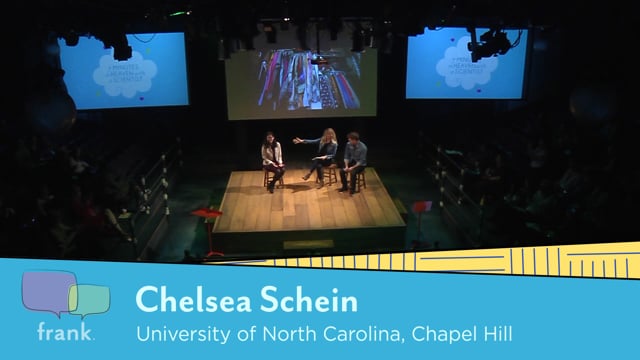 Seven Minutes In Heaven… With A Scientist
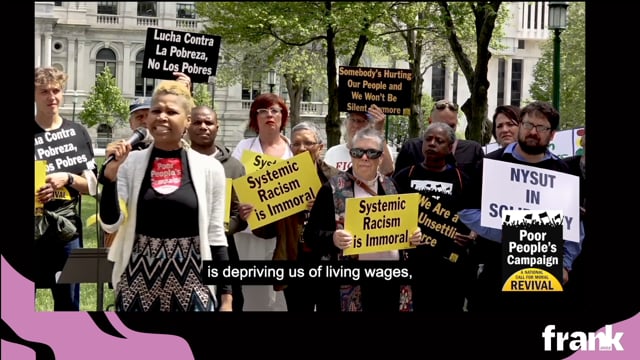 Moral Uprising with the Poor People’s Campaign
 The Unintended Consequences of Emotional Appeal