Hello. Well, it’s great to be here. This is relatively warm weather for me, so I’m excited. Got to walk around without 5,000 layers. So we had a lot of uplifting talks this morning. This talk is going to be a little less uplifting because the subject matter is bleak. I’m just going to be frank with you and lay that out there. So you heard, I’m the executive director of the Committee to Protect Journalists. I have a new book out. It’s called The New Censorship Inside the Global Battle for Media Freedom. That’s my Twitter handle, and let’s go. So before I was a press freedom advocate, I was myself a journalist. I worked for over a decade in Latin America. I covered lots of interesting stories, and I want to talk about this one story that I covered back in Mexico in 1994. Now January 1st, 1994 was the beginning of the North American Free Trade Agreement. That’s when it went into effect. Mexico was supposed to launch into the modern era, but there was this group, like nobody expected, of kind of ragtag revolutionaries that showed up in the southern state of Chiapas. And this guy, whose name was Subcomandante Marcos, was their leader. And they sort of came on the scene. There were a couple shots fired. There were some people who got killed. It was a little bit ugly for a while. And then they retreated into this remote area of Mexico called the Lackendown Jungle, and they kind of holed up there. And they just sort of invited the press to come talk to them. Now this was an irresistible story, and basically what we quickly realized was that the guns were kind of props, and the fighting was a bit of theater. And this was really an information war. And in order to wage information war, they needed the press. The Zapatistas needed the press. And this guy was a media genius. Everyone went to Chiapas, and myself included. We wanted an interview. I spent a week kind of hanging out, waiting to talk to the guy, sleeping in these really cramped hot barracks where they were all, the Zapatista rebels were all living. Then one night he showed up, and I sort of saw the glow of his pipe. And I was like, oh, that’s Marcus. It was the middle of the night. And he woke me up, and we had this, a bunch of journalists there, and we had this amazing conversation about kind of the goals of the revolution, what he was trying to achieve. And he threw in all sorts of funny bits, like he was in the United States, and he was in Dallas, and he worked as a Dallas cowboy cheerleader. And he worked in a gay bar in San Francisco, which was quite a funny thing to say at the time. And the reason he was talking to the press, and not just the international press, but the Mexican press, was because he had to. He had to. The only way to wage information war in that moment in time was to mediate it through the press. And so that was the strategy. Now, let’s fast forward 20 years. This is how you wage media war. I don’t even like to show you a picture of this guy. I think we all know who he is. He’s Jihadi John. He’s the Islamic State’s executioner. This is a screen grab from the horrible Foley execution video. I knew Foley was a colleague of mine. I don’t like to even show this stuff, because there is no way to show it without advancing the propaganda of the Islamic State. But this is the way you wage media war now. Journalists, you don’t have to talk to them. You don’t have to mediate through them. They can become props in your terrorizing execution videos. Why is that? It’s because the power dynamic between journalists and the people they cover has been completely transformed, and it has been transformed by technology. So this is a graph, and I can quickly explain what this is. So this is looking at people, internet users, over the last 20 years. So when Marcos was on the scene, we’re kind of at the bottom left there. And what you can see is that basically 10% of people were online in the United States. Basically nobody was online in Mexico, and the trajectory is up, up, up, up, up, up. Now 77% of people are online in the developed world. Maybe a third of the people in Mexico are online. 40% of people around the world. So we are living in this unprecedented age of information. The quantities of information available to us are absolutely staggering, and yet the amount of information to which we have access blinds us to the way that censorship functions today and the huge gaps in the information that’s available to us as a result of violence and censorship. So what’s happened during the internet, during the internet age? What has been the trajectory? I want to take you through a map that is 20 years apart. This is a map that the international NGO Freedom House puts together every year. I have some problems with their methodology. You see me during office hours. I’ll explain that. But I think it’s a pretty good snapshot of what Freedom of the Press looked like in 1999. Green, that’s good. Yellow, that’s partially free. Red, not so good. 20 years later. Now why they changed red to purple? I have no idea. I like the red. You’ll have to talk to them. But the purple is bad, okay? So just look at the countries that have flipped. Russia was partially free. Now it’s, forget it, Mexico, violence against the press has made it less free. Venezuela, even South Africa, which in the end of apartheid had a great opening and the ANC has become entrenched in South Africa. Not quite as pretty a picture anymore. And I’m sorry, folks, but the news gets worse. These are journalists killed during this period. This is that era of internet expansion, but this is supposed to be the golden age of information. But the people who bring us the information and the systems that deliver it, the people are dying and the systems are under threat. You can see there’s no good news here. And in fact, the numbers are up. The last three years have been the most deadly years we’ve ever recorded. This is based on our data from the Committee to Protect Journalists. Journalists in prison. Sorry, folks. More bad news. The last three years have been the highest rate of incarceration of journalists around the world. So the situation is terrible. Why is this? What’s happening with these journalists in prison? Why is there just this global crackdown? And it has to do with countries using kind of state security and national security frameworks to jail critical journalists. I’m talking about China. I’m talking about Iran. I’m talking about Ethiopia. And I’m talking about countries like Turkey. Now, I had an opportunity. I was just in Turkey last fall and I had an opportunity to meet with the country’s president, President Erdogan. And Turkey used to be one of the world’s leading jailers of journalists. There’s been some progress. Some journalists have been released. For prison, we wanted to talk to him about his press freedom record. I was in there with a delegation from the Committee to Protect Journalists. And he started out this session by lashing out at the media. There was no ground given. The New York Times, CNN, the Turkish media tendentious, unfair. The media is an opposition force. And now Erdogan is what I call a democratator. What does that mean? That means he wins elections. He wins elections. He has legitimate popularity. But he uses the popularity conferred on him by the ballot box to undermine the institutions that live in his power, including the media. And this is a new strategy of repression that’s highly effective that allows these leaders to marginalize the press and to hide their actions behind the facade of democratic legitimacy. And what Erdogan said to me that was really shocking is he said, increasingly, I’m against the internet every day. Now if this is how he talks to a group of global press freedom advocates, I can only imagine what he says in private. But he’s not alone. Researchers all over the world who fear this information share his perspective. And without going into the details, I can tell you that there’s a global consortium, if you will, of internet restrictors forming, looking for strategies to undermine the global internet as a shared, the internet itself, as a shared global resource. And they are gaining ground. Okay, so let’s get back to who is bringing us the information on the ground. So we know what these technologies, these wonderful technologies that have transformed communication have done to the media industry. And they don’t have the resources they once have. They’re not putting people on the ground in the same way. So we are relying on local journalists and sometimes eyewitnesses. You know, remember Taru Square, remember Citizen Journalists. These are people in many instances who are bringing us the news that we need. They’re part of this global information ecosystem. And there are places around the world. Pakistan, the tribal areas of Pakistan or Iraq that are simply too dangerous for Western reporters. And we’re relying on local journalists in these countries, the British, the news, and they are being killed in record numbers. Syria. Syria is an information black hole. There’s a military campaign going on and we are blind. We have no idea what is happening in Syria because journalists can’t get in there. Local journalists have been in there for some time. And local Syrian journalists and eyewitnesses are having, it’s even more difficult for them to share information. And if you look at the statistics, 80 journalists have been killed. Most of those are freelancers. Most of those are local journalists. 90 journalists have been abducted. We know about Foley and Sotloff and we know about the Japanese journalist Kenji Goto who was just killed. But most of them are Syrian and of the 20 journalists who are still missing, almost all of them are Syrian. Okay, journalists behind bars. Most of them worked online. There’s an information war going on. The technology, we hear wonderful stories about the technology and how it allows this to happen. But what we’re not understanding is the ways in which repressive governments are using the technology to crack down on the media itself. Now, there’s a journalist that some of you may have heard of, Mazir Bahari. He’s an Iranian-Canadian journalist. He was in Iran. He covered the dispute following the 2009 presidential election. He was arrested. He spent four months in an Iranian prison. John Stewart just made a movie about him. Hopefully some of you have seen it. It’s amazing. But when Mazir got out of prison, I had a conversation with him and I said, Mazir, what did they interrogate you about? And he was like, they wanted my Facebook password. They wanted my email password. They wanted all my social media. And if you think about what social media is, all the stuff that an average person puts on social media, your friends or contacts, your opinions, all that stuff, that’s the kind of stuff that interrogate issues to pull your fingernails out to get. Now they get that password. They’ve got it. They can use the same technology to dismantle networks. And they’re doing it. And they’re doing it in a wholesale way. And I’m not just talking about Iran. This is a global phenomenon. We know about NSA surveillance in the United States. But this is a question of this technology that the NSA has that’s terrifying, that allows it to do this. It’s going to be, it’s being disseminated, this powerful surveillance tools to governments all over the world. Governments are building this capacity. And it has, if they, if they gain it, it has the ability to undermine the internet again as a shared global system. Okay. So what does the new consensorship, the new censorship consist of? Well, it’s the democratators. This new style of authoritarian government, this new style of repression based on democratic legitimacy. It’s much harder to combat because the repression is sometimes hidden. The terror dynamic. That’s what I’m talking about here, where journalists have lost their power in relation to the people they cover. So they’re no longer indispensable. They collectively have lost their information monopoly. And that’s a good thing in many ways, but let’s recognize that it kept them safe in certain situations. Online censorship and surveillance is growing. The tools that we’ve used to create this information revolution are being exploited by repressive governments and their capacity is growing. And this is something we must be vigilant for. This is a fight that is looming. All right. So now that I’ve totally bummed you out, I can’t pretend that I’ve got like a lot of good news here, but I have some ideas and I have some things that I want us to think about. First of them is this article 19. Most people don’t know about article 19, but this is kind of our global First Amendment. This is kind of what we have to work with. And it’s really pretty good. This is the Universal Declaration of Human Rights, which is one of the founding documents of the United Nations. This right applies to everyone in the world unconditionally. And you get it. You get the right to say what you want and you can hold opinions and blah, blah. But the important thing I want to point to you here is that this right exists regardless of frontiers. This is the only human right that’s explicitly transnational. It’s explicitly transnational. Americans have no right to restrict this basic freedom based on borders. So it is a challenge to sovereignty. And this universal right has come into conflict. This is the nature of the conflict with 19th century notions of sovereignty, for example, China. China is sort of their framework is what happens in my borders, we control. So what is this thing that’s happening outside of our borders that we can’t control? That’s not acceptable. And China is fighting very, very hard to change the global architecture of the internet so that it can control it more easily within its territory. And then you have this same right coming into conflict with more traditional societies which have their own concepts of say honor and sacred symbols. And that’s kind of what happened with the Charlie Hebdo attack in France. I mean, that was really a transnational attack. That was really attacked, sort of organized externally. And why should people who are not in France really, the people who perpetrated the attack were French but the organizers were not French? Why are they so obsessed with this? Because this communication, because of the technology, is now global. What Charlie Hebdo does is global. And this is unacceptable to certain groups around the world. So this transnational right has come into conflict as never before. And what the Charlie Hebdo attacks tell us is that there is no safe haven in the global battle for free expression. Okay, so now how can we fight this new censorship? First let’s recognize that we live in the information age. That information is power. That information is a shared global resource but it’s not evenly distributed. We need information in order to confront the global challenges that we face, whether we’re talking about global warming or epidemic disease or conflict or human rights, information and our access to information, global access to information is essential to our ability to address these enormous challenges. So what can we do? We can, you know, there’s some ideas here. We can expose the democratators. The effectiveness of this kind of system of repression depends on it remaining hidden to a certain extent. So the democratators I mentioned, President Erdogan, I’d certainly put Putin in that category, the late Hugo Chavez of Venezuela, Orban in Hungary, there are many other examples. These folks are using this new strategy of repression. They need to be exposed. We need to find ways to make front line news gatherers and recognizing that most of them are non-traditional, give them access to the safety and support that they need to get the job done. We need to speak out when there is violence committed against, again, not just traditional journalists. We have to get out of this mindset of thinking about, you know, the kind of correspondence in the vest full of camera lenses. You know, that is so outdated. Let’s put that out of our minds. The front line news gatherers are often local journalists in their own countries who are feeding this information system. They need our help and support. I’ve talked about the internet. We need to do this within the context of a global freedom of expression coalition. We need to bring together all the folks who have a stake in this battle. Right now, they don’t really see their common interests. I consider that, you know, that includes international business. That includes, of course, the media community, the tech community, international civil society. All of these folks need to come together to find a way to fight for their shared interests. But the most fundamental thing we need to do and the most difficult challenge before us is to somehow recalibrate that power dynamic. To ensure that the people who are on the front lines gathering the news that we all need and we all depend on have our support and our value. And I think that we can do that by thinking, thinking and considering where does our information come from. And I think that we can do that by thinking about the people who are on the front lines and who come out of the air. There are people who gather this. And the other framework I think we need to move away from is this reliance on technology. This is not a problem that will be solved by technology. Technology to a certain extent created it. That’s not to say that the technology is not transformative and welcome. We can’t go back to the Marcos era. We can’t go back to the Marcos era in which the media mediated everything. The media had this information monopoly. The media was the gatekeeper. We don’t want to go back to that. I mean, that was certainly an exciting moment to see that information more waged in that way but there is no returning to that. But what we need to do is to figure out a way to recognize, honor, appreciate and consider the journalists in the broadest sense on the front line bringing us the news and recognize that the central battle of our age is the fight for global free expression. Thank you very much. Thank you.




 Seven Minutes In Heaven… With A Scientist
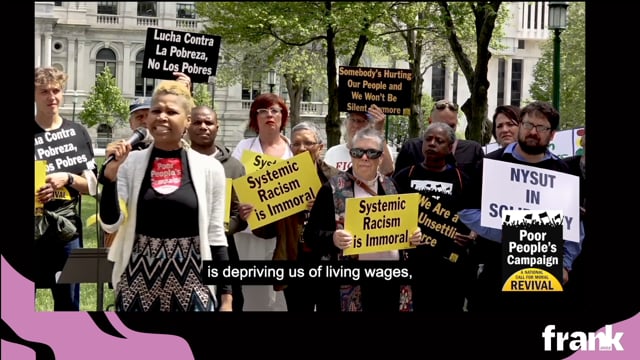 Moral Uprising with the Poor People’s Campaign
 The Unintended Consequences of Emotional Appeal