I’m sure to be here with you all. I’m glad you all got a stretch too. I was going to invite you to do that. Yeah, thank you. So I come to this conversation having worked in the public sector, the nonprofit sector, and now the private sector. And throughout all those roles, the work that I’ve done was always in building partnerships and communicating that change. So I realized when I got invited to this conference that I’m a part of an emerging discipline that I didn’t even know I was a part of, of public interest communications. And I’m really impressed with the direction that this is going and Florida’s leadership on this. So when I got invited, I really thought about what is it that I can share with you from the places that I’ve been. I want to give you something that will not only perhaps inspire you, but leave you with something of value that you can take away with you. I landed on something that GSK is doing that I think is pretty special. And I want to share it with you for two reasons. The first is that I believe the magic can happen at sector intersection. Maybe some of you, maybe that’ll be one of those hashtag words today, sector intersection. The second has to do with giving voice, giving voice to others. So as background for those of you who don’t know, GSK is a global healthcare company. We discover and develop medicines, vaccines and consumer healthcare products. These products help millions of people around the world do more, feel better and live longer. In 2009, our global CEO Andrew Witte launched a new employee volunteer program. This program is called Pulse, or the Pulse Volunteer Partnership. Each year GSK sends up to 100 employees out all around the world to serve with nonprofits. And through this service, which they do for up to six months, full time, what they’re doing is working together on tackling some very pressing and complicated global health challenges. The program is designed to bring change. Change in the employees themselves, change in the communities that they’re serving, but also change for GSK. So our employees are coming back with fresh ideas, new energy, and also with a bigger world view. So as I mentioned, the program was started in 2009. By 2012, it was clear that our Pulse alums were coming back with more than just some new ideas. They were actually coming back with some really compelling business ideas that had social value. So in an effort to collect and nurture those ideas, GSK launched something called Pulse Lab. I’ll illuminate what I’m talking about here by sharing my colleague Graham’s story. Graham is a scientist at GSK, and he spent six months on his Pulse assignment in rural Kenya, helping volunteer community health workers. He helped them set up small businesses, such as he helped them buy bee hives and by selling the honey from the hives, they generated income for themselves and their local hospital. Through the process, Graham became convinced that we could find a way to use social enterprise to overcome some of the hurdles that limit access to health in the world’s poorest countries. One of those hurdles is diagnosis. Cheap, reliable diagnosis of diseases in remote rural areas can be really challenging. Tests might not work properly because of a lack of electricity or water, or they may just not be available. This means that for the most common conditions, they can go undetected. For instance, in developed countries, where we are potentially devastating conditions for pregnant women like Proclampsia or Anemia, they’ll go diagnosed, and those women will be treated. But in the least developed countries, these conditions might not be picked up. What that means is that every minute, at least one woman somewhere in the world dies from complications related to pregnancy or childbirth. Tests could be saved if we bridge this gap. So when Graham returned to GSK from his pulse experience, he brought with him a seed, an idea. Could we design diagnostic kits that are cost-effective, accurate, and able to be read by health workers with minimal training? And could these health workers then create a small, sustainable business around the test? GSK doesn’t have much experience in diagnostics, but the head of our global R&D supported Graham’s idea and put him in touch with some of his contacts, including folks at Johns Hopkins University, who were investigating diagnostics. Graham used the Pulse Lab as well as internal social media to engage with other like-minded colleagues. He built a team of passionate internal experts, and they mentored the students at Hopkins who were researching these new diagnostics. The work progressed all the way to field trials in Nepal, but unfortunately, then they had negative results. It wasn’t successful. I share Graham’s whole story, including the ending that we’re all a little disappointed in here, because I think it’s important for us to be frank about when we succeed and when we have setbacks and of course how we are evolving in that process. So while very disappointing, Graham’s work certainly renewed GSK’s interest in diagnostics, and there continues to be an interest in the space to this day, especially in the areas of neglected and tropical diseases, which is a huge area. For Graham, his pulse experience has been formative for his career. He got promoted and now heads up an entire team of scientists. And the disruptive innovation that he observed when he was in Kenya, the work that was addressing those at the bottom of the pyramid, that has now inspired him to find more cost-effective, safer medicines which can be stable and accessible and hard to reach communities. And as for the pulse program, the beat goes on. We’re continuing to see employees coming back from their pulse assignments with energy and ideas. And these ideas, again, some of them are very good business ideas for society. So what we did was we took it to the next level and we launched the innovation challenge. Thirty-one ideas were submitted through the innovation challenge, and it was done so through a crowd-sourcing platform, which allowed the ideas to be further developed. The top-voted ideas were reviewed by an expert panel, and there were five winners selected. These winners were selected because their ideas were not only innovative, but they also had the high propensity of being funded by the business. So now each of these winners is working with the right people at the company so that their ideas can be activated for social good. So as you can see through our pulse program, our employees are getting out into the field, working alongside nonprofit partners on very complicated health issues, and then they’re bringing back very important information to the company. They’re helping bring back, excuse me, and bring about change in themselves, in the community, in the company. So as these employees bring the outside in, which helps make GSK stay in step with global health needs, it’s also, frankly, helping GSK be a better company. So as you go forward in the field of public interest communications, I encourage you to consider two things. One is as you advance work on the causes that are most dear to you, think about where is the sector intersection, because that’s where the magic can happen, and some really great things for society can unfold. Are you working with the private sector? Also, I encourage you to think about how you’re giving voice, not just to those to whom you’re communicating, the larger public, but think about looking back inwards in your organization. Are you giving voice to your colleagues who might have some very compelling ideas to help society? Thank you for your kind attention. Look at you even moving that. You don’t have to do that. We have me for that.





 Seven Minutes In Heaven… With A Scientist
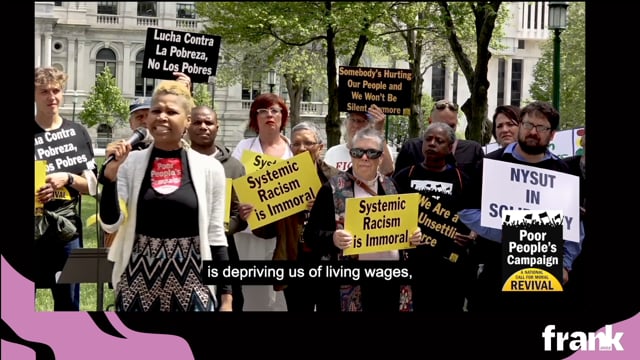 Moral Uprising with the Poor People’s Campaign
 The Unintended Consequences of Emotional Appeal