
Fresh From the frank Stage
Standout talks from the most recent 2023 gathering, featuring bold voices, urgent truths and unforgettable moments.

Amahra Spence
Liberation Rehearsal Notes from a Time Traveler

Shanelle Matthews
Narrative Power Today for an Abolitionist Future
Nima Shirazi
Irresistible Forces, Immovable Objects
The Speaker
Annie Neimand Ph.D..
Annie Neimand, Ph.D.., is a social change strategist and researcher specializing in systems thinking, human-centered design and frameworks for justice. Formerly Director of Research at UF’s Center for Public Interest Communications, she’s collaborated with the UN, Gates Foundation and National Geographic.
Go To Bio
Watch Next
-
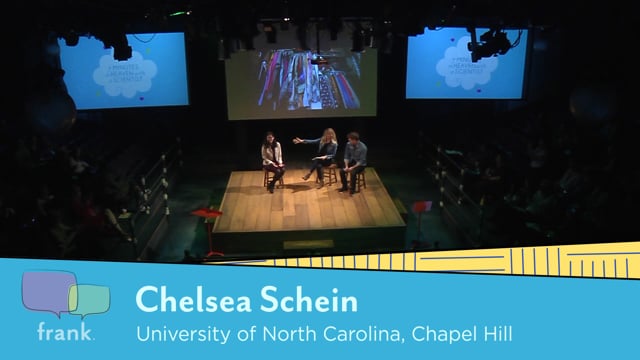 Seven Minutes In Heaven… With A Scientist
 -
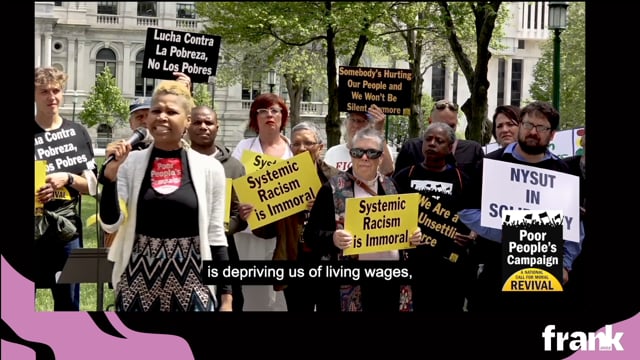 Moral Uprising with the Poor People’s Campaign
 -
 The Unintended Consequences of Emotional Appeal
Seven Minutes in Heaven with a Scientist
Behavioral ScienceCommunicationsPublic InterestSeven Minutes in HeavenThe Event
Transcript
How are you feeling? No, how are you feeling? Okay, one more time because we all have to feel as good as we feel right now. How are you feeling? Yes! Okay, welcome to Seven Minutes in Heaven with a Scientist. I am Annie Neiman. And I’m Lauren Griffin. And we are the hosts of Seven Minutes in Heaven with a Scientist, but we are also the resident Frank researchers. So what that means is that we are in charge of building the academic leg of what you all do every single day. One of the ways we do that is through the Frank Research Prize in Public Interest Communications. Want to tell them what that is? I certainly do. So today we are here to introduce our three finalists for the Frank Research Prize in Public Interest Communications. Now the Frank Prize is sponsored by the College of Journalism and Communications here at UF, so we want to give them a big shout out. Thank you so much. And we also need to give a shout out to our review board of practitioners and scholars who helped us whittle down this massive pile of submissions to the three finalists you’re going to meet today. We absolutely couldn’t do it without you guys. Thank you so much. So here’s what happens with the prize. Every year we bring in some of the top scholars whose work is helping to grow the field of public interest communications. We get it down to three finalists and then you guys get to help us pick the winner. And the winner gets $10,000. Oh my gosh. $10,000 is a lot. I don’t know if I’ve ever seen $10,000 before in my life. I don’t think I have either, but… Is it in like a sack? Or a giant check. Troy, when you left, did you have like a sack over your shoulder with $10,000? No? I don’t want to talk about that. Okay. Very wise man there. So our two runners up also get $1,500 each and they leave with all of you as good friends. So it’s a good deal for everybody. Now you’re all going to be voting on this, but we’ll talk more about that later. Right. So I saw a lot of new hands up yesterday. How many people? Is this your first time here? So you’re probably wondering what is seven minutes in heaven with a scientist? Are we going to be kissing scientists in my dreams maybe, but no, we’re not going to be kissing scientists. Let me give you some context. So we at Frank tend to think of researchers as rock stars. As Liz rightly noted, we are professional science fangirls. No big deal. We’re a professional title. But I heard yesterday, Dan Ariely, no big deal that you had seen seven minutes in heaven on video and we’re sad that we didn’t give you the same seven minutes in heaven treatment. So I just want you to know that I can’t believe you know I exist. That is like, I’m like sweating thinking of you, thinking of me. And we’ve walked by each other many times today and I stared at you. I was trying to figure out how to introduce myself to you. So I guess this works. Hi. I love you. You’re one of my favorite, favorite, favorite. So I hope that does it for you. So does it for me. So last year we launched seven minutes in heaven with a scientist here with our Frank Prize finalists, our academic crushes. We went into the closet with Troy Campbell who won our 10K prize. No big deal. Julia Frostino who’s not here, amazing Frankster. And Jeff Niderdepe who is also a badass. Next time that maybe they’ll be here. But it was so much fun. I think it’s probably my favorite thing we’ve ever done. We loved it so much that we launched the seven minutes in heaven podcast that you should be getting in your Frank newsletter every single month. So check it out if you haven’t. So but it was so much fun that we thought we would bring it back again this year except this year we’re doing it a little bit differently. So we know these researchers really well. We are obsessed with them. We have crushes on them. We have Google alerts on every researcher actually in this room to know what you’re doing. So we don’t need to interview them to find out who our research crush is. So we invited one of our favorite, favorite communicators to come out here and help you all find your next research crush, your next research obsession. And twist, last year I was the one who got to spend seven-ish intimate minutes in heaven with my favorite research crushes one on one. But this year we decided to throw all of them in the closet at once so you are going to see everybody together talking science. Doesn’t that sound awesome? Yes? I’m getting like hot thinking about it. So all right. So are you all ready for seven minutes in heaven with a scientist? Yes? Are you ready? All right. Hit it. No, not start over. Hit it. Hit it. Hit it. Hit it. Hit it. Hit it. Hit it. Hit it. Hit it. Hit it. Thank you. If you’re feeling lost and you don’t know what to do, need someone to trust, someone to talk to, spend seven minutes in heaven with a scientist because everyone, everyone, just a little bit curious. Thanks, folks. Sexy, right? I’m married to him so I get that all the time. All right. So are you ready to meet our interviewer? Yes. Lauren, who is our interviewer? We are so happy to have Kristen Grimm from Spitfire Strategies here. Thank you so much. Woo! Let’s welcome Kristen. Hi. All right, Kristen. Thank you. No big deal, but you’re in charge of helping all of these people find their next research crush. Yeah. Well, first of all, I feel very good about this because as you see, I love scientists too. So is anybody else here love scientists? Woo! Would other people like some t-shirts that say, I love scientists? All right. Now, Bobby told you that you can’t buy it. You have to earn it. So let’s see it. Jill has got some. Jill has got some. I want this look. All right. Feeling very good about this crowd. Yes. Feeling good about the crowd. Yes. All right. So we should bring out our… Yes. Are you ready to meet your potential new research crush? I am. Although, you know, Annie, I had to tell you something and I know we’re different in age and in many ways because I could never stand in those on a stage. But back in my day, during seven minutes in heaven, I did it more as like a one-on-one thing. Like, this is a lot. You know, it’s a lot of goodness in one closet. Times have changed. Yeah, no, that’s what I’m saying. So, yeah, but let’s bring them out. I’m nothing if not game to try something. I am curious. Yes, we are curious this year. All right. Do you want to meet our very first finalists? Yes. Okay. Let’s welcome to the stage Dr. James Druckmann. He is a professor of political science at Northwestern University and he works in the Institute of Policy Research. Watch star. No big deal. All right, Lauren, who is our next finalist? Our second finalist is Dr. Lisa Fazio. She is an assistant professor of humanities and development at Vanderbilt University. And our last finalist has a name that will be stuck in your head for the rest of your time here. Let’s welcome to the stage Sandra VanderLinden from Cambridge University where he studies psychology. All right, are you ready? I’m ready. I do need to. I think that since we’re in a post-truth world, I just think it would help all of us if we all wore our hats. And really, how we’re actually going to decide who wins this prize is whose hat stays on the longest. All right. No, no, I’m kidding. We’re going to vote because that’s so much better. Oh boy, yeah. I hope you guys are good at your day job. Okay, so. Think I’m out. I think you’re going to have to give up the ghost. But yeah, I’m feeling good about Lisa. Okay. So, James. I’m going to give up here. You know what? You got to let it go. Okay, you’re not tin-fuel worthy. It’s okay. You’re a researcher. You just can’t go there. The funny thing is you are the one who wrote about conspiracy theories and you can’t balance that. This is why it’s not staying on. It’s a conspiracy. All right. I lost mine too. All right. So, James, what makes you curious? So, I’m curious about curiosity really. So that started when I was a kid. So we had a rule at my dinner table when I was growing up that I was limited to ask three questions. Everybody in the family knew that if there was not that limit, I would take up the entire dinner conversation and I would just ask one question after another. My sister had a different role. She could ask as many questions as she wanted because we all knew she’d only ask one. Can I be excused? I’m very curious about curiosity. And then I was also curious about the role of science instead of curiosity. And that came… Oh. It wasn’t me. See, I’m making science and there’s a conspiracy. So my dad worked at the National Academy of Sciences when I was growing up and he produced reports. And one of those reports was called Enhancing Human Performance, which came out. And in the report, they evaluated the scientific evidence for ESP and they concluded the best scientific evidence does not justify the conclusion that ESP exists. And they went on to very nicely actually say we understand people might disagree and here are ways to assess this. And I was very young when this came out and he ended up getting all kinds of pushback, including hate mail. And so, I’ve got a letter. I’m still not figuring out the ideology behind this. You damn liberals don’t know the science. I’m onto you. And so… I don’t really… I’m still… I want to ask him what the political stand… So anyways, I was very curious and then I was curious why people were not accepting science and kind of what was going on there. Interesting. Lisa. Yeah. So I’ve always been a curious person. I come from a family of academics. This is a part of our everyday values as research methods and what’s the data and how do we figure that out? So while other kids were doing volcanoes for the science fair, in my family I tested whether my gerbil had color vision. Seemed like a reasonable thing to do at the time. And then when I got to college, I knew I wanted to research something. I was passionate about it, but I had no idea what it was I wanted to study. Psychology, chemistry, psychology, I didn’t know. And I took a cognitive psychology class and I got fascinated by the fact that we can use these strict scientific methods to figure out how we think and what really interests me is when we think incorrectly. So we can have elaborate false memories of events that have never actually occurred. And so one of the things that I research now is what about with factual information? How do we develop these incorrect representations, incorrect facts in our head and then what can we do to fix it later on? Interesting. Sandra. So I grew up in Holland and when most people think of Holland, they think of happy people riding their bikes along the canal waving at each other. And for the most part that’s true. My parents actually grew up right after the Second World War. And when I was little, I was curious where a lot of my family was in the sense that my friends seemed to have a lot more family than me. And so I was curious about this and I started asking my parents and eventually they told me that about most of my family on my mother’s side was executed during the Second World War in Auschwitz. And that really got me thinking about propaganda and misinformation and how that can be used against other groups and how that influences human behavior at a collective level. And so one day at the Anne Frank Museum, this was the house that she was hiding in when the Nazis were occupying Amsterdam, she wrote this letter and when I was reading this letter really struck me how fundamental her insights were about the nature of human behavior even though she was a little girl. But it also struck me that even though I could cognitively comprehend all of the atrocities that had occurred, I couldn’t possibly experience and feel the same things that she had. And so this idea of psychological distance really dawned on me. Thinking about genocide around the world, famous saying, you know, the death of a single individual is a tragedy but the death of a million is a statistic. And so I got interested in this idea of distance and particularly one of the, what I think is the biggest existential threats of our time, climate change which is incredibly abstract, it cuts across all kinds of issues. You can’t experience it directly, it’s not socially relevant for most people and so I thought if I can crack the psychology of climate change maybe that will reveal some interesting insights about lots of different social issues. Alright, so Lisa we’ll start with you. What did you explore in your paper and what were your findings? Yeah, so what we were interested in is this old findings from the 1970s. It’s called the illusory truth effect. And what it is is that if you read something twice you think it’s more true than if you’ve only read it once. Scary. But psychologists had always assumed that this only happens for facts that you really don’t know anything about. So it’s typically tested with things like French horn players get a bonus when they join the US Army. Turns out you do. You can earn a couple thousand extra bucks if you play the French horn and you go into the US Army. But most people have no real knowledge to base whether that’s a true or false fact. So in some ways it’s not surprising that when you hear it twice you’ll think it’s more true. What we wanted to look at is what happens if you’ve got prior knowledge that contradicts that information. So what we looked at was facts like the skirt that Scottish men wear is called a sorry. Now you all presumably know that it’s actually called a kilt. But it turns out even among people who can later answer the question what’s the skirt’s name it’s a kilt they’ll still think that that statement with sorry is more true if they’ve heard it twice as opposed to once. So just being exposed to that sentence two times makes it feel more true to you. Nice. Sandra what did you explore and what did you find? So the paper was called the conspiracy effect and the idea was that although we know a lot about the personality correlates of conspiracy thinking and how conspiratorial worldviews work in terms of the people who endorse these theories what’s less known is how we’re all affected by being exposed to conspiracy theories on a daily basis. And so really about the influence process. If I briefly expose you to conspiracy theory almost you can think of it like a social contagion. Can you catch that sort of line of thinking and how does that then influence your behavior and decision making about science and society. And so in the experiment what we did is we had three different groups and one group was exposed to a conspiracy video about global warming. It was called the great global warming swindle. It was about a two minute video. Then another video was from the UN which was a positive social change video which was basically the opposite and the third was a control group. And then we asked people some questions after of course they didn’t know they were participating in a study about conspiracy theories. But we asked people some questions about do you endorse the scientific consensus on climate change because we know that belief is linked to all sorts of other beliefs that people have about climate change. But also things like civic action. Are you willing to sign a petition a real petition to help stop global warming. And we also thought about well maybe being exposed to conspiracy theory in one domain could trickle down and influence other forms of behavior. And so we asked people about some general pro-social tendencies as well. And so what we found was that the conspiracy effect is real in the sense that those people who were in the conspiracy condition were significantly and substantially less likely to accept the scientific consensus on climate change. They were much less likely to sign a petition and actually enact social change and do something about it. But quite interestingly there were also generally a bit less pro-social in the sense that being exposed to a certain line of thinking in one domain actually transfers to other domains as well. And so when you think of Donald Trump as the conspiracy candidate floating conspiracy theories about climate change, vaccines, fake news exposing us all essentially to conspiracy theories on a daily basis that really embodies the conspiracy effect. Wow. James, do you have better news for us? I hope so. So we were interested, so this was in our paper we were interested in how people process scientific information. And in particular what do people do when they get scientific information? So if they’re told there’s a consensus scientific information behind something like a new technology like carbon nanotubes, what do they do with that information? But then what happens if that information is politicized? And by politicized I mean when people bring out the point that science is inherently uncertain and can be used for political purposes. So a good example of that was in 2014 there was a consensus scientific statement that there is human action is the primary cause of climate change. And the day after that report, Marco Rubio, who was then Senator Marco Rubio said, I don’t believe that there’s reasonable doubt on the subject I’ve seen debate. Another example would be Donald Trump in 2012 when he said climate change was a Chinese hoax invented by the Chinese to undermine US manufacturing. So we wanted to see what happens when you politicize that science. And so what we did, we did a little more, I’m going to get to that in a second, the upside. So what we did is we, I was saying you’re on the downside. I’ll start on the downside. The downside is what we found is when you gave people the, we randomly assigned an actually representative sample and we get, some people just got scientific information about a technology and they became more supportive of that technology like carbon nanotubes. So that was good, they were believing that. But we also found it was really easy to undermine that science by simply reminding people that science is used, science is uncertain and can be used for political purposes. So that’s kind of the depressing point. But what we’re really interested in is counteracting that. How can we counteract that? How can we? So I’ll tell you. And so, and then the, in the short line is you play offense. And so what you do is if you get in there beforehand, before there’s that politicization attempt and you tell people, you warn them, look, there’s going to be attempts to politicize this. Those attempts are false and you shouldn’t believe them. That was really effective at resuscitating the science. Now we also found, of course, you can’t always preempt things because you don’t know what’s coming. Even if you get an after the fact and you directly play offense, even retrospectively, it can be effective, especially if people are motivated. But if you even, you should directly get in there, challenge attempts to politicize that science and that can resuscitate the science. So there is an upside if you, if you, if you play offense. It’s true. You are, you are more hopeful than the Holland guy in the waving. Yeah. No, totally. Yeah. Okay. Sander, according to your research, how can we better communicate truth in a post-truth world and build trust on our issues? Right. Actually, Dan Ariely said something really important about trust last night, I think, that we have a very asymmetric relationship with trust. And so it takes a really long time to build, but we lose it in just a matter of seconds. And so people trust what they know to be true. And so how can we communicate things that are true? And actually want to build off something that Jamie just said here. In some of our research, we draw on a medical analogy where just as vaccines can offer protection against infections by injecting yourself with the weakened strain of the virus. In some of our research, we find that you can do pretty much the same with information, that if you pre-expose people to a weakened dose, a non-lethal dose of falsehoods or misinformation, and then debunk that preemptively, that actually helps people build resistance against influence and propaganda and misinformation. And so essentially what that means is when the truth is being attacked from all sides, if we want to communicate truth in a post-truth world, wrapping the truth in a protective cover that might help increase the life expectancy of truth in the current information environment. All right, Lisa. Yeah, so I think one thing that’s important to keep in mind with big political divides, different social tribes, all of these differences between people is that we’re all human beings, and that we all have brains. And our brains work in specific ways. Most importantly, they don’t like to do work. Our brains are amazing computational powerhouses. They’ve got the capability of doing really deep, critical thinking, and they hate it. We will do almost anything to take a shortcut and go with the quick response. And that’s what happens in these illusory truth studies. People go with their gut. It just feels more true. And they’re not actually looking back and looking at what their prior knowledge is and what that has to say on the subject. James. Yeah, so we did… This is a great hard problem right now. What we did is we did a follow-up study on looking at playing an offense, and we found that when we looked at climate change, there was a certain group of people that we could not move no matter what. And what we found is that that group had various characteristics, but one thing is that they believed in conspiracy. So we were inspired somewhat by Sanders’ work on this. A lot of his conversations are true. Yeah, so back and forth. And so we did another study. And so what we did is we said, what if we validate and we respect those belief systems? And so what we did is we identified a subgroup of people who were likely to believe climate change is a hoax. And then we sent them messages about scientific consensus on climate change, but we said respectfully, or not, but we tried to be respectful in the message, that a majority of people in this country do believe in conspiracies, and that’s true, a majority believe in one or more conspiracies. And when we did that, when we validated their belief systems, they were much more likely to then believe that climate change is human induced. So we actually were able to move them. And perhaps even more importantly, because we were a little worried about that, right? We’re revalidating a belief system we want to validate. But we also asked them, would they be open to getting more information on the issue? And they were open to that. So we were very pleased to see that we could actually engage them. So one of the themes that a lot of speakers have said is, in this time, you want to play often somewhat, but you have to do it respectfully. And so you want to validate other belief systems and engage them. So that point of engagement, so even if you don’t like those belief systems, you want to make sure you validate them and respect them. And then you can try to engage them and change them, perhaps. All right, and sticking with you, so this is a lot of good research. How would you practically suggest that advocates and activists apply it? So James? Yeah, I mean, I think one of the things that’s very inspiring to me is this group and this gathering is I’ve learned so much from listening to everybody else. And then I try to think of, well, what’s my role? What can I contribute here? And I think if I have any comparative advantages, at least I think a lot about psychology and politics and how they interact with one another and how to evaluate the effects of different messages and kind of on different outcomes. And so I like to think after many years of doing this, I have some skills in doing this, but what I don’t know is exactly what issues should I be studying, what population should I be looking at, what messages should I be looking at. And so the idea of kind of collaborating with groups of activists and journalists and public interest communicators and kind of bringing in, looking at academics as a resource, but then academics can also look at this community as somebody can tell us what we should be doing. I think that’s really what would be helpful for all of us. We know what’s to study better and then we can be helpful in helping society. Great, Sandra. Now I agree in the sense that I think operating at the nexus between research and practice is really important. I was at a meeting not too long ago attended by the DUN and some government institutes, but also companies like Facebook and Google and they’re all very concerned about the fake news situation. And one thing that struck me as really interesting is they said, this inoculation psychological vaccine research, and this was Facebook talking about their new warning label system. And they were saying, essentially what we’re doing is trying to warn people in advance of fake news stories. And they were showing me this tool and we were just talking about this at the research and I think it’s a very practical way of implementing some of these findings in the sense that what happens is that when you share a fake news story, what might happen is that you receive a warning before you share it that says this source or this information hasn’t been verified. Do you really want to share this or something like that? And I think with a lot of this, it’s the fact that people on autopilot reshare, we reshare information without thinking too much about it. And this sort of creates this virality and the transmission of fake news that really speeds it up and makes it so that it’s actually influencing us. And so I think intervening and breaking that virality and that is really important. I thought that was a really practical instance. So these are sort of the interim solutions, right? I think in the long term, this is really about social anxiety and social tensions and value sets that are conflicting between different groups of people. And I think sometimes what I’ve realized is that we’re really not reaching out to those communities who are marginalized, who feel that their voices are not being heard. And there’s lots of research that shows that positive interactions with the issues and groups that you hold negative stereotypes about can be really influential. And so in some research, a colleague of mine that we’re working on a paper, but he went out canvassing door to door talking to people about climate change. And we find that that’s a factor for both conservatives and liberals. And so I think grassroots and advocacy organizations, they’re in a unique position to actually go out there, maybe implement some of these insights, but actually talk to people and have positive conversations. Okay, Lisa. Yeah, so I think one thing we can do is use this lazy brain for good. So you can take advantage of the fact that our brains don’t want to do work. So this illusory truth effect happens because when you see it twice, you can either just rely on how easily you process that sentence. It’s called, we call it fluency. It’s just how quickly and easy was it to understand. And we would interpret that increase in fluency as a signal that this statement is likely true. Or you can do the more hard work of actually comparing it with your prior knowledge. Well, repetition isn’t the only thing that increases this fluency, this ease of processing. You can do a number of things. So high contrast colors, people think the information is more true. Easy to read fonts, people think the information is more true. Simple sentences that are easy to understand, that don’t have complex words in them, complex syntax, people think it’s more true. If I’ve got two people standing in front of you, one giving this complicated scientific talk, the other speaking plainly, you’re gonna think at least implicitly that the plain speaking person is telling the truth more. You’re gonna believe it more. And so one thing I think as communicators you can do is use this lazy brain for good by making sure that your message gets that same sense of fluency, that same ease of processing that’ll help people believe it and spread it. So lean into the lazy. Lean into the lazy brain. Use it for good. All right, I feel like we’ve really been talking about you a lot. Do you feel like that? Like I’ve really given you some time, so let’s talk about me. So here’s my problem. And this has been long standing. So my husband and I have very different views of food. So my husband cures me, for example. So as I was packing for this trip and I went to the closet that has my sundress collection, I happened to notice that there was a gigantic prosciutto that he is curing there, which now explain why my dogs were hanging out by that closet so much as well. Anyways, and all the dogs here have been following me around. So, but the thing that we really disagree about, which is not why maybe meat shouldn’t be hanging in our closet, which I know you’re like, maybe that’s what I should focus on, but I’m not. I’m focused on in the fridge, right? I am a big person that that date, the expiration date, means it gets thrown away. And he is like, that is a government conspiracy, basically. He is like, and so he’s constantly trying to sneak this food into my coffee cup. Or like, you know what I’m like, did you check the cheese date? And then like, I had to chase him around the kitchen. I mean, it really gets very intense at my house. So now you may think to yourself, hey, why did David marry me? But that’s a longer story. So you’re not on David’s side. You’re on my side because I am really critical to your prize success. I just want to say that you can sort of see that I am prize winning myself. So, okay. So I’d like to know when I go home and I would like to finally end this once and for all, how am I going to get David to not put, you know, expired cream in my coffee? James. Yeah. So the upside is we, I knew you mentioned this yesterday. And so the first thing I’d say is learn the science. And so, I wanted to learn the science because we have the same argument in my household. And so I’m actually, when I’m about to advise, if you call me a week, I’ll tell you if it worked. So, you know, I would suggest, I mean, based on what we found in our paper is play offense, try to, before you get to the point where you’re having the conversation about the prosciutto and if you should throw it away, before that, have a conversation about why expiration dates and you should get rid of food before expiration dates. But when you do that, try to be respectful of his belief system and where he’s coming from. Okay. That might be a challenge, but, you know, if you do that, it could be strategically helpful to you. And it also could potentially preempt to when you get to that point, this is already in his mind. And so I tried to do this last night when I talked to my wife. I won’t tell you what side I’m on in this argument. So we’ll see if it worked. I think we know. All right. Well, I’ll look forward to the experiment. We’ll both report in. All right. Sandra, advice. I’m trying to be careful in framing my response here. So, you know, going out for James, so one thing you could do is you could survey all of the doctors in your local area and try to get a scientific… Because I seem like a woman with a lot of free time. Right. This is what I was going to say. And be like, all the doctors… I’m going to get down a little bit. Just move it. Exactly. You know, it’s better to be safe than sorry, maybe, right? If that is the perspective that you’re after. Right. On a more serious note, I would say, you know, thinking about topics like trust and cooperation, maybe one way to gain trust and cooperation is to say, okay, so this week we’ll try your way. I’ll, you know, I’ll eat the expired food, but I trust that next week… Is there going to be a next week? I mean, I’m going to read this 30-page treaty you just handed to me, but I’m, you know… It’s cool. Yeah. Okay. I’ll go your way. One week his way, one week my way. I understand respect. I got it. I got it. Lisa, save me here. So you can try just repeating the information at him and keep telling him that expiration dates mean something and that we’re all going to die if we eat the expired sour cream. One thing we’re interested in exploring right now that we haven’t figured out yet is where’s the limit? So we know that this works for facts that contradict your prior knowledge, but we also know it’s not going to work for some things. No matter how many times I tell Kristin that her name is George, she’s not going to believe me. That’s not going to… She’s known her name since birth. It’s not going to overwhelm that really entrenched memory. And so I think where that boundary is of where this illusory truth effect works and where it doesn’t is something important that we need to figure out. All right. This is all very good advice. It may extend my marriage for a week, which is exciting for me. So we’re going to bring Annie back up because the important thing to know is that this is not your prize. This is my prize. I got it because I used to run the cruise here and we got really competitive, which I thought was super awesome sauce and everybody else didn’t. So I have been promoted to interviewing the finalists. So… And that’s fine. That’s fine. Because I have enjoyed. I do have crushes on each and every one of you. I think it’s a really difficult choice, but let’s get off the stage so we’re not talking about you while we talk about judging you. So let’s go off the stage. So you’re feeling lost and you don’t know what to do. You want one? Wow. This is kind of… Oh my gosh. That was so hot. I can’t even. Oh my gosh. All right. They don’t work, Kristen. Don’t go into having anything. What’s with those hats? So now you all are going to vote for the $10,000 winner. This is how you’re going to do it. You don’t have to do it this moment. It’s open till 10.30 tomorrow and the papers are published on the Frank website. So if you want to read the methodology and get more context, you can read them there. You have time. You can track down the researchers and ask them questions and get some more information to find out if they are your new crush. But you are going to text your number to that number in the black box. And if you like James Druckmann and his co-author was Toby Bolson who presented at Frank Scholar, fabulous. He’s right here. So if you want to harass him and ask him questions, you can use this number. If you loved Lisa Fosio, here’s your number. And if you love Sandra VanderLinden, here’s his number right here. And you have till 10.45 AM. And we will announce the winner tomorrow. I just tried to say sorry, the service is not available. All right. I’ll fix that. But make sure you get your vote in by tomorrow at 10.45. And if you enjoyed this and you want more of the research that helps drive social change, you can visit our website. We have an amazing website where we have all of our podcasts up. Seven Minutes in Heaven With A Scientist.com. All one word. So go there, listen to the other episodes. We’ve talked to people about climate change, conspiracy theories, the election. We cover all sorts of amazing research and we would love to share it with you. You can also sign up for the monthly Frank newsletter by going to the Frank website. And you can get it delivered right to your inbox so you don’t have to do anything. It’s just right there. Yes. And we share the science of social change every month. So if you want all of this science to make your work even better, you can have it delivered to you monthly. And if you don’t want to check your inbox, you can connect with us on social media. You should be following us on Instagram, Twitter, Facebook, Snapchat. And we will share and connect with you and we’ll keep doing this great work. Thank you very much. We hope you liked it. And I’ll go fix this now.
Watch Next
-
Seven Minutes In Heaven… With A Scientist
-
Moral Uprising with the Poor People’s Campaign
-
The Unintended Consequences of Emotional Appeal