
Fresh From the frank Stage
Standout talks from the most recent 2023 gathering, featuring bold voices, urgent truths and unforgettable moments.

Amahra Spence
Liberation Rehearsal Notes from a Time Traveler

Shanelle Matthews
Narrative Power Today for an Abolitionist Future
Nima Shirazi
Irresistible Forces, Immovable Objects
The Speaker
Annie Neimand Ph.D..
Annie Neimand, Ph.D.., is a social change strategist and researcher specializing in systems thinking, human-centered design and frameworks for justice. Formerly Director of Research at UF’s Center for Public Interest Communications, she’s collaborated with the UN, Gates Foundation and National Geographic.
Go To Bio
Watch Next
-
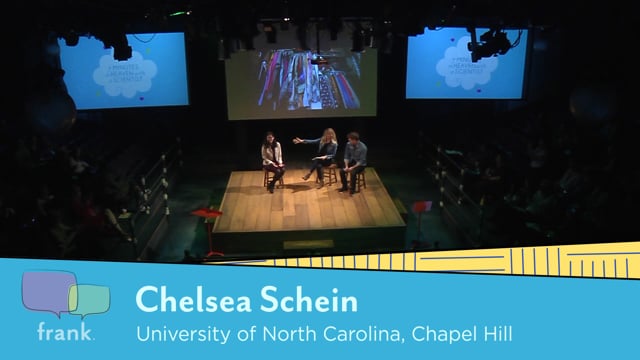 Seven Minutes In Heaven… With A Scientist
 -
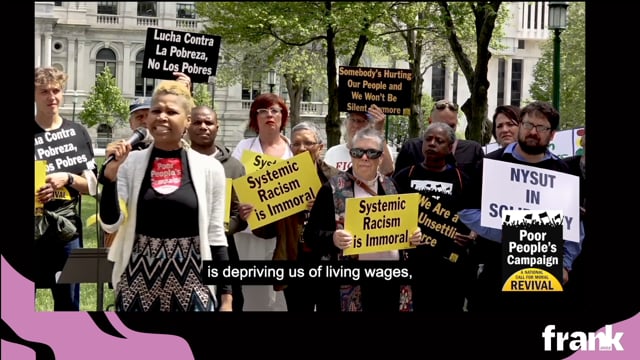 Moral Uprising with the Poor People’s Campaign
 -
 The Unintended Consequences of Emotional Appeal
Seven Minutes In Heaven… With A Scientist
Behavioral ScienceCommunicationsPublic InterestSeven Minutes in HeavenThe Event
Transcript
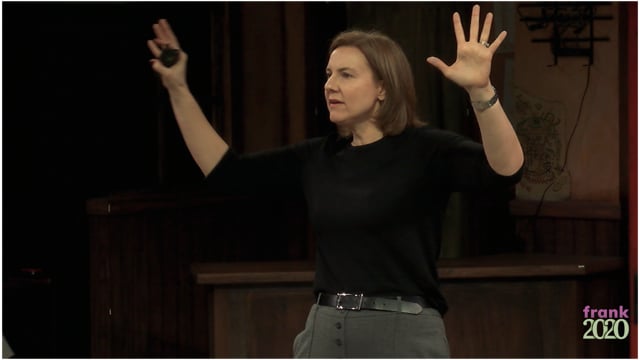
How are you feeling? Good morning. Are you awake? Yes. Are you still drunk? I know some of you are, because I saw you this morning and you were definitely drunk. So today we are going to interview all of our prize finalists for a live taping of our podcast, Seven Minutes in Heaven with a Scientist, because everyone is a little bit curious, right? A little sigh curious, as Anne Cristiano calls it. So let me give you a backstory on Seven Minutes in Heaven in case you’re like, what the hell is this? The scientists agreed to do this. So one day a couple years ago Anne Cristiano and Lauren Griffin and I were sitting in Anne’s office and we were obsessing over some science as we do every single day. And we came back to this conversation we usually come to, which is wouldn’t it be great if everyone who’s working tirelessly to drive social change had access to this research and knew how to apply it? And we’re like, yes, we need to get it into their hands. So we said, what if we sit down with these scientists and have one-on-one conversations and make them accessible to change makers? And because we’re Frank, we’re like, let’s do it in a closet and record it because we don’t do anything normal here at Frank. So thus was born Seven Minutes in Heaven with a scientist where we spend seven-ish intimate minutes in heaven with your new favorite researcher. Or we like to say research crush, the brains behind your latest research obsession. So today we will meet some of those scientists who you will soon be stalking their Google scholar page just like the rest of us. And it’s absolutely a wonderful experience for our scientists to do this or be here. Last night it was 9.30 p.m. and I’m talking and I’m in that scientific mode where I’m just apologizing to the person I’m talking to and I’m sorry, I’ll stop. I promise I’ll only tell you one more fact and one more nuance. And they’re like, no, keep going on and on and on. And so many scientists like me have seen our favorite scientists get on things like the Today Show, be on it for so long and say one thing of interest. And we think, no, the science is so much more flexible. It’s so much more practical. It’s so much more nuanced. And so to have a program here like this and to have people talk and as Annie says, let’s get deep real quick and get to that is just absolutely fantastic to see the science communicated that way and really exploring the nuances and power of it. So yeah, I’m very excited to be here and I know all the three finalists are very excited to be here too. So are you ready for the first recording of Seven Minutes in Heaven with the scientists? Yes? Are you ready? Are you ready? I’m ready. Round one! All right. So we’re here with our first prize finalist, Chelsea Shine from the University of North Carolina Chapel Hill. All right, Chelsea, we’re going to get deep real quick if that’s okay with you. So as we were preparing for this interview, you shared a really formative story with us that really was the basis for your passion. Can you share that story with everybody? Sure. So my interest in rural psychology started back when I was in high school. So when I was 16, my twin sister and I worked in a summer camp in Ashkelon, Israel. And one thing I noticed on the first day of camp was this constant thud in the background. And this was in 2006, and we were working eight miles north of the Gaza Strip. So this thud wasn’t construction, it was rockets landing in the Gaza Strip. And sensing my shock, one of the parents of my campers told me that as long as the noises were going in the opposite direction, there was nothing to worry about. And as the camp days went along, I became desensitized to the noises. But that was until one of the rockets landed two blocks away from where we were. And another rocket landed the next day. And suddenly I couldn’t quite avoid this growing feeling of moral hypocrisy. I couldn’t quite understand why I thought it was totally okay when the noises were far away and the suffering of other kids didn’t matter. But suddenly when it was kids I knew and kids I saw, I had an immense amount of moral concern. And so that experience launched me on a path of studying our moral lines, of trying to understand why it is. We feel an immense amount of moral concern towards some people and are kind of numb to the experiences of others. And so how did this experience lead into the questions you answer as a researcher? Yes, so the broad questions I ask as a researcher is who do we consider as part of our moral communities and whose interests do we kind of ignore and what leads us to feel a sense of moral outrage and to feel a sense of caring about others. And so let’s talk about your specific research I’m sharing with us today which is challenging things in the field of psychology and clarifying it at the same time which is wonderful. Sure, so one of the questions I ask in this particular paper is whether or not liberals and conservatives are fundamentally different when it comes to our moral values. And the consensus in the field when I started was that actually liberals and conservatives have fundamentally different moral mechanisms. And that kind of makes some sense. We just look at the news and it seems like we’re fundamentally divided. But the question I want to ask is is there something that unifies these two processes? Is it possible that even though our moral decisions and judgments are different, the underlying psychological mechanisms can be shared? And the reason I thought this is if you think of an issue such as gun rights. While liberals might view their position as protecting children, conservatives hold their position for the same reasons for protecting children. So what I did in a series of seven experiments is I looked at whether or not liberals and conservatives both ground their moral experiences and moral judgments and perceptions of harm. But they just see harm and see who they care and concern about in different locations. So let me give you one example. So raise your hand if you believe it is harmful to kick a dog. Okay, keep your hands up if you believe that’s immoral. So there’s a perfect one-oh correlation, correspondence between perceptions of harm and immorality in this case. Now raise your hand if you believe it’s immoral to burn an American flag. So this audience is, so some hands, not my standard audience response, that’s cool. So keep your hands up if you believe that burning a flag is both harmful and immoral. So usually what happens when I ask this question is that the same people who view an act as immoral also view it as harmful. When many of us in this room are liberal though, we don’t necessarily see that harm. And instead of follow-up studies what I want to know is if this appeal to harm is just this like evil manipulation of other people’s ideas or if it was genuinely held. So what I had people do is I had people answer these questions as quickly as they could and that prevented them from engaging in this rationalization. And what we found across all those seven studies is that people automatically perceive harm where they see immorality. And this isn’t just this effortful process, this is a genuine perception of harm. People genuinely believed that when they saw an act as immoral, it caused harm most notably to children. So are you saying on a gut emotional level everybody is reacting to information and making judgments on a perception of harm? Absolutely. So what does this mean then for the people in the room who are working on issues where different stakeholders or communities see harm in different ways? Sure. So I think there’s two points that we should keep in mind. The first is that harm is a matter of perception. So things that seem very obvious to us might not be for others. So if we’re talking about reproductive rights, many of us in the room don’t see a fetus at 20 weeks as capable of experiencing pain, but the narrative is very different for people who believe abortion is immoral. And does outright discounting that? Well we know the scientific facts are in the favor. Isn’t necessarily getting at people’s gut feelings. The second point I think is helpful to keep in mind is that both liberals and conservatives have moral reasons for their beliefs. So moral opponents aren’t fundamentally evil. And that’s a really tough thing to keep in mind, especially when we view opposing views as inherently harmful themselves. Aben. Yeah. And so that’s for the policy people. So just after everybody sort of encounters your research, what’s one thing you’d like them to do that’s different? I’d like them to stop and listen. And that’s not easy. Again, especially when someone holds an opinion that we think itself is inherently harmful. So if I’m talking to someone who believes that gay marriage is immoral, I believe that position itself is dangerous. So it takes everything in me to recognize that this person is also grounding their beliefs immorality, at least at times. I’m not saying that’s true for everyone. At least some of those people, at least the neighbors I have in North Carolina, do have these genuine perceptions that are driving their beliefs. So it’s really, we need to be empathetic with the different communities we’re trying to influence and really get to know where they’re perceiving harm in order to truly communicate with them in a way that’s not threatening to how they see the world. Absolutely. Wow. So what are you working on next? Sure. So in my dissertation, I’m trying to use the knowledge I had from this previous paper to try to bridge some of these political divides. So I’m trying to see, can we get liberals and conservatives to dehumanize each other less? And can we get them to just simply listen to each other? And one way I’m trying to do this is just to appeal to kind of shared moral values first. So before we have a conversation on these really difficult topics, let’s first sit down in a room and talk about three similarities we have. Let’s talk about how we both really care about strengthening our communities. Then we can jump into the difficult parts. Then we can recognize that the other person cares about our community as well. And then we can launch a stronger dialogue even in these really contentious issues. Wow. Well, thank you so much. Chelsea Shine, everybody.
Watch Next
-
Seven Minutes In Heaven… With A Scientist
-
Moral Uprising with the Poor People’s Campaign
-
The Unintended Consequences of Emotional Appeal