
Fresh From the frank Stage
Standout talks from the most recent 2023 gathering, featuring bold voices, urgent truths and unforgettable moments.

Amahra Spence
Liberation Rehearsal Notes from a Time Traveler

Shanelle Matthews
Narrative Power Today for an Abolitionist Future
Nima Shirazi
Irresistible Forces, Immovable Objects
The Speaker
Annie Neimand Ph.D..
Annie Neimand, Ph.D.., is a social change strategist and researcher specializing in systems thinking, human-centered design and frameworks for justice. Formerly Director of Research at UF’s Center for Public Interest Communications, she’s collaborated with the UN, Gates Foundation and National Geographic.
Go To Bio
Watch Next
-
 Seven Minutes In Heaven… With A Scientist
 -
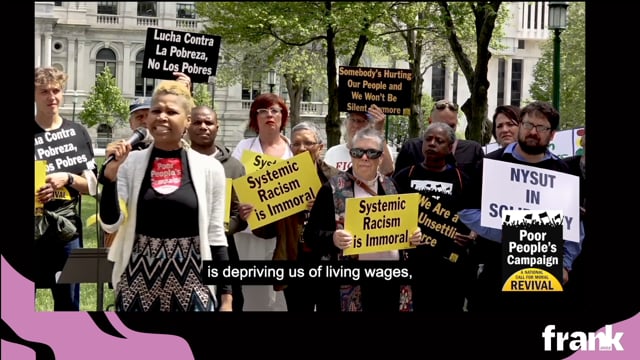 Moral Uprising with the Poor People’s Campaign
 -
 The Unintended Consequences of Emotional Appeal
Sociology, A History of Public Interest Communications
CommunicationsFrank KarelPublic InterestSociology
Transcript
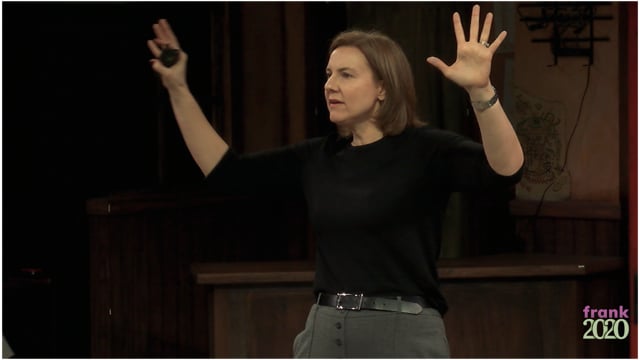
Hello everybody. I hope you’re having a good time. I’m having a really awesome time so far. This is really great. Yeah. One guy or girl. I am a sociology PhD student here at the University of Florida. That’s what it looks like. You haven’t seen it yet. Take a note in your little diary that they gave you. I am a PhD student here at the University of Florida. I’m also research director for Frank. And some of you might be wondering why does Frank need a research director and why one located in academia? Well being located in academia I see a real disconnect between research coming from my field and others and discourse, policy, law made in the public’s interest. So when I found out about this growing movement at the University of Florida that sought to address this disconnect I was thrilled to jump in. I was certainly an easy convert to the cult of Frank and I’m pretty sure you guys all are jumping on the bandwagon with me. Okay so as research director I have two objectives. My first is to bridge the practice of public interest communications and academia. Again being located in academia I see really important and critical research that gets lost in the ivory tower. Researchers are doing really great work that fails to make it in the hands of society decision makers and communicators. Frank Carell saw the power of using science in public interest campaigns and social change efforts and we here at the University of Florida Frank Salma-Modder want to continue his legacy. My second objective as research director is to begin building a discipline of public public interest communications. As you know public interest communications is not a degree you can get in college. You all came here from very diverse fields. English, PR, sociology, political science, public health. Someone I think majored in Irish studies. Am I wrong? Irish studies. So it’s not something you can can’t major in it yet. So we want to build that discipline with its own theory, methods and practice. We want to locate its roots in other disciplines. We want to document the historic work of public interest communicators and we want to offer one of the first degrees in public interest communications. So when I first came to Frank I understood public interest communications to be located in public relations because it is here. But as I became more familiar with Frank and public interest communications in general I saw links to my own field sociology. The idea that science could be used in the public’s interest was a tale I was familiar with as it parallels a history of sociology. So what I would like to do with you today is show you how sociology is fundamentally about public interest communications and has always sought to use science for the public’s interest. So I give you a very brief lesson, sociology, a history of public interest communications. Okay, sociology, the scientific study of society. It was born in 18th century Europe. It emerged out of multiple fields including economics, history, philosophy, psychology, journalism and activism. And if you know anything about 18th century Europe you know it was quite a dynamic period to say the least. It was characterized by a lot of progress but a lot of chaos. And sociology was born at that time. It emerged at the confluence of the industrialization of society, the spreading of ideas brought forth by the enlightenment of truth and reason and freedom and individualism and at the restructuring of society following the French Revolution. Okay, so these were huge changes that radically altered the way people worked and lived and thought and loved and communicated. And actually eventually the whole structure of society as it led to the rise of capitalism and democracy. So while these changes were arguably very progressive and great they also brought a lot of death, disorder, destruction, inequality, chaos. In other words 18th century Europe was a hot mess, right? It was pretty bad. So sociology was an intervention into this hot mess. The early sociological thinkers like Marx and Comte and Weber and Durkheim were looking at this mess and they were saying okay what do we do with this society that’s in so much chaos? How do we move a society in disorder to order? And they believed that science could and should be used in the construction of policy and law and ideology because science would lead to truth and move decision-making practices beyond personal and religious beliefs. These early sociological thinkers believed that governance through science was in the public’s best interests. Okay, so throughout history sociology has always to the best of its knowledge sought to shepherd in positive social change. Sociology aided in the development of the public education system, labor movements, health policies and it underscored a lot of social and civil rights movements and laws. So to me there has always been a marriage between sociology the social sciences and public interest communications. There has always been a relationship between sciences commitment to careful and systematic research and communications commitment to the facts of what work. And this marriage this relationship has helped ushered in long and historic social change. For example we can look at the 1960s anti-tobacco campaigns movements where researchers worked with communicators and the Surgeon General to compile thousands of scientific articles showing the health hazards of smoking. These organizing efforts successfully led to the 1965 labeling act that required health warning labels on all cigarette packets. And we even see the power of these organizing efforts today where earlier this month CVS publicly announced they would no longer carry tobacco products. Or we can look at the 1960s civil rights movement home to arguably one of the most famous public interest communications campaigns the Montgomery Bus Boy Cots. Lasting one year the Montgomery Bus Boy Cots aided in the desegregation of the South brought forth certainly one of the most famous public interest communicators and sociology major Dr. Martin Luther King Jr. and utilized foundational strategy of public interest communications speaking to the cultural values of the time. The Montgomery Bus Boy Cots were so successful because they spoke to capitalistic rationality. As you know at that time black men, women and children were made to sit in the back and whites in the front of one bus because two buses did not make fiscal sense. The boycott leaders saw the power of withholding funds in this context and successfully pressured the bus industry to desegregate. So these organizing efforts these organizing efforts led by those with great devotion and fidelity to justice and equality inspired by sociological ideas helped desegregate the South. So again to me sociology has always been married to public interest communications and sociology has been so successful because of its communicative and transformative power. Okay so here we are 2014 200 years of marriage between public interest communications and the social sciences. We are again at the confluence of political cultural and technological changes. We can organize and connect and communicate faster and better than ever. However we still face barriers due to our politically and political and ideologically polarized context. So the question is have we fulfilled the promise of this of the relationship between public interest communications and the sciences? Have we successfully established the critical role of science in constructing policy and law and programs in discourse? Has this marriage survived? I say yes and no. On the one hand we know that 50 years of anti-tobacco campaigning has led to a time where fewer people smoke than ever before. We also know that racist ideology that was used in the justification of legal segregation is behind us yet we still see remnants of it in housing policing and education practices. So yes and no. But today the sciences are working across disciplines to advance research and make sense of our social world. However and this is why this conference is so significant and so essential. This research is getting locked in academia and lost in the academic shuffle. There has been a disconnect between research and science and the humanities and communications. Am I right? Yes. I’m like huh. So as research director I want to revive this marriage. As a sociologist I see public interest communications as the future of sociology and the heart of interdisciplinary work. At Frank we want to build this discipline and the work is here. We have theory in the sciences. We have the research done by many of you here and we have a long history of practice. A living history sitting in this room that needs to be documented. And as communicators with researchers and with scientists we need to continue to provide fact-based data-driven narratives that communicate in the language of our time. A language that uses science to reach the emotional and rational gateways that drive personal enlightenment and social progress. So at Frank that is our mission. We want to build this discipline of public interest communications. We want to bring together diverse thinkers, researchers, communicators, scholars, everybody and build this discipline together. A discipline based in science, knowledge of the facts that work and when. And a science that comes together to use research and our skills as communicators to do good for all. Thank you.
Watch Next
-
Seven Minutes In Heaven… With A Scientist
-
Moral Uprising with the Poor People’s Campaign
-
The Unintended Consequences of Emotional Appeal