
Fresh From the frank Stage
Standout talks from the most recent 2023 gathering, featuring bold voices, urgent truths and unforgettable moments.

Amahra Spence
Liberation Rehearsal Notes from a Time Traveler

Shanelle Matthews
Narrative Power Today for an Abolitionist Future
Nima Shirazi
Irresistible Forces, Immovable Objects
The Speaker
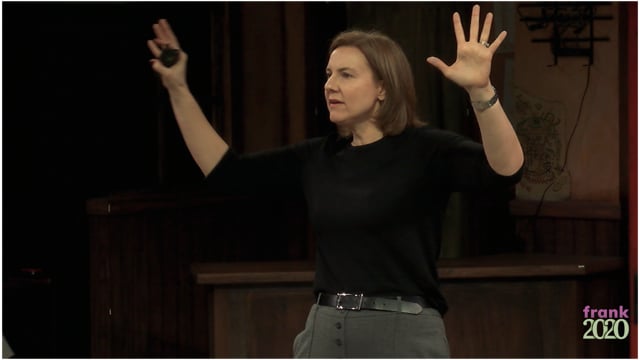
Ai-Jen Poo President, National Domestic Workers Alliance & Co-Founder, Caring Across Generations
Ai-Jen Poo is a labor leader and MacArthur Fellow transforming the care economy. She organizes for dignity, accessibility and justice for domestic workers while building broad coalitions that uplift caregivers and families nationwide.
Go To BioWatch Next
-
 Seven Minutes In Heaven… With A Scientist
 -
 Moral Uprising with the Poor People’s Campaign
 -
 The Unintended Consequences of Emotional Appeal
The Age of Dignity for Domestic Workers
Behavioral ScienceFamilyHealthcarePublic ServiceStorytelling
Transcript
Hello. No pressure. It’s great to be with all of you. So I’m here to talk about the power of story. I have spent the last 17 years working alongside domestic workers, nannies, housekeepers, and caregivers for the elderly. And they are the workforce that goes to work every day in millions of homes across the country doing the work that makes all other work possible. Caring for the most precious elements of our lives, our children, our aging loved ones, our homes. And it is really the work that makes it possible for us to go out and do what we do every day. And despite this really critical role that this work plays in all of our lives and in the economy, it is among the most vulnerable work in our economy today. You never quite know what you’re going to get. It’s a little bit, it’s like defined by the invisibility of working behind closed doors. You could walk into any neighborhood and not know which homes are actually workplaces. They’re excluded from some of the most basic labor protections that we all take for granted. We don’t even think about them and they exclude domestic workers. And so there’s all kinds of challenges facing this workforce every day that goes to care for our families. And there’s enormous challenges that come with trying to make social change and transform those conditions for this workforce as well. If we think about the traditional means of making social change, whether it’s civic engagement or policy advocacy or forming a union and collectively bargaining, I mean none of those forms of change actually are methods really work for us. There’s no collective, there’s no one to bargain with. It’s like Mr. and Mrs. Smith. It’s really defined by invisibility, as I said before. A lot of the workforce is immigrants, so they don’t vote, right? There’s so many challenges that we faced in terms of making social change. And that’s actually been a huge strength for us because it’s really forced us to be creative about how we think about and practice the art and science of social change. And one of the things that we discovered really early on was the power of story. And just to bring you all into that, I want to actually ask you to do something with me right now, which is to turn to the person sitting next to you, and I’m actually hoping at somebody that you don’t know. But in the next two minutes, I’d love for you to share a story of somebody in your life who’s taken care of you and the value of that relationship in your life. So share a story of somebody who’s taken care of you, anybody, family member, caregiver, nanny, anyone, someone who’s taken care of you and the value of that relationship in your life. And you’ve got two minutes to go back and forth. Thank you so much for participating. And thank you for bringing all the people who take care of us into this frank space. Can we have a round of applause for all the people in our lives who take care of us? So one of the ways that we realized this was an incredibly powerful driving force for social change was when we won our first campaign in New York City. We were fighting for what was called the Nanny Bill in City Council. And usually when bills get voted on, it’s a pretty boring process where the speaker kind of reads the bill number, says a little bit about the bill, the sponsor says a little bit about the bill, and then they read through every member. And usually the members just get on the mic and say, yay or nay. Pretty boring. Sometimes there’s something passionate that happens, like a speech that somebody makes. It’s usually by the sponsor, but usually it’s pretty straightforward and happens quickly. And that day what happened was the sponsor introduced the bill, and there were about 50 or 60 domestic workers in the balcony watching and waiting for the first city bill to protect the rights of domestic workers to pass. And that day, every single member, at least in the first half of the vote, actually got up and started by City Council member Bill Perkins from Harlem, who got up and told a story about his grandmother, who was a domestic worker, whose work was never really recognized or adequately compensated, but she made it possible for him to go to school and do what he does in the service of New York City. And he triggered just a series of stories about all the council members who were directly connected and in relationship to domestic workers. And we just realized that we are this interconnected web of human relationships, and that story really opens that up for us. And it was a powerful tool that we used to then fight for bills at the state level and transform public policy in four states for domestic workers. And in the middle of the campaign to win a Bill of Rights for domestic workers in California, the film The Help came out. How many of you saw the movie The Help? Okay. So here was a moment where all of a sudden there was a major Hollywood feature film with two African American domestic workers as the protagonists, really highlighting the kinds of abuses and vulnerabilities facing domestic workers. And suddenly there was a moment where there was more space in the public imagination for the stories of domestic workers. And we decided to seize this as a moment of opportunity to basically open up that space and actually turn the attention of the millions of people who saw that film and were touched by it to actually think about and experience the stories of domestic workers today, to understand that it wasn’t a story about the past, that there are millions of women who do this work today and face many of the same abuses and vulnerabilities, and that there’s something that every single person could do about it, to support policy change, to support institutional change, and to also support fair employment relationships in their own lives. So we launched a campaign called Be The Help, and we witnessed what we now call transportive, scaled storytelling, but the power of popular culture storytelling to reach really broad audiences and to help you drive fundamental narrative and norm change inside of our popular culture. And that came at a really critical time. We drove tens of thousands of petition signatures to help us pass the California Domestic Worker Bill of Rights, which we won. Yeah. Thank you. Thank you. And got hundreds of thousands of people engaged in a way that there’s no way we could have reached. And when Octavia Spencer won the Golden Globe for her performance in that role, she got up and she said, all work has dignity and should be recognized as such. A line that we fed her, by the way. And we got more press from that one quote than all of our campaigns combined in the past. So it gave us a taste of the power of popular culture narrative for driving social change. And it came at a really critical time because we were realizing that this question of what happens to domestic workers and how we value domestic work in society is actually a question that touches all of us very, very directly. Because in this country, we are undergoing an unbelievable demographic shift right now, and we don’t really know it and talk about it in the way that we should. And that is the age wave. The fact that the Baby Boom generation is turning 65 at a rate of 10,000 people per day, 4 million people per year. And people in my grandmother’s demographic group of 85 and older are actually the fastest growing demographic in this country because people are living longer than ever before as a result of advances in healthcare. And it means that we just need more care and assistance to live well, to live life on our own terms as we grow older, particularly if we want to age in place. And so this is actually a major shift in our culture, and it just means that we’re going to need a lot more care and a lot more domestic workers. And what it means is that the home care workforce has become the fastest growing occupation in the country. So what we have to do is not just impact the story at scale, but we have to actually engage people at scale around their own direct experience with care in this whole other big way. So that is when we decided to take what we learned from the work and the help. What we learned through our grassroots advocacy and our policy work at the city and state level, and also learned from the LGBT movement, which was a huge source of inspiration for us, the way that they combined local organizing and advocacy with popular culture and narrative change work, which ultimately resulted in us moving from the freedom to love, to choose who you love and marry from an impossibility to an inevitability in a very short period of time, that we wanted to do something very similar around aging and caregiving. So we took all of those lessons in and we developed a theory of culture change that has four steps to it. The first is just really identifying and making the case, really trying to understand what is the narrative values and norm shift that you want to make. And we decided that we really want to change the way this country thinks and feels about aging and caregiving, and that if we could do that we could make the impossible inevitable. So everything we’re doing is trying to build upon that. And we decided that the next step would have to be to really organize the storytelling industry. Who are the people who are doing popular culture storytelling? What are the institutions that are influencing the stories we ingest that are the oxygen that we breathe around us every day, whether it’s television or film or music or all kinds of entertainment? And then to take what we learn and experiment, see what has traction, what stories take off, what stories take hold, and ultimately try to create a 360 degree storytelling environment, where the stories that carry the values and the images and the faces of the people that we want to be seen in our new vision for society ultimately can be. Where we open up more space and democratize the story of who we are as a country. And ultimately when we do that we can see new possibilities in terms of what’s possible politically and at the policy level. And so here we are, we’re in stage three of trying to create this 360 degree storytelling environment. And one of the things we decided would be helpful is to have anchor moments for storytelling, to really try to catalyze storytelling at scale. And so we decided that we were going to try to make a major national holiday. We decided that we were going to try to make grandparents’ day the kind of national holiday that you celebrate like Mother’s Day or Christmas. It’s like, and we wanted to brand it, not only did we want to make the holiday, but we wanted to brand it as a holiday for multi-generational storytelling. So we’ve basically been, this is our third year trying to elevate the celebration of grandparents’ day. And last year we did a summer long storytelling campaign called Throwback Summer, where we had young people nominate their grandparents in one of five best year book categories, including best dressed, most talented, most ahead of their time, thousands of people participated in sharing their stories and voting. And we got Grandparents’ Day to trend on Twitter and Facebook for the first time. We have teamed up with The Moth. How many of you know The Moth? They’re amazing, amazing organization. And they have a community program that is partnering with us to train care storytellers. And this is Bev, who is a retired school teacher on the Upper West Side. She’s 80, and she talks about being independent with benefits. And that’s Marlene Champion. She’s a professional caregiver who’s been caring for people ever since she was 17 years old and brings an enormous amount of humor and humility to that work. And this is Melissa, who is a family caregiver caring for her mother with Alzheimer’s. And the three of them, along with dozens of others, are our care storytellers helping to inspire everyday people around the country to tell their stories, but also helping to inspire influential storytellers in Hollywood to tell these stories more. I just wrote a book called The Age of Dignity. It’s out in bookstores now. It was just released February 3rd. And it’s full of stories, including my own of my grandparents and my aunt and my family. And we’re also using it as a platform to inspire other people to see their own stories reflected, but also move us towards the kind of solutions that we want to get to in stage four of our strategy. And we’re still also working with films and television showrunners and screenwriters to try to seed the kinds of stories that we no need to be told for us to really take this on as a country. And still Alice is a film that we’re doing a lot of organizing around because not only is it a courageous story of a woman with early onset Alzheimer’s, but it is also a story about her family coming together in a courageous circle of care on what they grapple with. And so we’re organizing around that film, working with the actors and the director to try to use it as a platform again for storytelling and for moving people towards solutions. Which finally leaves me with my final lesson for all of you that I wanted to share. And we are still, all of this is experimental, we are still learning. We obviously have not yet created the 360 degree storytelling environment that we know we need to create on aging and caregiving, but hopefully with all of your help we will. And we will create the kind of story momentum that will help us make the cultural and values and ultimately the story shift in our society that will open up more caring, more understanding and the kinds of solutions that we need for the future. But as we do this work, a really important realization came to us. Which is that all of us, especially in this room, we often talk about changing hearts and minds. And really at the end of the day I think we have much more practice at changing minds. That our muscle is really around analysis and logical thinking and making our arguments well and numbers and data. And at the end of the day there is this whole aspect of the human experience which is about our emotional lives. We experience the world as humans with emotional and emotional experience and reality. And that ultimately that space of our emotional life while incredibly unruly and unpredictable is also a space of expansive imagination and creativity and possibility, which often times the space of politics is not. And I would say that we cannot afford, as people who believe in social change, who carry the vision for the future that we carry, we cannot afford to leave that arena of the emotional life on the table. That ultimately it is our responsibility to get in there, get in the arena and actually try to enhance our sense of connection, our sense of love, our sense of the human experience in its entirety. And that the process of telling stories and sharing stories in small ways like we just did or in scaled ways like through movies and film and entertainment, that that in and of itself can help us to understand our whole humanity, our connection to one another and perhaps be in and of itself the solution. Thank you.
Watch Next
-
Seven Minutes In Heaven… With A Scientist
-
Moral Uprising with the Poor People’s Campaign
-
The Unintended Consequences of Emotional Appeal