Good afternoon everyone. I’m Karim and I’m here to tell you one thing and one thing only. Why anger is not enough. I’m going to tell you this by telling you a story. A story of the bad, the quiet and the angry. And the angry was me. So a little bit of a backstory. I grew up in this little town in the Egyptian Nile Delta. It’s called Tala, means the little hill. And grown up in this town, I had to suffer and fear one thing, hepatitis C. One in every four in my town was infected. This meant a lot of friends, family, neighbors, teachers at school had to die from this. And this gave me some frustration because I didn’t know why can’t we help these people? Why can’t we fix this issue? I didn’t know how to handle that. The only thing I knew was to study hard and to become a physician myself, which I did. I studied and I went to the largest, oldest and most of the prestigious medical school at the country, Cairo University. So symbolic for our country that when President Obama wanted to talk to the peoples of the Middle East for the first time, he came to the main hall of my university. The hospital for my medical school was established in the 1500s. I was so proud and I felt like finally I am doing something to address that. But this hospital, this school, had a lot of areas that was neglected. It occupies the other half of an island in the Nile River. Some areas in it are neglected, underdeveloped and simply not clean. So I and this fine group of people decided to basically make it cleaner. And we made a campaign on Facebook. We called it the cleaner the better. And we invited people to come down with us and help us on this clean up day and resolve this frustration, this anger that we have about the school. And as turns out, 500 people came down on that day. It was supposed to be a great day. And here I introduce my second character, the bad, Mr. Mossad. And let me tell you a little bit of a backstory. In every university in Egypt, there used to be a secret police office. That wasn’t that secret. And the head of the secret police office is basically the de facto ruler, the governor of the university can do anything without getting their permission. And we did this without getting their permission so they were scared. He was scared. He asked us, this fine group of people that I told you about, into his office. And he detained us for four hours. He screamed, yelled, interrogated and questioned us about every single detail in our lives. And if it weren’t for one of my friend’s father’s connections in the police, we might not have lived this room on that day. This incident and many alike made me angry. And many people like me angry so much so that when we found an invitation circulating on Facebook only a couple months later, asking us to come down to the streets on a day of anger, we all did. It was the angry Friday, January 28th, 2011. 500,000 people flooded the streets of Cairo in anger. We defied our fear because we wanted to make this change finally happen. The police stood up to us, but we stood fast. They fired bullets, tearing gas, everything they had in their quiver. But we stood there until they ran out of ammunition and they ran out of the square. And we were in. It was the first piece of land that we could finally claim to be for the people, by the people. I remember vividly, I looked up into the sky that night and I screamed with the loudest of my voice and I said, down, down, Hustney, Mubarak, down, down, Ahmad Musad. He resembled everything that was wrong with my country. He resembled all the corruption, the frustration, the oppression that we had. He was the fault in my stars. And finally, there was a way to bring him down. The very next day, the army came down. It was the first time I see a tank in my entire life that wasn’t in a movie. It’s a tank that actually can fire and was directed right at me. I was afraid, but I was more angry than afraid. That’s why I decided to stay in Tahirih Square for 18 days. And here, I need to introduce the third character of my story, my best friend, Mahmoud, the quiet person. But let me tell you a little bit of a backstory. The media at the time was saying that the people in Tahirih Square are getting paid and fed to be there to bring down the country. So much so that they said that Hillary Clinton herself was staying right at the corner, giving everyone a $50 bill in a bucket of KFCs. So I had to call Mahmoud every night and explain to him that this wasn’t true. I wanted him to come down with me, by my side. But he said, Kareem, you know what? This is not my way. I’m afraid that someone might get harmed and I don’t want this to be on my hand. I didn’t understand. But I stayed. I grew angrier and angrier over time. And one thing I tried to do was to prove to everyone that we are not there because we’re getting paid. So I decided to call upon the most respected social group in our society that no one would think they’re coming there for $50 a day. I called upon the physicians of our country and we did a campaign on Facebook and we invited everyone. And 13,000 physicians showed up on that day in their white coats and we marched from the house of wisdom, our general medical syndicate, into Tahirih Square. And you can see how angry I was on that day. That was me if you guys didn’t remember. As much as skinnier back then. And we succeeded. One day later, Mubarak stepped down. We emerged victorious out of Tahirih Square. I went back into the university. No more Ahmad Mossad. But people looked at me and they asked me, Kareem, now what? What can we do? And I was like, oh, that’s easy. Anger brought Mubarak down. Anger is going to fix everything. Just to give you an update, Ahmad Mossad, I saw him three months later directing traffic not far away from my university. Huge demotion. He became angry. But nonetheless, I had this working hammer. So I imagined the universe to be a big nail. And I tried to hammer everywhere I could. It was a wackadoodle. Like, I am heading everywhere. And we tried to actually fix things that way. Everything was a protest. Everything was a march. Everything was a blockade. We were trying to fix our 60 years of corruption, of oppression, of no democracy. We didn’t know how to fix things, but this was the only thing we knew could work. During that work, I always called upon my friend, Mamoud, to come by my side. And he always said, Kareem, I prefer to remain quiet. This is my way of doing things. And again, I didn’t listen. More people grow angrier and angrier beyond those originally that were at the Harir Square. And unfortunately, when angry people come against angry people and see only things from their parochial, personal interest, violence can erupt, which unfortunately happened. Those bad people, the likes of Ahmad Mossad, stayed on the sidelines, breathing fire into this, convincing them that we, the Tahirir Square people, are the bad ones. They say, see, we told you, they don’t know how to fix things. See, all this chaos is because of them. And we lost that paddle. They could mobilize those people to their camp to convince them to be angry with them, angry at us. And the heroes of yaster day became the traders of that day. June 30, 2013, a coup happened. And the likes of Ahmad Mossad were carried again on the shoulders, in the same spot, in Tahirir Square. And they came back to the university. And the likes of Ahmad Mossad became once more the governors and the rulers of the university. And they squatted once more on our chests because I didn’t listen. The people like me didn’t listen. Egyptian democracy was dead. I became a persona non grata. I had to leave the country. I went to Harvard because I wanted to study what did I do wrong. And the very first lesson that I learned was to close my mouth, open my ears, and listen. Because anger is necessary, but not sufficient. You need to move into somewhere else. Mahmood on the other hand stayed in Egypt. He was drafted into the military to do his obligatory military service. As a military physician, he refused to carry a weapon because he didn’t want to carry anyone’s blood on his hand. Unfortunately, Mahmood was killed in an attack on his camp at night in April 2018. And his quiet voice was turned down forever. This lesson had taught me a very important thing. It taught me to find grace in my heart. For those I think are bad. And for those that think I am bad, taught me to find love in my heart for the likes of Mahmood. The ones who choose a path that’s different from mine and to listen to them. And taught me to find hope in my heart for me, for myself, for people like me, for you. As long as the likes of you are in here and out there in the world, trying to fix it, trying to make it a little bit better, one person at a time, one emotion at a time. I am here to tell you one thing. Anger is not enough. But grace, love, and hope, maybe. Thank you very much.



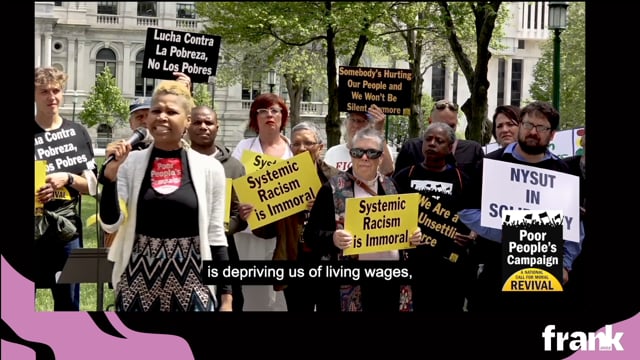 Moral Uprising with the Poor People’s Campaign
 The Unintended Consequences of Emotional Appeal
 Welcome (2015)