
Fresh From the frank Stage
Standout talks from the most recent 2023 gathering, featuring bold voices, urgent truths and unforgettable moments.

Amahra Spence
Liberation Rehearsal Notes from a Time Traveler

Shanelle Matthews
Narrative Power Today for an Abolitionist Future
Nima Shirazi
Irresistible Forces, Immovable Objects
The Speaker
Marcia Puig-Lluch Program Facilitator, ROOT & SHOOT Research Coordination Network
Marcia Puig-Lluch is a researcher exploring strategic communication, social influence and global engagement. She combines academic insight with practical experience to help organizations strengthen messaging and cultural understanding.
Go To BioWatch Next
-
 Seven Minutes In Heaven… With A Scientist
 -
 Moral Uprising with the Poor People’s Campaign
 -
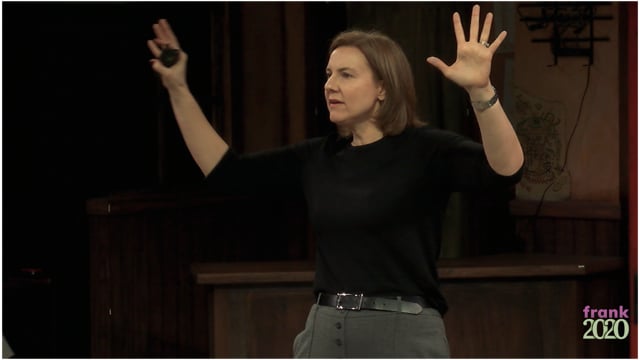 The Unintended Consequences of Emotional Appeal
The Human Element: Harnessing the Power of Coordination
Behavioral ScienceCreativityEducationPublic ServiceSocial MediaStorytelling
Transcript
So, thank you. Thank you. So I wanted to start off by saying I was a Carrell Fellow. I still am. And I was stationed at Wider Opportunities for Women, which is an absolutely phenomenal organization. But I wanted to also start off by saying that, and I get more and more embarrassed about this fact the longer that I am here, because I went into it not knowing what communications was. I understood it as a concept, and I understood that it was important, but in terms of how you could use communications to really affect strategic or to make actual change was something that was a complete mystery to me. And above that, I didn’t really know what advocacy was either. I think one of the first questions I asked my mentor while I was there was, how do you come up with strategies to do what you do, to actually get things moving and to solve all of these issues? So we touched a little bit upon this, but Wider Opportunities for Women is really about solving all of these, trying to solve all of these problems, or really get economic security for women, families, and seniors. And they do this by helping women gain access to high-paying non-traditional jobs, by looking at the real monetary cost of sexual assault and stalking, and looking at the different factors that affect seniors. So one of my first tasks at WOW was to create a Facebook post and a tweet, and keep in mind this is the first time I’d ever tweeted, so it was very empowering for me, was to create these about, that we featured tradeswoman. So what we do every Tuesday is that various labor, feminist, and trade organizations trend hashtag, tradeswoman Tuesday. It’s the story about a woman who goes into the trades, or who went into the trades. And so my very first one was about Ms. Rose Laredi. Now Rose is a boiler maker from the local 154 in Pittsburgh. And she became a boiler maker on a whim. Honestly, she was 19 years old. She needed a job. And she came across this apprenticeship, and she realized it was very high-paying. And so she went out on a whim, and she got the job. But then something incredible happened, and she really liked it. So she did have a lot of difficulties. She was the only woman at one point working there with a crew of over 100 men. So you can imagine she was 19 years old. So while all the men were wondering, hey, where are we going to go out for lunch? She was wondering, where am I going to shower after a long day of welding? And she was in a shower after a long day of welding. She, at one point, they also thought she was a spy from the Department of Labor, sent there to collect evidence about discrimination. So you can only imagine how well they treated her for that. However, she really liked her job, and she fell in love with it. And so she kept at it. She gained all of these skills, and she turned a career. She turned it into a career. So 30 years later, that’s what she’s still doing. So it’s a profession for her, but it’s also her passion. And it’s wonderful that she was able to gain access into this job. So of course, we came up with a lot of different stories, and it was really great to be able to see all of these individual stories. We’re talking about the power of storytelling. And it wasn’t just Rose Lourini. It was Alicia Fording, who was a steam-fitter apprentice. And it was Rob Howe, who also went into the trades. And not only was it great to celebrate these women, but it was a communication strategy in and of itself. Because part of the research that Oahu had done had shown that the reason why women weren’t going into the trades was also because they didn’t have any mentors. They didn’t have anybody to look up to. So by putting these stories out there, women who were kind of unsure, women who considered going into the trades, but didn’t know how, had these role models to look up to. So that was one of the hashtags I became familiar with over the summer. The other was hashtag black women equal pay. So I’m sure we’re all familiar with the terrible statistic that women only make 77 cents to every man’s dollar. But if you look at that intersectionally, it gets even worse. Black women only make 64 cents to every man’s dollar. Now, on the date right here. Well, 208 days into 2015 marked the day that black women would have finally made the same amount of money that white men did in 2014 alone. So they had to work an extra 208 days, assuming they were working the same job just to achieve parity. And so we really wanted to push this message out there and really get a conversation started. And so wider opportunities for women and a bunch of other organizations got together, made this hashtag, and we really wanted to trend it. So for one hour from two o’clock to three o’clock on this day, we made different tweets. And part of my task was to really incorporate the research that while I was doing. Black women over a 40-year career would lose up to $776,000. And that racial gap, that economic gap, would persist across the lifespan. So by the time these women were tired, 70% of them would be economically insecure. So this is kind of my personal story here. On the day of the storm, I had my tweet deck open. And it was the first time I’d used tweet deck, so I was also very excited. I had about a dozen or so tweets ready to go. And at two o’clock, I posted the first one. I got, you know, I saw it kind of hung in there for a while before being swallowed up. I saw a couple of our sister organizations post as well before they got swallowed up. But I kept going at it every 10 minutes. I would post more and more. But before I knew it, something incredible had happened. And that was that it gained momentum to the point where it wasn’t just our organization tweeting about it. It was other organizations. It was senators. It was the Department of Labor. But the best part, in my opinion, was it was people who really were not part of this coordinated effort. It was women who used this hashtag, not just the women who were not part of the organization. It was this hashtag, not because it was some sort of communication strategy, but because that statistic, 64 cents to every man’s dollar, that was their reality. And they were finally able to be part of this conversation in a way that made it more apparent, if that makes sense. So by the end of the storm, we had 7,300 participants. We sent out 15,000 tweets. The potential impact was 19 million people. The potential impressions were 62 million people. And we were talking a lot about when your Frank moment was. And I’ve had a lot of Frank moments during this conference. But I think my first Frank moment was when I received these statistics. Because in that moment, being a first time Twitter, I really thought that I could change the world. So it was really empowering for me. And it was great to be able to see all sorts of people being involved in this conversation. It brings me to the power of words. It’s not just the ability to coordinate. It’s not just a coordinated effort in terms of organizations, but to create some sort of movement, a coordinated movement where organizations, people in power, can speak, but also give an opportunity for the marginalized and the people who this is actually affecting a chance for them to speak as well. So thank you very much. Thank you. Thank you. Thank you. Thank you. Thank you. Thank you. Thank you.
Watch Next
-
Seven Minutes In Heaven… With A Scientist
-
Moral Uprising with the Poor People’s Campaign
-
The Unintended Consequences of Emotional Appeal