Thank you very much Liz. Thank you everybody. I’m here to start, I’m surprisingly with a story about curiosity. But this year we’re going to tell the story together. You have one line, actually you have one word, and the word is, very good. Now I just want to make sure you’ve got this right. It’s not, like, what did you say? It’s, like, that’s interesting. So I want to practice, okay? So the title of this talk is The Power of, I just don’t think you have it. Actually that’s good enough. Alright, it’s going to come up in times. Your cue is, it’ll be up there on the screen. So when you see it up there, you chime in, okay? Alright, so our story begins. I’m Halloween, October 31st, 2017 years ago. We were all much younger then. And really to fix this time for you, we were less than a week away from this election. Remember this election? Unfortunately, the person who got those popular votes did not become president. Fortunately, that would never happen again. Fun. Now also happening at this time was the dot com bulb, or the dot com boom. Everywhere dot coms were exploding, all different kinds of companies. And they were advertising everywhere in newspapers and magazines and the internet. And you would see magazines like these were thick with dot com ads. In fact, I remember passing by a newsstand and seeing a copy of Business 2.0 that was as thick as a phone book. It had so many ads in it. Okay, so back to October 31st, 2000. It’s the morning, I’m in my kitchen, I’m reading The New York Times as I do the morning, and I hit the business section and I see this article in the advertising section. And it had this headline jumped out of me. These dot coms may know about e-commerce, but what they don’t know about marketing, dot dot dot. And the article went on to talk about a study that was done by Roper Starch Worldwide about dot com advertising and how these ads were in all these magazines. So look at what the study said. Take a look at this. You just want to underscore that for you. They’re not only out of the everywhere, for the most part, they are not very good. Now, how do they know these ads are not very good? Well, let’s go back to those magazines that are stuck with ads. And let’s take a single magazine, for example, Fast Company. Roper Starch is a very interesting methodology. What they do to study the ads is this. They’ll take a copy of Fast Company and they’ll sit down with someone who read it. And they’ll say, oh, Kristen, did you read this magazine? And Kristen will say yes. They’ll say, okay, here’s what we’re going to do. We’re going to page through this magazine one page at a time. And every time we see an ad like this, I’m going to ask you a few questions. So we hit the first ad and I ask Kristen, do you remember when you read this magazine, do you remember seeing this ad? And if she says yes, it gets a score. And if she says no, it gets a score. And that score is called noted. That’s the noted score. This measures the stopping power of the ad. Did it stop you and get your attention? The second thing I ask is, do you remember what the advertiser was? And with this ad, seeing that eBay logo jumping out, you probably would. So this is called the associated score, which measures the branding power of the ad. So not only did you see it, but you remembered it was for eBay. And then the third question is, did you read half or more of the ad? And if you did, this tends to predict response. Because if you read the whole ad, maybe you actually did something about it when you were eBay. So every ad gets three scores. As it turned out, these ads across the board got very low scores. So I saw it. I saw this article about the study of advertising the dot com sector. And I thought to myself, I wonder if they have done studies of other sectors, because it said in the article that they had done banking and insurance and automotive. I thought, I wonder if they’ve ever done a study of non-profit advertising, public interest advertising, the field in which I was working. So I called up a guy mentioned in the article named Phil Sawyer from Roper Starch. And I said, have you done these ads? Have you ever done non-profit ads? And Phil said, well, let me tell you how it works. When we go through a magazine like Bass Company, we do every ad in the magazine. So if we’re paging through and we get a non-profit ad like an ad for Planned Parenthood, we will say to Kristen those same three questions. Kristen, do you remember seeing it? Did you read it? Etc. Etc. And we’ll get the scores. Now, if we’re doing a study of dot com ads, we’ll take that ad for a non-profit, we’ll just put it in our data bank for a later. But we’ll do it. We’ll do it for every single ad. And he said, and if there were, let’s say, three non-profit ads in that magazine, we’ll do them all and we’ll put them in our database. So I said, well, great to see you when you have all this research on non-profit advertising. Have you ever done a study collecting all that research? And he said, well, that’s not an easy question to answer. We’ve been doing this for 80 years. So I’ll call you back in a couple of days. A couple of days later, he calls back and he says, well, yes, I looked through the files and there are hundreds of non-profit ads that we collect over the years. We have the data. And then he said those words I’ll never forget. He said, no one has ever called and asked us to sort for this category. So it’s like, oh my God. It’s like the research is there, you just have to ask. So he said, okay, I’m asking. And he said, that’ll be $25,000. Well, at the time my company was barely three years old, I didn’t have $25,000. I barely had enough money for pens at this point. So it’s like, what am I going to do? So I had a friend work at the few charitable trusts, Josh Reichert, and I called him up and I said, Josh, there’s all this research out there just waiting to be had if we just had $25,000. Would you be willing to write a grant and give me the money? And he basically said, yeah, this is interesting. Go get it. So we did the study. And the study came back. And here’s the key takeaway from the study. Take a moment to read that. You see that? Quite common are those that rank among the lowest ads in a given issue of a publication. So they’re not just saying these ads are bad. They’re the worst ads in the publications in which they’re appeared. And these aren’t, you know, little middling shitbird nonprofits. These are organizations like these, putting in these ads that are doing terrible. So we had this research that was done by Roper Starch. But I didn’t think that we had the whole picture. And again, I thought to myself, oh, getting better. But do these nonprofits know about this research? Have they done research of their own? Because if I could talk to every nonprofit that placed these ads and say, look, this is what Roper Starch said, do you have your own research that supports or contradicts, then I would have the whole story. And then I realized this is a lot of work. This is really turning into a book. So I thought, okay, I want to, I’d like to do this as a book. But maybe I won’t go the conventional route. Maybe I won’t go look for a publisher, given that the few charitable trusts under the research, I thought, maybe if I went to some foundations, that they would support this and that we could do it that way and they’d even give away the books. Well, when I ran that idea by a friend, Bruce Drachenberg, he said to me, well, if you want to get the foundations behind this, there’s one person you have to go see. Because if he gets it, he’ll get his colleagues behind it and this will be a go project. So I bought a ticket to Princeton, New Jersey, and I flew and I met with this man. This is Frank Carell for those of you who don’t know. This is the man after he was just sent. This is Frank. And Frank not only got it, he got behind it and he got others behind it. And we were able to do the book. And what I’d like you to do now is, when you came in, I don’t think you noticed it, but underneath every other chair is this envelope. Go take this envelope out right now. It’s under your chair and open it up and you’re going to see what came of this project. It’s not a car. It is not a car. So, this is the book. This is the book, like that, and happening good causes. Thanks to Frank and his colleagues, we printed 15,000 copies of this book. We have given away just about everyone. This is all that’s left. We didn’t have enough for every single person here. That’s why we put one between each seat, between each pair of you. So, listen, if between the two of you who are sitting around this book, if one of you wants it, one of you doesn’t, the one who wants it, keep it. If you both want it, later do rock, paper, scissors. If neither of you want it, and one of you can think of someone to give it to, then find a new home. And if neither of you want it, and can’t think of someone to give it to, put it back under your seat and we will find it a home later. But here’s the point. We printed 15,000 copies of this and they spread around the country and it led to the stunning sequel. Why bad presentations happen to good causes. It was underwritten by 10 foundations and we printed 30,000 copies and we gave them away and we’re still giving away copies every day on a PDF on my website. And I’m happy to say that before these books, as I said, my business was struggling. I barely could afford a pen. But since these books have been published today, I have many boxes of pens. And it all started with this. Because this is what curiosity is. Curiosity is that little voice in your brain that says it starts with, I wonder, and it becomes this itch that you just have to scratch. And my message to you is when you hear that voice, when you feel that itch, listen to it, scratch it, good things will follow. So welcome to Frank 2017 and our theme, which also happens to be the one diagnosis no cat wants to hear.



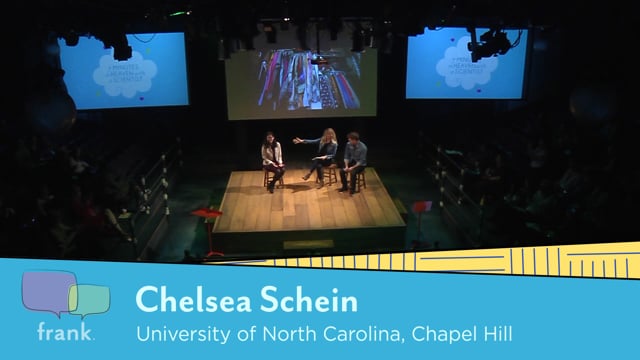 Seven Minutes In Heaven… With A Scientist
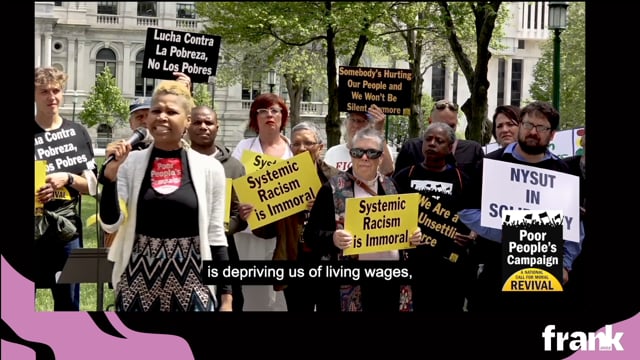 Moral Uprising with the Poor People’s Campaign
 The Unintended Consequences of Emotional Appeal