
Fresh From the frank Stage
Standout talks from the most recent 2023 gathering, featuring bold voices, urgent truths and unforgettable moments.

Amahra Spence
Liberation Rehearsal Notes from a Time Traveler

Shanelle Matthews
Narrative Power Today for an Abolitionist Future
Nima Shirazi
Irresistible Forces, Immovable Objects
The Speaker
Tracy Van Slyke Chief Strategy Officer, Pop Culture Collaborative
Tracy Van Slyke is the Chief Strategy Officer at the Pop Culture Collaborative, bringing 17 years of experience connecting media, justice organizers and philanthropy to drive narrative change for accessibility and cultural justice.
Go To Bio
Watch Next
-
 Seven Minutes In Heaven… With A Scientist
 -
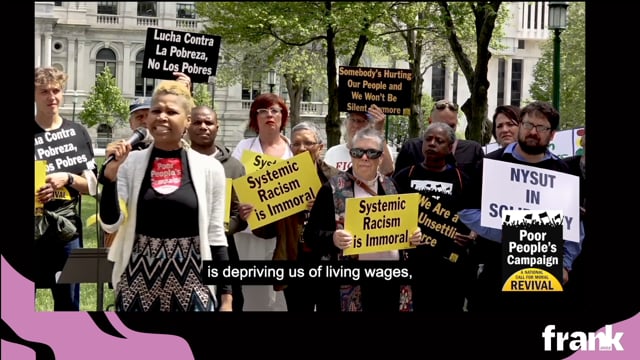 Moral Uprising with the Poor People’s Campaign
 -
 The Unintended Consequences of Emotional Appeal
The World We Want
Behavioral ScienceCreativityFamilyProblem SolvingPublic RelationsStorytelling
Transcript
I’m Tracy Van Slyke. I’m the strategy director for the Pop Culture Collaborative. And by show of hands, who here knows Minecraft? OK, does anyone in your family play it? OK, my eight-year-old son plays it. My eight-year-old son plays it alone. He plays it with his friends online. He plays it with his friends in person. He takes a Minecraft coding class. He wears Minecraft clothes. He demanded a Minecraft-themed birthday party. And he reads Minecraft books. At least he’s reading. And he draws Minecraft comic books. He’s a Minecraft fan. And I’m sorry if this reflects negatively on my parenting. OK, who wanted to go to Wakanda after seeing Black Panther? OK, some fans wanted to become citizens and made their own passports. Who here knows the show The Good Place? OK, everyone wanted to visit The Good Place and talk like philosophy with Eleanor and Sheedy. OK, last year, people got to go visit The Good Place at San Diego Comic-Con without dying. And if you don’t know what that means, that joke, you got to go watch and binge the show after all these talks are done. A couple weeks ago, Gillette released this ad. Remember, Against Toxic Masculinity? Was anyone surprised that they did that? OK, I wasn’t. Not because I’m super smart. But because I’ve been talking to a lot of people in the ad world who said they are listening to their audiences and that audiences are demanding that brands stand up for values. OK, so what? It’s fun. It’s entertaining. But what is the impact on social change and transformative narrative shift? I’m going to tell you, I promise, but I’m going to go backwards a little bit. Because I want to tell you a little bit about how I got there. I have worked for 20 years. I’ve just aged myself at the intersection of media and movement building. And my core question that has always driven my work has been, what are the narrative experiences that are powerful enough to make people not only believe but want to fight for a world based in equity and justice? And it was about six years ago that I had the soul-shaking moment of clarity. I was writing the bazillionth press statement in the latest movement, News Moments, at the tail end of a two-year organizing and communications campaign. And I said to myself, because this was a moment that was supposed to be about changing the national narrative around the economy, and it had become a really narrow policy fight for a lot of different reasons. And I had said to myself, dear god, or nameless, benevolent, powerful, surely female being, why am I caught in this cycle? What’s going on? And it’s taken many years, and some learning actually from a lot of people in this room, where I’ve realized what was making me so uncomfortable. One, as social change communicators and storytellers, we tell our stories based on what we want people to believe and do. And I know that’s kind of strange to say, because, yeah, duh. But I think we’re starting at the wrong point. I think we’re starting at the point of just asking what people believe now and not why they believe it. And we’re not digging into people’s passions and experiences that they are craving. And that impacts this kind of story as we do. Second, we talk a lot. We talk a lot about policies we want. We talk about the problems we’ve got, about who’s to blame. But we give little space for actually people to imagine what a new future looks like or to participate in the imagining of what that new world could be. So I went on a year-long quest to imagine what was next for myself. And what I realized is that I wanted to work at the intersection, at the space, of mass audience storytelling, strategic narrative shift, and people’s passions. So right now, I’m at the Pop Culture Collaborative, which is an amazing organization. Our mission is to transform the narrative environment around people of color, Muslims, immigrants, refugees, and indigenous communities, especially those that are women, queer, trans, and disabled, by building partnerships between social justice and entertainment. But that’s kind of a tall order. I don’t know if you notice that. Little daunting. So I have continued to ask myself, how do we take the lessons of the past and apply them to the stories and strategies of the future? And that is why I am really investing right now in what I call people-powered pop culture change. People-powered pop culture change is where mass audiences become mass participators in culture change strategies. Working with artists, technologists, researchers, and more, they are the insight drivers, the playful collaborators, the hard-line organizers, and the creative forces within narrative experiences. The result? Culture change does not happen to people. It is also manifested by them. So I’m working with a lot of people, especially in this room, to explore three main areas. The first is audience research and listening. That is like the Gillette ad, when Nike made Colin Kaepernick, the brand ambassador. They didn’t do that out of the goodness of their heart. They were listening to their audiences. And we can do that, too, in a much better way. As social change communicators and storytellers, we can say, not only how are these beliefs looked right now, how do they look right now? Because we know that from polling and focus groups. But how did they get created? What experiences did people have that got to them to that point? What core ideas are they holding right now that could be barriers to change? And what passions and experiences are they craving? Imagine, if we had those insights, what storytelling could do? What storytelling could move people to act out against injustice and be more powerful and long-lasting than we have right now? Two, fandoms. OK, so not so long ago, the creator of the cult hit show The Expanse credited a fan organizing, because the sci-fi network had canceled The Expanse. But it was fans who cried out and created all this content that made Amazon take it and resurrect it. Alternately, fan organizing also torpedoed the movie Ghost in the Shell, because the casting of Scarlett Johansson had whitewashed the main Asian character. So fandoms are fans first. Individual fans are like consuming. They’re commenting. They comment a lot. They analyze. They explore mythology. And they purchase to the tune of billions of dollars. Fandoms self-organize communities who are coming together across shared pop culture passions and identities are incredibly powerful. Andrew Slack, who is the founder of the Harry Potter Alliance, and Sean Taylor, who’s a senior fellow of the pop culture collaborative, who you’re going to hear from next, contend that fandoms are not only where people are inspired, but where they aspire to something greater. They organize. The amount of impact they have on the entertainment industry means that there’s some of the best organizers in the business. Sometimes for good, sometimes for bad. There’s a lot of trolls out there. Two, they are building really deep community. They used to lot enjoy. We say that we want to build community. They do it. They’re also remixing and creating new content that are reaching from hundreds to millions of audience members. What if fans were forging bonds across pop culture passions and identities because they believed in a shared world vision based in equity and justice? What if they were using their organizing, creative, and purchasing power to make that vision a reality? Last but not least, immerse. So I think we all know these days that your favorite story doesn’t end when the credits roll at the end of a movie or a television show. We now have all these connected mobile apps and games and books and comic books and even in-person experiences where you can explore that story world even more. Marvel may be the most super powered example of an immersive, experiential, sprawling, multi-platform story world. When audiences go deeper and deeper over and over again into a story world, they are exposed to the rules, the values, and the behaviors of that story. And they’re also helping shape those behaviors with other fans. This is incredibly important because what if we were working with artists and technologists and organizers to create these immersive story worlds where people are not only exploring how but embodying why or exploring why but embodying how to think and take care of each other despite our differences? So I just want to say in closing that a lot of you right now are all professionals. So a lot of you are pinging right now going, oh, this is really interesting or this is complete crap, either way, it’s fine. We can talk later. But I’m going to encourage you to take your professional judge hat off for a moment and think and understand that people-powered pop culture change is not what you do, it’s also what you’re a part of. Okay, and so I’m going to ask you, what’s your Minecraft? What’s your Wakanda? What’s your good place? This is where we start. What’s your passion? Thank you very much. Thank you.
Watch Next
-
Seven Minutes In Heaven… With A Scientist
-
Moral Uprising with the Poor People’s Campaign
-
The Unintended Consequences of Emotional Appeal