In 2020, I was actually, as Liz said, majoring in mechatronics engineering, which is totally wild, I know. But I switched my major, like Liz said, to anthropology and mathematics because I am passionate about equitable rights and transformative justice. I believe that community grassroots systems are the key to changing the injustices that we see in our society. I found that majoring in engineering did not allow me to dedicate the amount of time and energy that I personally feel these causes deserve. I came into the Carel Fellowship with strong feelings of imposter syndrome. I mean, people like me are not supposed to end up in positions like this. Growing up in poverty, having parents who struggled with drug addiction, a struggle that often coincides with our criminal justice system, being shuffled around as a result, all compounded with me being a teen mom, these are not the type of things that we think of when we think about successful, productive members of society. But I have matured, gained life experience, and have been fortunate enough to have help along the way. My upbringing forced me to learn early on that we have a system that fails to understand that drug addiction is an issue of mental health, poverty, and access to resources. It’s a system that I have since become passionate about rebuilding. My mom’s incarceration is also uniquely tied to another issue very close to my heart, drowning prevention. During the summer of 2018, my two-year-old daughter, Ellie, died while away for summer vacation at her father’s house, a custody agreement that I have since changed for my son. Shortly after this, my mom, who had been sober for five years, unfortunately yet unsurprisingly relapsed. Since my daughter’s death, I have become an advocate for pool-fencing legislation and raised awareness on how to prevent child drowning. At times, as I have advocated for these issues that are very important to me, I have noticed the treatment and rhetoric has been similar to those sob stories that we see on talent competition shows. I’ve been tokenized as some sort of inspiration story. Many have asked me, you know, how do you keep going or have said something along the lines of, you’re so strong, I could never do it? Well, neither could I, at least not on my own. Too often, I feel that my story has been commodified as an asset. And while I’m aware that I have the against all odds bootstrap narrative and a personal tragedy turn noble cause that some see as uniquely valuable, my experiences are not utilities to capitalize on. I am not an exception because I’m exceptional. I’m an exception because of exceptional barriers in society. The only reason that I have been able to make it to where I am now is because I’ve had various forms of help along the way. My aunt got custody of me when I was 13. My partner’s family gave us the opportunity to return to school by allowing us to stay with them until we could afford our own place. The faculty, AB Tech, the community college that I was attending at the time of my daughter’s death went above and beyond to ensure that I had everything I needed to continue school. And those are just the big things. It doesn’t matter how smart, strong, talented, or hardworking someone is. The truth is, is that we all need help. And when it comes to advocacy work, I wish we could focus on that side of the story. During my internship through the Carell Fellowship, last summer I gained valuable skills that can help turn that into reality. Last summer, I interned with the National League of Cities or NLC. They are an inclusive, nonpartisan organization that works to support local leadership and influence federal policy and drive innovative solutions for more than 2,500 member cities, towns, and villages. Despite the pandemic-induced work environment, my experience with NLC gave me the opportunity to appreciate the behind-the-scenes collaboration that this kind of work requires and gave me the perspective of how advocacy works from both sides. At NLC, I worked on their reimagining public safety task force, helping to advocate for equitable justice and learning the importance of public interest communications and movement building. I was also empowered to propose adding drowning prevention as a public safety initiative, which was successful. I went on to write a blog on drowning prevention that aimed to convince local leaders to take this issue seriously, follow CDC and WHO recommendations, and apply for a grant that could help fund those efforts. The article was added as a feature resource of NLC’s Institute for Youth Education and Families, made its way into their weekly newsletter, and beat out other articles for a place in the CEO’s staff newsletter. I also published two other blogs on the topics of systemic inequities surrounding our justice system and mouse incarceration while I was at NLC. I began to feel more than just an inspirational story. My experience at NLC helped empower me to take control of my personal story and gave me lessons that will stick with me as I continue in the work of social change. Between the seemingly unending pandemic, the heightened awareness of police brutality and racism, social media echo chambers, widening wealth inequality, billionaire space races, the increased polarization of our politics, the January 6th insurrection, and the extinction level crisis of biodiversity and climate, people all over the world are feeling jaded, anxious, and demoralized. So how do we generate change? How do we turn all that pain and all that anger into something more? Well, I don’t know the answer to that exactly, but I do know that it doesn’t happen by oneself. Just like humans, advocacy work requires help from, or better yet, collaboration with others. And that requires us to give space and ownership to those with experiences and stories to tell. Because we like to typically think that we know best and we like to be in control. It can be hard to trust others, but no one said this work would be easy. So here are some of the lessons that I learned. One of the most difficult things for me was to relinquish control, which is especially difficult when our advocacy efforts are driven by our personal stories. For me, this was most apparent during the editing process on my article on drowning prevention. I recognize that I’m not only attached to my story, but also the how and why that story gets told. The process of writing on topics that are close to my heart helped me understand how to take edits, comments, and feedback. As a writer and storyteller, I understand that these are simply part of the process, not personal criticisms. I learned when to compromise on edits and when to save deleted lines for future work, and even when to push back on edits and how to do so productively. On the flip side, I also learned that it’s important as editors to be sensitive to people’s personal stories and allow for pushback on edits. Similar to how a writer can become attached to their words, editors could also become attached to their edits. When people are telling their own stories, it is especially important to not get too attached to our edits because that’s how you end up with tokenization, capitalizing on someone else’s experiences, or even replacing their voice with your own voice. So while I do tell my story in hopes that my suffering can prevent the suffering of others, I am not here to be a poster girl of inspiration. I am not going to give you some platitude of turning your pain or your trauma into something meaningful because it’s not that simple. And more importantly, suffering shouldn’t be something that we capitalize on. Further, while many of us who choose to do this type of work have been personally impacted by systemic inequities or tragedy, it is important to realize that experiencing pain and suffering is not a prerequisite for this kind of work. I do want to encourage you all to make sure that suffering, though, be it your suffering or someone else’s, is never wasted. For me, this fellowship has been completely transformative. I have gained friends and mentors, and I’ve gotten an inside look at public interest communications. Both the Carell Fellowship and NLC have created a lasting impact on me, and for that, I am forever grateful. Thank you.




 Seven Minutes In Heaven… With A Scientist
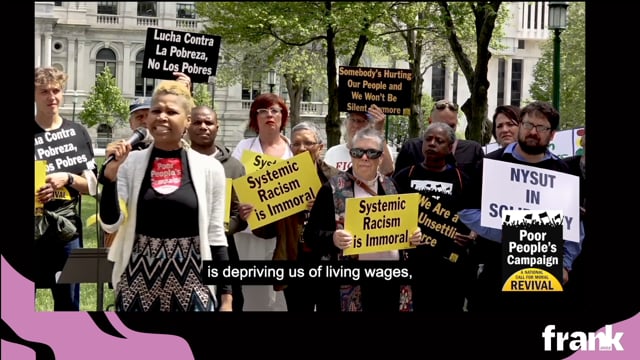 Moral Uprising with the Poor People’s Campaign
 The Unintended Consequences of Emotional Appeal