I realize that looks shameless, but a really quick story. I have a five-year-old, a four-year-old, and a not yet two-year-old. I drink lots of coffee. And my five-year-old was like, so daddy, what are you doing today? And they’re still at the age where they actually ask me what I do. You can imagine it’s extremely complicated to tell them what I do. I basically say I make ads, which puts me in a really bad category, because that always interrupts their cartoon watching. But what they basically said was, I told them I was doing this, and he said, oh, you have circle time today. And that’s awesome. He said, can you please get a video so I can see your classmates? And so thank you for being my classmates today. Oh crap, we started the timer. OK, so real quickly, a couple of ground rules. You will be tempted, because this happens to me a lot, that as I talk about the truth campaign and the scope and the scale to say that’s not applicable to me, you have a lot of money, you have this big platform, it’s not applicable. I challenge you not to do that. Please don’t do that. Lean forward, because it’s really a question of scale. The techniques, the strategy, the insights, the discipline, the rigor, all of that, you can apply to what you’re doing. It’s just a matter of scale. Number two, I talk like a marketer, because guilty is charged. I’m a marketer, right? You are too. Whether you are a practitioner or fill in the blank what role you play, you are competing for market share. You may not think that way right now. You may not talk that way right now. You may not be selling a product. But if you’re trying to get someone’s attention, you’re competing for market share. You are. So think like that. I get up every day and try to take the posture that no one gives a rip about truth. There’s no 18-year-old in America sitting on the edge of their couch saying, my life would be complete with another truth campaign. It’s not true. And so I have to enter the conversation assuming I don’t have permission to talk to them. And I have to earn their trust. You need to do the exact same thing. So real quickly, I safe to assume by the hand claps, you guys know who we are. We were founded out of a big fight. That’s important, because we’re fighters. And as much as I’d like to say I’m a lover, I’m also a fighter. So this is a photograph, a really famous photograph of the tobacco executive standing before Congress saying, smoking doesn’t cause cancer. It’s addictive. We don’t. It’s addictive? Shocking. They lied, right? And they got called on the carpet. And they had to pay a ton of money, in my opinion, not enough money for what they did. How do you put a price tag on wrecking communities for decades? But they paid out a lot of money. That money went to the states largely. So every state that was part of this big settlement, and they were basically making amends for the undue health care costs that the states had to take on as a result of this lie, perpetrating this lie. And then a portion of the money went aside to an organization, to focus on public education, primarily around young adults and youth, to ensure that this fraud didn’t happen again, that we educated people so they didn’t fall prey to the tactics of the tobacco industry. So I’m telling you our story in three acts. It’s extremely ambitious. I’m going to talk really fast, because I’m already a couple of minutes behind. But the first act is the longest act. It’s the most important act. And I’m going to look backwards and talk about the decisions that we made, the discipline, the rigor that we applied in terms of understanding the audience. And it sort of sets the stage for who we are and what we’re going to be doing moving forward. So first thing we did was really look at what in the world is oh, wow, you can’t see that type. I’ll read it for you. What is going on with the consumer? If you look at the stats, over 85% of adult smokers started before the age of 18, 85%. If you ratchet that number up to your early 20s, you virtually get every single adult. So people are making these decisions to smoke at a very, very, very young age. We looked at the adolescent sort of timeframe to say, why is this happening? Well, if you are an 18-year-old or under, I’m sorry I’m talking about you while you’re in the room. But if you have one in your household, you know this to be true. You have the irrational and the irrational at odds at all times. Doesn’t really make sense, right? They can make these very well-informed decisions, but they look like adults. And then they do this thing that just comes from id, and you’re like, what’s wrong with you? They’re not fully developed. It’s natural, right? And so we looked at why and how these actions were sort of bucketed together, and we identified what we’re calling sort of these need states, and I’ll read them to you because the type is kind of small. But it’s this need to be independent. It’s also this need to fit in, which is really interesting how those two things kind of butt up against each other. I want to be different just like all my friends. It’s true. This need for self-expression, this need for respect, so important at a young age, and you think, what have you done to earn respect? You haven’t done anything yet. Risk-taking, extremely important, but all of these things are sort of bucketed into, they’re trying to figure out who they are. It’s supernatural. It’s going to happen no matter what, and those of you who are parents know the more you try to force your hand or force their hand against that, the more they are incentivized to do these things because you’re challenging the very need states that are part of who they’re going to be. Now all of this goes around for this really exercise for control and or power. And so, guess what the tobacco industry did? They know this, right? They know this better than I do. And so they’ve exploited those need states. They use that momentum to their advantage. They co-app culture to say, hey, we’re just like you, we speak like you. If you’re in an African-American neighborhood in DC, you have 10 times more tobacco ads than you do in a white neighborhood. Why is that? Why are they doing that? So for us, you can see what the tobacco industry has done for decades in terms of trying to exploit these need states. So how did the public health community respond? Well, we brought up this guy. He’s awesome, see Evercoop, love him, but he’s an adult. Hey kids, don’t do cigarettes. Use the facts. Because it’s a logical conversation, right? But it’s not logical. If I could win your decision on, or youth’s decision on the smoke based on the mayor to the argument, I win every single time. There’s nothing good that comes from it. It will kill you if you use it properly. A third of you will die from it. That’s not why people make decisions. And so we had this choice. We could either do option one, which is to attack it head on and say we’re gonna push against all of that momentum and try to counterbalance with facts and well-meaning intentions, or we could use this to our advantage and channel the momentum. It seems fairly obvious now, but it wasn’t obvious at the time. And that’s what we did. So looking back, we kicked ass. I say we because I didn’t do it. I stand on the shoulders of people who made some really difficult decisions early on. But we drove the smoking rate down. We were part of the effort to drive the smoking rate down from 25% to 10%. Conservative estimate from that first period of time was there were 450 lives saved from not dying due to tobacco related death and disease. And we won a whole bunch of awards. Super, super proud of that. We were called the most successful campaign, health campaign in history. No pressure, but what do you do for an encore, right? You’re the best. Next, which leads us to act two. It’s a very short act by design. So a lot had happened. We had been successful. We drove the smoking rate down, but what else had happened? Well, the landscape had shifted drastically. I was talking to this guy. So angry, Slim Shady. But a vastly, vastly different audience, right? Super independent. The last thing you do to a Gen Xer as an Xer is say, hey, come join us, right? Disempowered, anti-authoritarian. Your parents weren’t your friends, right? You slipped forward to Gen Y or Gen Z. Here’s where we are. The most informed, the most diverse, the most patient, the most knowledgeable, a vastly, vastly different audience. And so the landscape had shifted dramatically from us. There really wasn’t attention around rebellion for the sense of power with Gen Y. They had all the power. They were the I.T. people in their household. When I graduated as a, or the I.T., I’m in a mixed marriage. I’m an Xer, my wife is a millennial. And when I went to college, maybe 5% of my coursework was done in a collaborative setting. Maybe five. It’s probably closer to like two or three. If you’re in college now, I’m sure this is playing true at University of Florida. 50%, maybe 75% of your coursework is done in a collaborative setting. They come out wire to engage and to participate. That had a tremendous impact on a brand who was anti-authoritarian, F the man, be independent and really playing to that independence versus the momentum now being vastly different. So here’s a quick video to talk about how Act Two came to life. Since its beginning in 2000, Truth has had incredible success in preventing teen smoking. In 2014, teen smoking was at an all-time low, but there was still work to be done. 3,200 teens were trying their first cigarette every day. Truth reinvigorated the brand and put out a call to arms to be hyper-relevant to a new generation. The anthemic rallying cry, finish it. And Truth demonstrated their progress as it was happening. The beat go hard, though. Over the last three years, Truth has motivated teens to join the fight by connecting smoking to the things they care about. Hashtag! Let’s take a look at some actual Big Tobacco documents to see what they’ve said about the military. Classic downscale smoker. Less educated. Limited job prospects. Does Big Tobacco see heroes or dollar signs? Know the truth, spread the truth. Truth has saved more than a million lives and enlisted a new generation to help finish it. So hopefully you can see the strategy come through. We’re talking about things that you care about and we’re tethering them back to things that we care about. We’re also a very cognizant that we’re building a brand. So go back to the example that we gave from the tobacco industry. We’re going head-to-head and we’re competing for market share. What you don’t see is Sierra Coupe as well-meaning as he is, just touting out the facts. It’s how do we connect the dots. And did you know there were such things as cat influencers? It’s just not people influencers. It’s an amazing world we live in. We’re very proud of the fact we saved over a million lives, a conservative effort there. Very, very proud of the work. We took literally an afternoon to do some fist bumping and then we got on to what do we do next. And so that’s where we are today. We’re at Act 3. Literally worked on it this morning. I’m working on it this evening. What do we do? We have this unique opportunity or challenge where the smoking rate is dropping down to a very, very low number where, God willing, I’ll be out of a job. As we open up the aperture a little bit, though, we see the difference in the way we’re doing it. We open up the aperture a little bit, though. We see that there are pockets of smoking that are still very, very hard for us to move in particular regions of the country or particular demographics. We’re looking at that as potentially a place where we focus. We’re also looking at other issues that commingle with smoking. And you can’t get very far down that pipeline without talking about opioids. And while every smoker is not an opioid addict, almost every single opioid addict is a smoker. It’s raging through communities. You know this better than I do. We’re actively pursuing a platform where CHUT can expand its messaging to talk about opioids and we’re going to be launching, I think, some pilot work in the spring. We’re super excited about this. The brand has power. The brand has a platform. The brand has relevancy. And we think we can make a dent in this epidemic. If we think about the issue holistically, that’s another talk we’re going to take away for you, is what other issues does your brand or does your issue link up well with and how do you think about that so it’s more relevant for the consumer? So really quick, because I’m out of time. A few lessons learned. Harness the momentum. You can be the guy pushing a rock up a hill, but I’m just here to tell you like it’s a lot of energy for a very little movement. Look for the momentum. And then I would also say shape the narrative. What we don’t say is, hey kids, don’t smoke. We start a lot further upstream to identify what are the decisions that give you permission to try smoking and how do we attack that sort of decision making tree a little further upstream? I never say don’t smoke. That’s obvious. I’m not going to smoke. But FOMO, I can play into FOMO. I can play into your Love of Cat videos. You can do the exact same thing. We have a relentless focus on the consumer. I can’t tell you how many times I sit in front of my board and they say, it’s the governor of Rhode Island, it’s the attorney general of Iowa, very, very senior people and they go, I don’t get it. And we say, it’s not for you. Do you trust that we’ve done the research? I do. Let us do our thing and they get out of the way. Be focused on the consumer. Resist your urge to be the armchair quarterback on every decision being made. Do what is right for the consumer. And then the last point is we are so outcome driven. You can’t know if you’re going to have success if you don’t know where you’re going and what you’re trying to accomplish. I have not even talked about the longitudinal cohort, all of those things, which I know we have the ability to do because of our size and scale. But the important point here is before you start to talk about the communication, develop the communication, know who you’re talking to, know what you want to achieve, put whatever triggers you can in place so you know when you get there. So I hope that helps a little bit. This has been incredibly fun and rewarding. Thank you guys very much for the time and support.




 Seven Minutes In Heaven… With A Scientist
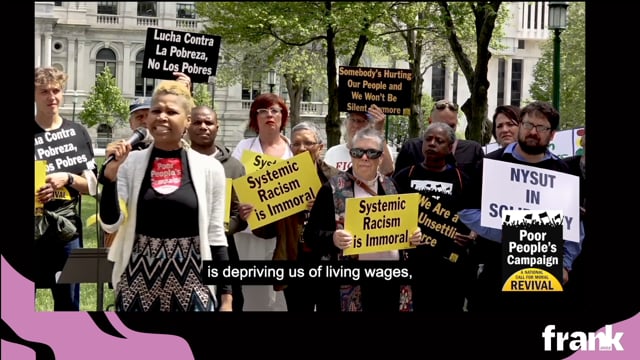 Moral Uprising with the Poor People’s Campaign
 The Unintended Consequences of Emotional Appeal