
Fresh From the frank Stage
Standout talks from the most recent 2023 gathering, featuring bold voices, urgent truths and unforgettable moments.

Amahra Spence
Liberation Rehearsal Notes from a Time Traveler

Shanelle Matthews
Narrative Power Today for an Abolitionist Future
Nima Shirazi
Irresistible Forces, Immovable Objects
The Speaker
Sarah Jaffe Award-Winning Audiobook Producer
Sarah Jaffe is an award-winning audiobook producer with over a decade of experience specializing in high-quality, bestselling titles across genres. Known for her creative casting and dedication to authentic voices, she brings a sharp ear and inventive approach to every production.
Go To BioWatch Next
-
 Seven Minutes In Heaven… With A Scientist
 -
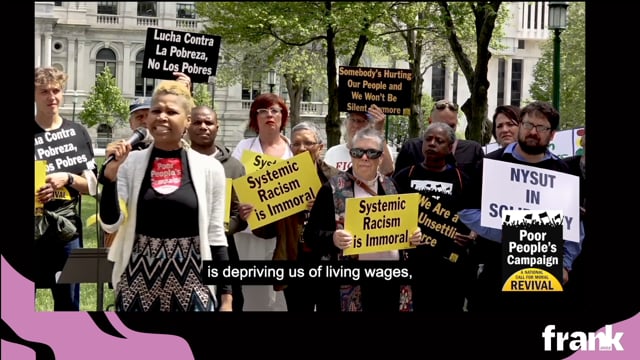 Moral Uprising with the Poor People’s Campaign
 -
 The Unintended Consequences of Emotional Appeal
We Will Not Change The World By Asking Nicely
Global StoriesProblem SolvingPublic RelationsPublic ServiceSociologyStorytelling
Transcript
I wore the sparkly shoes just for all of you. I want you to know that. I’m, thank you Liz, thank you everyone for having me. Apologies I’m coming down with a cold, I really will try not to sniffle. So I have these pictures here. I actually was just doing some googling while on the break and I came up with, I found this quote from James Baldwin that is so perfect that I’m going to read it to all of you to start off because I think it relates very much to what we’re all thinking about here. And this is actually from an interview during the Jimmy Carter years, which is an interesting time to think about what James Baldwin was thinking about. He says, of course people tell me all the time in the West that they are trying, they are trying hard. Some have tears in their eyes and let me know how awful they feel about the way our poor live, our blacks, our those and dozens of other countries. People can cry much easier than they can change. A rule of psychology, people like me picked up as kids on the street. And so there’s been a lot of crying since Donald Trump won. There’s been a lot of crying since the 2008 financial crisis. There’s been a lot of tears shed. But the question of how we make changes, of course not about tears, it’s about power. And so that’s what I will be talking about here today. The question for today is understanding what we’re up against. And I think that question got a lot more real for a lot of people in this country after November 9th. But of course there are a lot of people for whom that question, it’s never been something you can put aside. It’s never been something you can cry about happening to somebody else. And so anyway, I wanted to start this. My book actually came out in August, so it does not include, it includes a little bit about Donald Trump. Does not include the election. It obviously does not include all the protests that have happened since the election. But I did want to start here because I think this is really important. This was the Philadelphia airport two days after the Muslim ban came down. As you can probably see from the signs, if you can read, where is my favorite one? There were so many good ones. Anyway, no ban, will trade races for refugees, Muslims make America great. This was Philadelphia, I happened to be in Philadelphia for my niece’s first birthday. Apologizing to her for the country that she’s going to grow up in. But the thing about the airport protests that struck me more than the women’s march more than the DC inauguration day protests was that this was a moment where a lot of people rushed to one of the most militarized locations in American life, the airport, right? This is where for those of us who are not normally stopped and harassed by cops, being asked to take off your medal and walk through a metal detector. Something that, meanwhile, millions of kids in American schools go through every morning. This was a moment where we went there to actually think about and try to actually stop potentially with our bodies what was going to happen. That there were people who were being held in these airports in limbo because they had literally gotten on a plane from somewhere else before this ban came down. And these protests, among other things, they got people actually released. They provided the political context for judges to then say that this ban was on constitutional. And what they did was they, again, I can’t stress enough the question of risk and the question of willingness to put your body in that place. And potentially open yourself up to arrest, to harm, in order to try to stop that happening to somebody else. Because this is something that we are going to need over the next few years. And these protests were called, a lot of people referred to them as spontaneous, and that was true in terms of the amount of people who came out. But also they were built from organizing. They were built from groups that have had a base in immigrant communities for years. They were built from networks that people have built over the movements of the last eight years, the movements that I write about in my book. Some of the legal camp in JFK airport that a few people have written wonderful pieces about, where volunteer lawyers who are, some of them are corporate lawyers, most of them are not full time immigration attorneys who dropped everything and camped out in the airport to try to fight case by case to get people freed. Reminded me of the legal networks that formed around these different protest movements. And the other thing that’s significant about this before I move back in time a little bit, is that there was basically various forms of a Muslim ban under George W. Bush. The networks, the frameworks that Trump is building on have existed under Obama. So what’s happening in this moment here is that we’re actually protesting things that have been happening and that our ability to see those things is changing. Partly, some people have been kind of like, where were all of you? But I also think this is, as Liz was saying, an indication that politics is shifting, things that we didn’t, things that we weren’t crying about before to go back to the Baldwin. We are now upset by, let’s see if I can get the slide thing working. Look at that, it works. This was Occupy Wall Street. I chose this one because I really like the revolution, anything else is bullshit sign. But also because it wasn’t all white people, because it’s important to note that Occupy was not in fact all white people, although it was certainly had a lot of issues around whiteness and race and racism. But to talk about Occupy, I have to go back to the 2008 financial crisis, which was the moment that I like to say when capitalist realism died. Capitalist realism, the thinker Mark Fisher, who actually passed away not that long ago, wrote this book called Capitalist Realism about the notion that it is easier to imagine the end of the world than to imagine the end of capitalism. And in 2008, whether we liked it or not, it was now possible to imagine the end of capitalism because it was kind of dying in front of us, self-inflicted wound, but still. And so there were a lot of attempts to respond to this. There was a lot of organizing that had been going on around the issues of inequality, around the issues of banks and finance, things that a lot of us didn’t talk about, didn’t think about before that moment. But the thing that really kind of caught the country’s imagination on these subjects was Occupy. It gave us the framework of We Are The 99%, which was the kind of, frankly, discussion of class in this country that we hadn’t had in quite a long time. And it was a response to, among many other things, the idea that politics or the feeling, rather, not really an idea, that most people are shut out of politics. And so the response to that was to claim a space in public, in your city, in your town, in small cities, small towns. The smallest one was somewhere in Montana in a town that I think had a population of like 210 people. And I apologize for not remembering the name of the town off the top of my head, but if anybody here is from there, please correct me. Okay, sadly. Okay. I keep hoping. So what happened after the financial crisis in not just the US around the world, and I think this is important to understanding what we’re up against, to understanding Trump, to understanding this rise of this nationalist, racist, right wing populism that we’re seeing everywhere, right? We’re seeing in France with Marine Le Pen, is to understand that the center has collapsed in most of these places because the center didn’t have an answer to this crisis. What happened in cities around this country and states around this country is that unlike the federal government, the states and cities can’t run a budget deficit. And so the holes that were blown in it, in their budgets by Wall Street, once again, had to be plugged somehow. And most of that was cuts to social services. This is something that they call austerity in the UK, in Europe, and increasingly here. And this was happening again on a bipartisan basis. And when politicians make cuts, they make ideological cuts, right? Budgets are moral documents. They are collections of choices. They are collections of decisions that get made about what your priorities are. And so around this time, we start talking about things like student debt, the fact that disinvestment in public universities has made our student debt problem astronomical. It’s over $1 trillion in student debt. Actually, it went over $1 trillion in 2012, so I have no idea what the actual number is right now. And this was when we started to ask questions of power. And then the problem then is that holding space in a park does not necessarily change anything. So what are some ways that we can actually have power? This, anybody recognize this? Come on, y’all. This is the Chicago Teacher Strike. This was 2012. This was, as my friend, Micah Eutrecht, says, the strike against austerity. The Chicago Teacher’s Union was taken over by a reformist caucus that got together and started reading books. Originally, they read Naomi Klein’s The Shock Doctrine. And what that book tells you is that a moment of shock, whether that be a quote unquote natural disaster or a disaster of the political economic system like we saw in 2008, is a place where politicians, once again, make decisions on and ram things through that perhaps they couldn’t do otherwise. And so to understand what was going on in Chicago, the fact that schools were being defunded, that schools were being closed, teachers were being laid off, and teachers were being asked to bear the brunt of cuts to their salaries, their pensions, their security, is, yeah. So this was their framework, again, was that our working conditions are our students’ learning conditions. And with that framework, they actually worked very well, organizing in the community and getting parents, 67% of Chicago public school parents supported the strike, despite the fact that having your teachers go on strike for eight days and your school’s clothes is a giant pain in the ass if you were a parent with kids in the public school. But if you organize around it and you make people understand that your demands are actually going to help everybody, they will support your strike. This is useful later. And now as we’re hearing again against Trump, the idea of strikes being discussed, the idea of a women’s strike next week. And the fact that one of the major, one of the most concentrated workplaces for women in this country, public schools, also public hospitals and private hospitals, this was, again, the attack on teachers is an attack on women’s work. It was also in Chicago in particular, it’s an attack on the learning conditions of black and brown students. And so when we saw the teachers strike, when we saw them win, we got an idea of what it actually takes to win battles. And of course, we can talk about school closures and things like that forever, but I only have a few more minutes. This, anybody know what this is? This is Ferguson. Yeah, this is, I mean, this is the best picture I could possibly have picked for what we’re up against, right? This is literally what this looks like. Hands up, don’t shoot. The I am a woman sign. I really was struck by that one because those signs actually were printed up for a strike by the fast food workers. At the time it was mostly just fast food workers, the fight for 15. And they had a strike on the anniversary of the Memphis sanitation workers strike where the workers with Martin Luther King famously had signs that said, I am a man. So Ferguson, in my book, I talk about how this is the movement that makes all other movements possible. Because this is, we all saw, I think, the pictures of the minor resistant vehicles rolling down a major city street. We saw the militarized police. We saw the tear gas. We saw that wonderful photo of the guy in the American flag shirt throwing the grenade back at the cops. This is what it looks like. And I should say that in the day since the election, several state governments have put forward various bills that would criminalize protest. One of them included asset forfeiture. So if you plan a protest, they can take your house. Yeah. And so when we think about this, we think about, and I’m, Ibram gave a wonderful talk this morning. And so I don’t have to repeat most of what he said because you already heard it. But like, we have to understand that this is all about power. One of the most useful things I think that came out of talking about the Ferguson movement was people beginning to connect up this sort of spectacular violence that was enacted on the protesters with the everyday violence that was enacted on people in that community with the fact that the city basically ran on money that was extracted from people through little things like parking tickets, speeding tickets, which add up and put people in jail. And so the other thing that is important when talking about the movements of the past several years around this photo here is that the movement for Black Lives, which I would also talk about Trayvon Martin, the killing of Trayvon Martin, and the organizations that were built out of that moment, was a real change where we started to actually see, and we have seen these organizations now last several years. Trayvon Martin was killed in 2012. Organizations that were formed in the wake of his death are celebrating five years now. And it’s not much of a celebration when you’re counting it from the death of somebody, which was, again, last weekend, was a five-year anniversary of Trayvon’s death. But these are organizations that have now managed to actually last for a little while, that are networked with each other, producing documents like the Vision for Black Lives platform, which is a really incredible platform that I urge everybody to read if you have not already. And those are networks that now, again, are providing the groundwork and the space for a lot of new people that come in, who were not maybe ready to do this a while ago, but are now. Slide. Ooh, I keep pushing the wrong button here, guys. All right, this one, everybody know what this is? This is Standing Rock, yeah. Which is also not in my book because this happened afterwards. And yeah, I went to Standing Rock right in late September after the Obama administration put the temporary holds on construction. And of course, there was a lot of hemming and hauling from the Obama administration, before they finally stopped it in time for, well, I mean, they basically said they were going to stop it after the election, so they already knew who was going to be president next. And since our current president actually has a personal financial stake in this, so does Rick Perry, who is now actually hilariously confirmed to be secretary of the department he couldn’t remember existed. So what happened with the fight over the Dakota Access Pipeline? It’s important to note a few things. One of them is that the pipeline was originally supposed to go right by Bismarck, North Dakota. And the people of Bismarck said, uh-uh, and so it got rerouted, and it got rerouted through land that belongs to the people of Standing Rock. And they said, uh-uh, and well, we see what has happened. And so the camps that sprang out, actually the camps that sprang out multiple on both sides of the Cannonball River were this incredible moment of coming together. And this real, like, when we think back to the Keystone XL fight, the role that Native people played in that is often really underplayed. And so I want to talk again about the networks when I spoke with Faith Spotted Eagle, who many of you probably heard of the first time when she got one electoral vote for president. She was talking about the networks once again that had been built around the Keystone XL fight that then created space for this. And then the way that those added on. One of the young organizers I interviewed for my book referred to these movements as like a dandelion. You pick the dandelion and you blow it out, and it, you know, the seeds go everywhere and then they sprout up new dandelions. And this is essentially how these movements have worked. So one starts, something grows, the Wisconsin Union protests, and then that gets blown out. People who are involved in that are involved in other things. And so all of these networks have spread like that. And the other thing here, well actually there are several, but one of the things that’s happened because of this is a lot of people went to the camps. A lot of other people have started campaigns where they live. So you probably heard of the city of Seattle divesting from Wells Fargo Bank over this. Here we are back at the banks again, always. And this, again, is the question of power. How do we actually make these things stop? One of the ways that you made these things stop, at least for a while, was tens of thousands of people showing up and being willing to put their bodies on the line. When I was there, the camp was not actually that militarized. It was a little bit of a quiet moment because they had just put a halt on the construction. But before that, there were surveillance drones buzzing overhead. And then a lot of you probably saw the videos of water hoses being turned on people and what that reminded everybody of. But the thing that was striking about being in the camp and the conversations that I had with people who were participating in the camp, was that it was about water and it was about the pipeline and it was about the environment in general and what we have done to it as a society. But it was also about decolonization. Faith Spotted Eagle was like, make sure you use that word. It was about the question of sovereignty, of who gets to decide what happens on their land, the land that, of course, we took away from people and then gave them little pieces of it to live on. And so when we think about all of these issues, they all loop back around. They’re all still questions of power and who has it. And so if I’m going to wrap up here talking about what we are up against, oh, before I do that, also there’s a march on Washington associated with this Native People Rising march. On Washington March 10th, if anybody is not busy between the women’s strike and all the other work I’m sure you’re doing because there is a lot of it. So when we talk about the fights that we’re having now, what we’re up against now, we’re up against this right wing nationalist, populist, xenophobic administration that is going to try to divide and conquer along the lines of borders and nationality, immigration, who is an American, who isn’t an American, it’s really powerful to me to talk about this standing in front of this picture and remind us like, hey guys, who says that that’s okay? One of the, actually I wish I had a good picture of the sign that was at the Philly Airport. It was Native People Welcome Muslim Immigrants. And so who gets to decide what the borders are is an important question. But the thing that I want to say from all of these movements and from the movements, or the movements of the future, is that we have to, those of us who did not have to feel this, those of us who were not in that picture facing down the cops, those of us who were not going to have this coming through our water, although something like 28 million people get their water from the misery. So that was actually a lot of us. We have to be willing to think about risk and we have to be willing to take those risks. Power, the old, old oft quoted thing from Frederick Douglass who’s doing a lot of great work these days. Power concedes nothing without a demand. This is really true, right? We’re not going to just like have a lot of feelings and then Trump goes away. We’re going to actually have to make those demands. They’re going to have to be big demands. We’re going to have to remember that a lot of these problems did not start on January 9th, that actually they’ve been our problem for a while. And so when I’m asking people to understand where these things come from, the real question is understand the systems that we live under and understand what it’s going to take to make those moves. Thank you.
Watch Next
-
Seven Minutes In Heaven… With A Scientist
-
Moral Uprising with the Poor People’s Campaign
-
The Unintended Consequences of Emotional Appeal